Tropicalities
pp. 83-84 · Read in the full issue
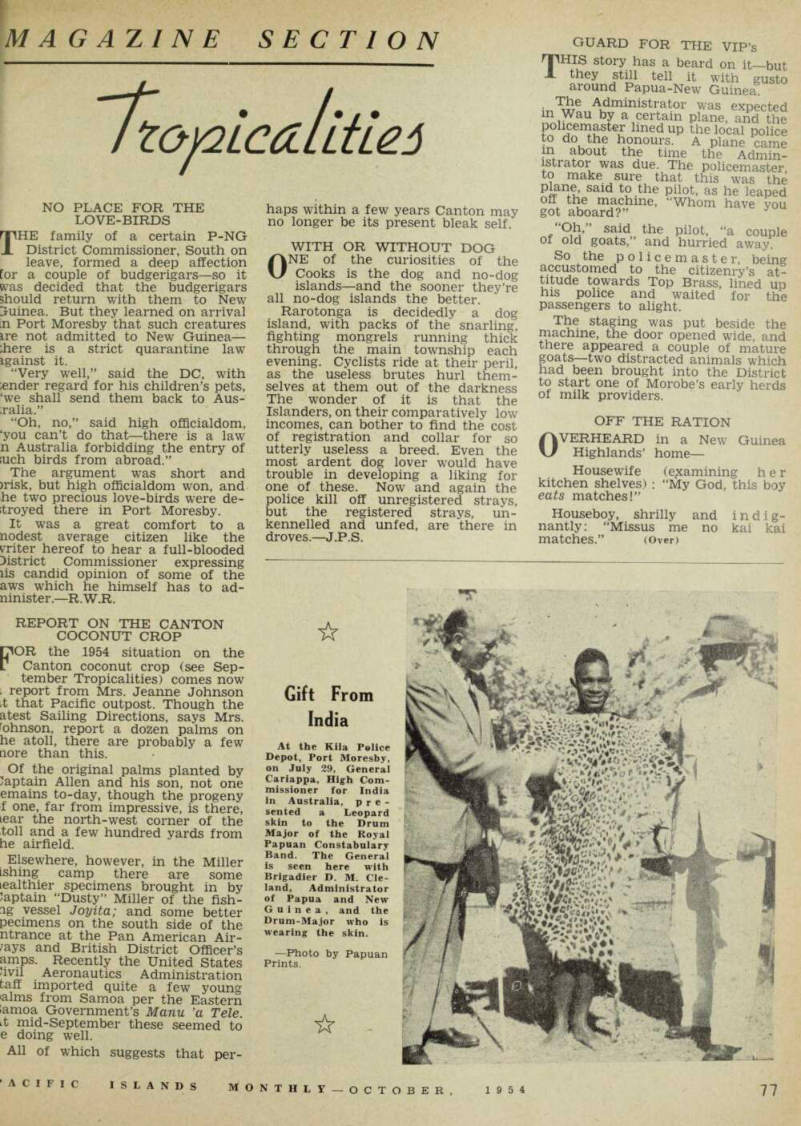
Magazine Section
No Place For The
Love-Birds
THE family of a certain P-NG District Commissioner, South on leave, formed a deep affection for a couple of budgerigars—so it was decided that the budgerigars should return with them to New juinea. But they learned on arrival in Port Moresby that such creatures ire not admitted to New Guinea— ihere is a strict quarantine law igainst it.
“Very well,” said the DC, with lender regard for his children’s pets, ‘we shall send them back to Aus ;ralia.”
“Oh, no,” said high officialdom, ‘you can’t do that—there is a law n Australia forbidding the entry of ;uch birds from abroad.”
The argument was short and )risk, but high officialdom won, and he two precious love-birds were de itroyed there in Port Moresby.
It was a great comfort to a nodest average citizen like the vriter hereof to hear a full-blooded District Commissioner expressing lis candid opinion of some of the aws which he himself has to ad ninister.—R.W.R.
Report On The Canton
Coconut Crop
FOR the 1954 situation on the Canton coconut crop (see Sep tember Tropicalities) comes now i report from Mrs. Jeanne Johnson t that Pacific outpost. Though the atest Sailing Directions, says Mrs. r ohnson, report a dozen palms on he atoll, there are probably a few nore than this.
Of the original palms planted by Captain Allen and his son, not one emains to-day, though the progeny f one, far from impressive, is there, Lear the north-west corner of the toll and a few hundred yards from he airfield.
Elsewhere, however, in the Miller ishing camp there are some lealthier specimens brought in by Japtain “Dusty” Miller of the fish ig vessel Joyita; and some better pecimens on the south side of the ntrance at the Pan American Air ways and British District Officer’s amps. Recently the United States bvil Aeronautics Administration tan imported quite a few young alms from Samoa per the Eastern iamoa Government’s Manu ’a Tele. it mid-September these seemed to e doing well.
All of which suggests that per
haps within a few years Canton may no longer be its present bleak self.
With Or Without Dog
ONE of the curiosities of the Cooks is the dog and no-dog islands—and the sooner they’re all no-dog islands the better.
Rarotonga is decidedly a dog island, with packs of the snarling, fighting mongrels running thick through the main township each evening. Cyclists ride at their peril, as the useless brutes hurl them selves at them out of the darkness The wonder of it is that the Islanders, on their comparatively low incomes, can bother to find the cost of registration and collar for so utterly useless a breed. Even the most ardent dog lover would have trouble in developing a liking for one of these. Now and again the police kill off unregistered strays, but the registered strays, un kennelled and unfed, are there in droves.—J.P.S.
Guard For The Vlp’S
THIS story has a beard on it—but they still tell it with gusto around Papua-New Guinea.
Administrator was expected m Wau by a certain plane, and the policemaster lined up the local police d ?u th f h ° nou f s - A plane came in about the time the Admin istrator was due. The policemaster to make sure that this was the saic * .^ e as he leaped on the machine, “Whom have vou got aboard?” * “Oh,” said the pilot, “a couple of old goats,” and hurried away.
So the policemaster, being accustomed to the citizenry’s at titude towards Top Brass, lined up his police and waited for the passengers to alight.
The staging was put beside the machine, the door opened wide, and there appeared a couple of mature goats—two distracted animals which had been brought into the District to start one of Morobe’s early herds of milk providers.
Off The Ration
OVERHEARD in a New Guinea Highlands’ home— Housewife (examining her kitchen shelves) : “My God, this boy eats matches!”
Houseboy, shrilly and ind i g nantly: “Missus me no kai kai matches.” (Over)
Gift From
India
At the Kila Police Depot, Port Moresby, on July 29, General Cariappa, High Com missioner for India in Australia, pre sented a Leopard skin to the Drum Major of the Royal Papuan Constabulary Band. The General is seen here with Brigadier D. M. Cle land, Administrator of Papua and New Guinea, and the Drum-Major who is wearing the skin. —Photo by Papuan Prints.
A Hippopotamus For Xmas?
FOUR years ago the body of a camel, washed ashore on the Island of Aunu’u, near Tutuila, Eastern Samoa, excited the interest of the islanders who wondered, until the village school teacher explained facts to them, what kind .of fish had fur and legs. The camel was one that had died and was tossed overboard from a Matson vessel.
Recently another strange carcase appeared at Aunu’u. This time the people decided it resembled a hippo potamus and sent word thus to Tutuila. They used the carcase to attract sharks, who willingly at tacked the decaying mass of flesh: four sharks were caught by the islanders.
Rechecking the story, the carcase was found to be either a sea-lion or large seal that had wandered too far from its native habitat and had expired in the warm water around Samoa.
Undaunted, the people of Aunu’u are now eagerly looking forward to spotting a floating elephant.—E. W.
Johnson.
Cook Is. English
rE English' commonly in use among Cook Island native teachers is hardly the Queen’s, and some of the screeds that are received from them by a European headmaster are couched in very peculiar terms indeed.
It is not commonly known that married girls are permitted to re tain educational jobs, and these young ladies sometimes have to re tire pro tern by reason of a Happy Event. This obviously can never occur without it being known in ad vance, yet it is customary to send a note of apology for absence to the Head. One such, recently received here, convulsed the directorate. It read: “Will you please excuse me for my don’t school. I am not come because I was born yesterday.”
And judging by the lady’s seeming brief acquaintance with English, one would imagine that the statement wasn’t far wrong!—EG.
Something New—A Fiji
Indian Poet
Leonard sewak cha n d RAMSAMUJ, a westernised and versatile 30-year-old Fiji-Indian, is breaking entirely new ground for one of his race. He has for saken the traditional commerce and handcrafts of his forbears to be come a poet—a part-time poet at the moment, but his work is re ceiving notice.
He was born in Suva in 1924, the son of the late “Ratu” Ram Samuj, a well-known businessman. After primary schooling at the Marist Brothers’ School he had four years’ study in agriculture at Wesley
College, Auckland, and two years’ in law at Victoria University, Well ington. Neither subject appealed to him and he devoted himself mainly to the study of the English language, written and spoken.
In 1942 he won the Boyce Cup for oratory at Wesley College, and in 1946 he won the New Speakers’
Prize at Victoria University and came second in the Plunket Medal Oratory Contest, New Zealand’s premier competition. He had never attended elocution classes. He learnt the rudiments of public speak ing from his father who coached him for a contest he won in Fiji in his teens.
Ramsamuj then started submit ting verses to NZ publications, several being published under the pen name “Omar Hjumes.”
Fellow students detected the in version of his name and the camouflage of the two additional letters, and thereafter Ramsamuj used his real name.
After his formal studies he travelled in India for a year. His NZ verses were published in Bom bay in an anthology, “Music of Life.” One critic commented: “The
English is that of a writer born t the language, whereas the attitud of mind is Indian, despite th foreign upbringing.”
After India, Ramsamuj went t England for two and a half yean making occasional visits to th Continent. He worked at the India High Commissioner’s office in Lon don, and also as private secretar to Mr. Cyril Asquith, general secre tary of the National Labour Organ isation. He lectured on inter national affairs and on India affairs to the Fabian Society.
In 1951, another collection of hi work, “Love’s Intoxication,” wa published in England by th Fortune Press. It was illustrated b “Joss,” of the London Star. One re viewer wrote: “No Indian poet, wit: the exception of the late Mrs. Naidi has shown so much gift and promis in this type of Indo-Anglican lyrics poetry.”
Ramsamuj returned to Fiji las year, when informed of the il] health of his mother, who subse quently died. He is now employe in the District Officer’s headquarter
at Nausori.-