Cocoa Plantations
pp. 48-51 · Read in the full issue
Big Go’S Seek Ng
Interesting Development in Expanding Industry
AN important development in New Guinea agriculture is indicated in a pending move into cocoa production in the Territory by probably two of Australia’s biggest confectionery manufacturers — Macßobertson (Aust.) Pty. Ltd., whose head office is in Melbourne, and Messrs. Cadbury-Fry-Pascal, a subsidiary of Cadbury Bros. Ltd., of Bourneville, England.
Although no official statement has been made (and is not likely to be made before current negotiations a'-r e finalised), Macßobertsons (Aust.) Ltd. are reported to have acquired a partly-developed cocoa plantation in the Markham Valley, on the Nadzab road, five miles from Lae. Known as the Wanaru Planta tion, the 1,080-acres property was purchased from Markham Valley Development Ltd. It will be de veloped fully on an experimental basis, with a view to acquiring further properties if the experi ments are successful. Purchase price is said to be £24,000. Wanaru originally belonged to Mr. Edwards, and it subsequently passed to Keith Noblett and the Markham Co., in
which Messrs. Noblett and Langley are shareholders. The Co. removed a good deal of timber.
Cadburys, also, have not declared their intentions. But it is known that the Chairman of Directors, from Bourneville, Mr. Paul Cadbury, will arrive in Australia, with other executives, in November. The party
will leave for P-NG almost immedi ately and will conduct a survey o: those areas in which cocoa is a present being grown. A BougainvilL planter, Mr. F. J. Salisbury, wh( was entertained by Cadburys durini his visit to England on a recen world tour, considers it likely tha the Company will acquire propert
and commence cocoa production in the Territory. |N recent years there has been an I extraordinary growth in cocoa production in New Guinea; and ;his is continuing under the stimulus )f high prices. In 1950-51, only 317 ions of cocoa, valued at £92,181, vere exported from P-NG. By i 952-53, however, the bearing acre ige had increased by well over 60 >er cent., and 638 tons valued at ;174,987 were exported. If the pre ent rate of increase in bearing icreages continues—and there are io reasons to doubt that it will—
e total area yielding cocoa by e end of 1953-54 should exceed 'OO acres.
With the present world demand f cocoa, and consequent high ices, the future of New Guinea’s coa crop seems assured. There is a fall in prices in September between £4OO and £450 Stg. per i, c.i.f., Europe.
IR. SALISBURY returned to Australia with much informa tion on the methods of ferment ion of cocoa beans employed on est African plantations. Although
many fermentaries are simply a hole in the ground, covered with plantain leaves, the larger planta tions employ a series of specially designed boxes, which speed up fermentation and save labour. These are built on a slope in the form of steps.
After the beans and their sur rounding pulp are scraped from the husks, they are delivered to the fermentary and tipped into the uppermost box, for the first stage of fermentation. Each box is con structed without a lid (although a detachable cover may be used) and has two hinged doors, one above the other and opening from the bottom, on the side facing the foot of the slope. The upper door of the filled box is then opened and
half the contents spilled into the lower box. By opening the lower door the remaining contents escape into the new box, and thus a com plete reversal of ferment positions is achieved.
In this way the beans are spilled downwards from box to box, and the pulp surrounding the beans is more readily converted into liquid which is run off. By the time the beans reach the last box they are clean, although turned brown by the fermentation process, and are ready for drying. J WITH the spotlight of public at tention being turned on P-NG’s rapidly developing cocoa in dustry, the history of cocoa and chocolate production is finding
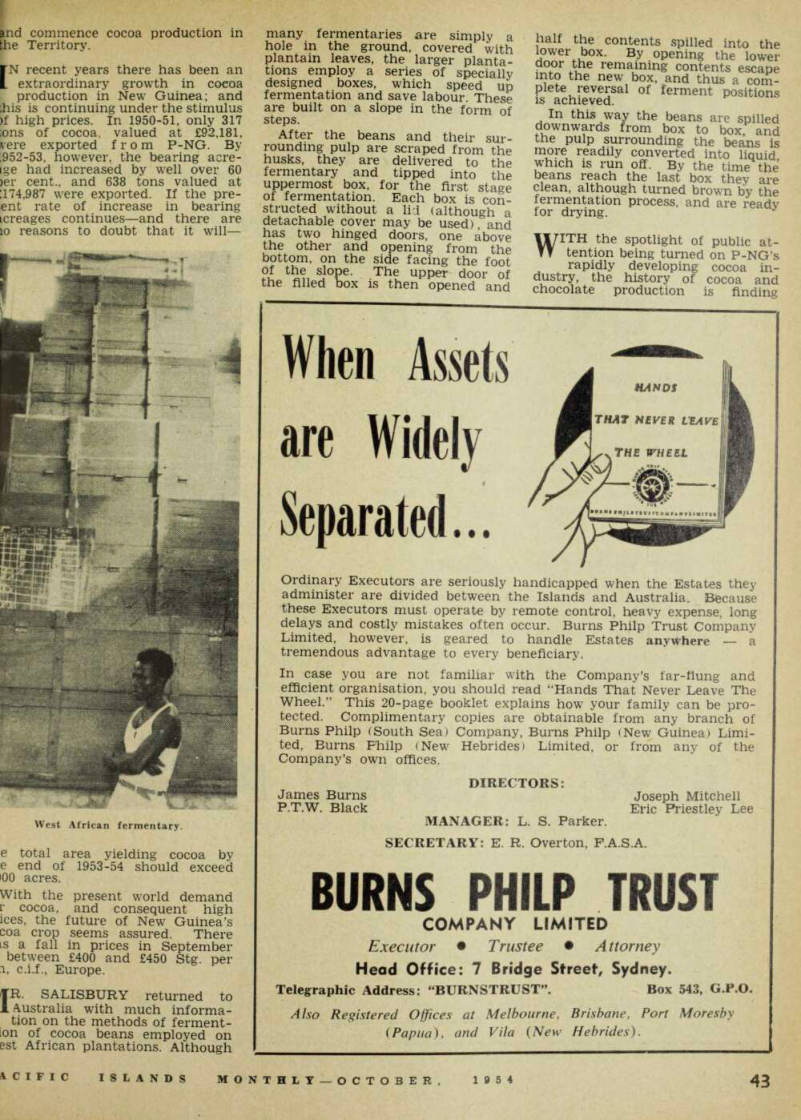
West African fermentary.
widespread interest, says Mr. Salis bury. - The cocoa tree is believed to be Indigenous to the Amazon Basin.
Western civilisation was introduced to cocoa in the 16th century, when Hernandos Cortes returned to Spain from his conquest of the Aztecs of Mexico. Both the Aztecs and the [ncas of Peru cultivated the cocoa ;re6. They roasted and ground cocoa jeans, and added spices to make a frothy beverage which was served Sold. They even used the beans is currency.
Cortes learned how to prepare the jeans for human consumption and jassed his knowledge on to his ellow Spaniards. They sweetened he drink with another new dis :overy—sugar. Chocolate eventu illy found favour with the French md British aristocracy in the 17th :entury, but it remained only a Irink until 1828, when the Dutch ound a method of expelling cocoa »utter under pressure. The pro bation of a palatable chocolate oon followed.
Cadbury’S Rep. In Rabaul
RABAUL, Sep. 26—Mr. Peter Joyd, general manager of Cadbury- Ltd., Hobart, has arrived iere to study the territory’s cocoa ndustry and investigate the possi ility of obtaining bulk cocoa upplies.