Tariff Board Melbourne
pp. 23-150 · Read in the full issue
Aid to Papua’s Rubber Industry:
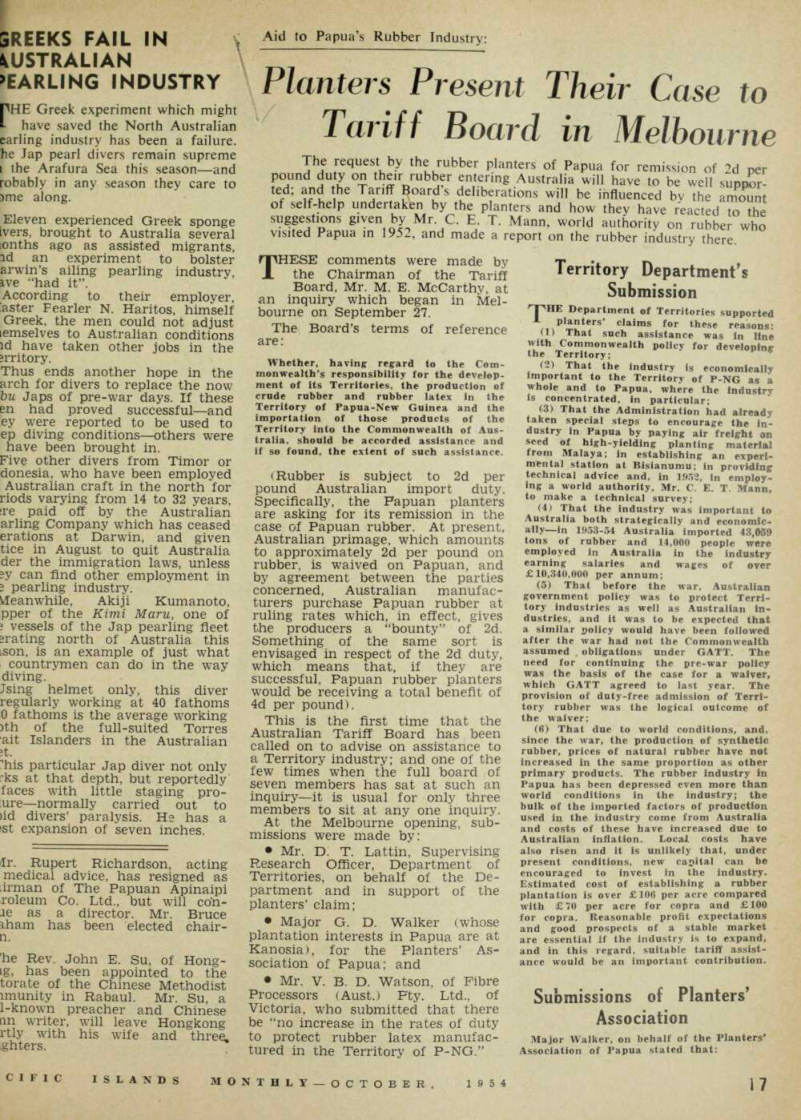
Planters Present Their Case to Tariff Board Melbourne
The request by the rubber planters of Papua for remission of 2d per rubber enterm g Australia will have to be well ted, and the Tariff Boards deliberates will be influenced bv the amount of self-help undertaken by the planters and how they have reacted to the suggestions given by Mr C. E T. Mann, world authority on rubber who visited Papua in 1952, and made a report on the rubber industry there.
THESE comments were made by the Chairman of the Tariff Board, Mr. M. E. McCarthy, at an inquiry which began in Mel bourne on September 27.
The Board’s terms of reference are: Whether, having regard to the Com monwealth’s responsibility for the develop ment of its Territories, the production of crude rubber and rubber latex in the Territory of Papua-New Guinea and the importation of those products of the Territory into the Commonwealth of Aus tralia, should be accorded assistance and if so found, the extent of such assistance. (Rubber is subject to 2d per pound Australian import duty.
Specifically, the Papuan planters are asking for its remission in the case of Papuan rubber. At present, Australian primage, which amounts to approximately 2d per pound on rubber, is waived on Papuan, and by agreement between the parties concerned, Australian manufac turers purchase Papuan rubber at ruling rates which, in effect, gives the producers a “bounty” of 2d.
Something of the same sort is envisaged in respect of the 2d duty, which means that, if they are successful, Papuan rubber planters would be receiving a total benefit of 4d per pound).
This is the first time that the Australian Tariff Board has been called on to advise on assistance to a Territory industry; and one of the few times when the full board of seven members has sat at such an inquiry—it is usual for only three members to sit at any one inquiry.
At the Melbourne opening, sub missions were made by: • Mr. D. T. Lattin, Supervising Research Officer, Department of Territories, on behalf of the De partment and in support of the planters’ claim; • Major G. D. Walker (whose plantation interests in Papua are at Kanosia), for the Planters’ As sociation of Papua; and • Mr. V. B. D. Watson, of Fibre Processors (Aust.) Pty. Ltd., of Victoria, who submitted that there be “no increase in the rates of duty to protect rubber latex manufac tured in the Territory of P-NG.”
Territory Department's
Submission
'T'HE Department of Territories supported planters’ claims for these reasons: (I) That such assistance was in line with Commonwealth policy for developing: the Territory; (2> That the industry is economically important to the Territory of P-NG as a whole and to Papua, where the Industry is concentrated, in particular; (3) That the Administration had already taken special steps to encourage the in dustry in Papua by paying air freight on seed of high-yielding planting material from Malaya; in establishing an experi mental station at Bisianumu; in providing technical advice and, in 1952, in employ ing a world authority, Mr. C. E. T. Mann, to make a technical survey; (4) That the industry was important to Australia both strategically and economic ally—in 1953-54 Australia imported 43,069 tons of rubber and 14,000 people were employed in Australia in the industry earning salaries and wages of over £10,340,000 per annum; (5) That before the war, Australian government policy was to protect Terri tory industries as well as Australian in dustries, and it was to be expected that a similar policy would have been followed after the war had not the Commonwealth assumed obligations under GATT. The need for continuing the pre-war policy was the basis of the case for a waiver, which GATT agreed to last year. The provision of duty-free admission of Terri tory rubber was the logical outcome of the waiver; (6) That due to world conditions, and, since the war, the production of synthetic rubber, prices of natural rubber have not increased in the same proportion as other primary products. The rubber industry in Papua has been depressed even more than world conditions in the industry; the bulk of the imported factors of production used in the industry come from Australia and costs of these have increased due to Australian inflation. Local costs have also risen and it is unlikely that, under present conditions, new capital can be encouraged to invest in the industry.
Estimated cost of establishing a rubber plantation is over £lO6 per acre compared with £7O per acre for copra and £lOO for copra. Reasonable profit expectations and good prospects of a stable market are essential if the industry is to expand, and in this regard, suitable tariff assist ance would be an important contribution.
Submissions of Planters'
Association
Major Walker, on behalf of the Planters’
Association of Papua stated that:
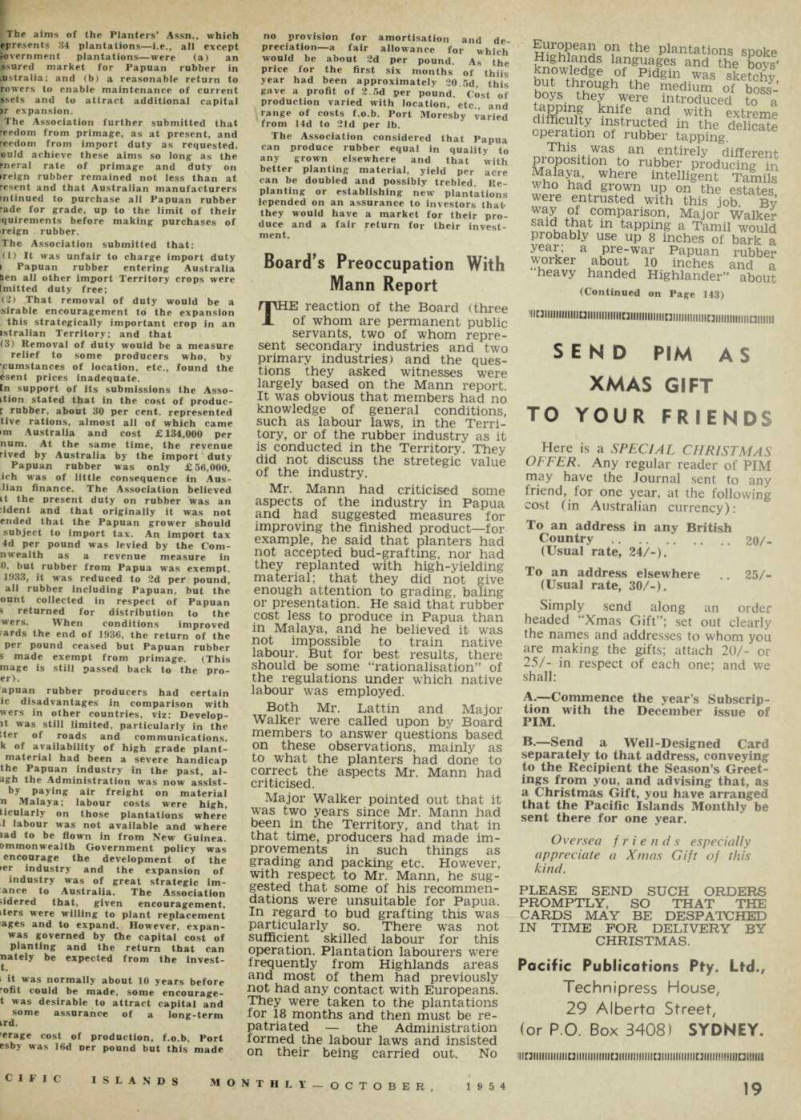
The aims of the Planters’ Assn., which epresents 34 plantations—i.e., all except government plantations—were (a) an ssured market for Papuan rubber in lUstralia; and (b) a reasonable return to rowers to enable maintenance of current ssets and to attract additional capital ir expansion.
The Association further submitted that reedom from primage, as at present, and reedom from import duty as requested, ©old achieve these aims so long as the sneral rate of primage and duty on >reign rubber remained not less than at resent and that Australian manufacturers mtinued to purchase all Papuan rubber rade for grade, up to the limit of their quirements before making purchases of reign rubber.
The Association submitted that; (1) It was unfair to charge import duty i Papuan rubber entering Australia lien all other import Territory crops were Imitted duty free; (2) That removal of duty would be a sirable encouragement to the expansion this strategically important crop in an istralian Territory; and that (3) Removal of duty would be a measure relief to some producers who, by '.cumstances of location, etc., found the esent prices inadequate.
In support of its submissions the Asse rtion stated that in the cost of produc ' rubber, about 30 per cent, represented tive rations, almost all of which came im Australia and cost £134,000 per num. At the same time, the revenue rived by Australia by the import duty Papuan rubber was only £56,000, ich was of little consequence in Aus lian finance. The Association believed it the present duty on rubber was an ;ident and that originally it was not ended that the Papuan grower should subject to import tax. An import tax 4d per pound was levied by the Com nwealth as a revenue measure in 0, but rubber from Papua was exempt. 1933, it was reduced to 2d per pound, all rubber including Papuan, but the ount collected in respect of Papuan s returned for distribution to the wers. When conditions improved -ards the end of 1936, the return of the per pound ceased but Papuan rubber s made exempt from primage. (This mage is still passed back to the pro er>. apuan rubber producers had certain ic disadvantages in comparison with wers in other countries, viz: Develop it was still limited, particularly in the tter of roads and communications, k of availability of high grade plant material had been a severe handicap the Papuan industry in the past, al agh the Administration was now assist by paying air freight on material n Malaya; labour costs were high, ticularly on those plantations where .1 labour was not available and where lad to be flown in from New Guinea, ommonwealth Government policy was encourage the development of the •er industry and the expansion of industry was of great strategic im ance to Australia. The Association sidered that, given encouragement, iters were willing to plant replacement •ages and to expand. However, expan was governed by the capital cost of planting and the return that can nately be expected from the invest it was normally about 10 years before rofit could be made, some encourage t was desirable to attract capital and some assurance of a long-term rrd. erage cost of production, f.o.b. Port esby was 16d uer pound but this made
no provision for amortisation and de preciation—a fair allowance for which would be about 2d per pound. As the price for the first six months of thiis year had been approximately 20.5 d, this gave a profit of 2.5 d per pound. Cost of production varied with location, etc. and range of costs f.o.b. Port Moresby varied from 14d to 21d per lb.
The Association considered that Papua can produce rubber equal in quality to any grown elsewhere and that with better planting material, yield per acre can be doubled and possibly trebled. Re planting or establishing new plantations lepended on an assurance to investors that they would have a market for their pro duce and a fair return for their invest ment.
Board's Preoccupation With
Mann Report
rpHE reaction of the Board (three A of whom are permanent public servants, two of whom repre sent secondary industries and two primary industries) and the ques tions they asked witnesses were largely based on the Mann report.
It was obvious that members had no knowledge of general conditions, such as labour laws, in the Terri tory, or of the rubber industry as it is conducted in the Territory. They did not discuss the stretegic value of the industry.
Mr. Mann had criticised some aspects of the industry in Papua and had suggested measures for improving the finished product—for example, he said that planters had not accepted bud-grafting, nor had they replanted with high-yielding material; that they did not give enough attention to grading, baling or presentation. He said that rubber cost less to produce in Papua than in Malaya, and he believed it was not impossible to train native labour. But for best results, there should be some “rationalisation” of the regulations under which native labour was employed.
Both Mr. Lattin and Major Walker were called upon by Board members to answer questions based on these observations, mainly as to what the planters had done to correct the aspects Mr. Mann had criticised.
Major Walker pointed out that it was two years since Mr. Mann had been in the Territory, and that in that time, producers had made im provements in such things as grading and packing etc. However, with respect to Mr. Mann, he sug gested that some of his recommen dations were unsuitable for Papua.
In regard to bud grafting this was particularly so. There was not sufficient skilled labour for this operation. Plantation labourers were frequently from Highlands areas and most of them had previously not had any contact with Europeans.
They were taken to the plantations for 18 months and then must be re patriated the Administration ormed the labour laws and insisted on their being carried out. No
European on the plantations spoke Highlands languages and the boys’ knowledge of Pidgin was skptrhv but through the medium of boss boys they were introduced to a knife and with extreme difficulty instructed in the delicate operation of rubber tapping.
This was an entirely different proposition to rubber producing in wh n w where mtelli gent Tamils who had grown up on the estates were entrusted with this job Bv £ f c 9 m Paris 9 n, Major Walker said that in tapping a Tamil would probably use up 8 inches of bark a year; a pre-war Papuan rubber worker about 10 inches and a heavy handed Highlander” about
(Continued on Page 143)
: inches. This made all the ference to the producing life of Iree and it also made it necessary employ more European super ion, which in turn added to cost production.
Seeds from high-yielding trees now being imported from laya, Major Walker said, but air ighted they cost 7d each—the •freight of 3d now being paid by Administration—and must be nted within a matter of days. Of se seeds, about 20 per cent, pived the various stages to be le mature trees. ne member asked Mr. Lattin r much of the £7,000,000 Com iwealth grant to the Territories allocated to the rubber industry. the same member commented it seemed inconsistent that P-NG Administration levied an >rt tax on rubber while the De m£n}, °f Territories was asking, l ehalf of the growers, for assist ' M the industry. He also ted to know what the industry 'apua had done for itself iri the d years.” r. Lattin replied that the Aus an grant was a general grant the there was nothing specific aside for rubber; that the in ry was not controlled by the frustration, and that export tax wholly revenue-producing and 'revision was made for helping industry from it. other member asked what was ? done to improve native skill bber tapping; and another (Mr ate) remarked that the whole :eting arrangement seemed to to be “untidy;” Would it not :tter if all duties were elimina rom all rubber, and the manu rers paid a bounty on the an rubber used? . Lattin declined to comment, a later stage, Mr Date (still ntly looking for a tidy solution) that he noted that cost of r recruitment and repatriation veraged at about 2d per pound. * Administration took over the n of these expenses, would not lanters’ needs be met? jor Walker, to whom the ques ts addressed, said that sticaUy it probably would e seemed doubtful of the re- Chairman asked why the :rs had fixed the amount of ince they required at 2d— was the present rate of duty not Id or U or some other And why is the rubber in ’ more deserving of assistance "ocoa or coconuts? commented that one reason to r assistance might be in order vide work for the natives, but se labourers were so difficult am and to train, it might be i to forget the rubber industry
and concentrate on some other that would show results, if the Com monwealth committted itself to as sisting the industry now, in ten years time world conditions might be such that rubber was even more depressed than today, then the Commonwealth might well feel committed to helping it further He asked how long it was contem plated that assistance would be necessary; was it likely to be per manent?
Neither Mr. Lattin nor Major Walker was prepared to commit themselves on this question The Chairman said that at pre sent, the duty paid on rubber was a purely revenue-raising measure as far as the Commonwealth was con cerned. On present rate of importa
meant about £U million to the Treasury. If the time Thmu* come when this duty and primage Sts th r . oq £ lred for ”uf!
afthe expenTT^e'^^tn
pXwng to^kelp^it'on^sTpro
tectiye tariff to safeguard Papuan tons of'rubber. Pr ° dUCed only 3000 C & r - b ‘he stated m very broad terms and at subsequent sittings of the Board they would be required to give ad ditional details as to colts the frn^ mg - r S Sul s ln audited accounts s:'°? 1 <-• md l vidual plantations, and statistics from all estates showing trees per acre, age of trees, acreage
planted or prepared for planting and all other relevant statistics. He said he must make it clear that claims for remission of 2d duty must be well supported by facts and figures, to show that 2d was warranted and not just chosen arbitarily because 2d happened to be the duty at the moment.
Latex “Should Be Excluded”
MR. Watson, of Fibre Processors (Aust.) Pty., Ltd., did not pre sent a prepared submission but his verbal evidence was heard by the Board.
He said that he had believed be fore attending the sitting that the Papuan rubber industry might ask for an increase in duty on latex; however, after listening to sub missions by the Territories’ Depart ment and the Planters’ Assn, he was now of the opinion that the reference to latex in the Board’s
terms of reference should be deleted.
He said that his firm manufact tured material for the shoe trade which consisted of scrap leather bonded together by latex.
To his knowledge, no rubber was exported from Papua in the form of latex and his opinion, after in specting latex in Papua, was that it would be useless for the work of his company, due to the imperfect laboratory control that would be exercised over it.
He said that they imported their latex from Malaya where it was produced under close laboratory control. It was imported in 40 gallons drums which were made in Malaya; the drums too, would pre sent an obstacle to the export of latex from Papua, as these, once used for latex, were useless.
Next Meetings of Board
rE inquiry on rubber will be continued in Sydney on Oc tober 18, and in Brisbane on November 9. On the night of Oc tober 9, some of the members of the Board (Mr. M. E. McCarthy, Chairman. Mr. J. B. Gumming and Mr. F. W. Higgins) with the sec retary, Mr. J. A. Hueston, will fly to Port Moresby, where they will conclude the inquiry.