Do You Remember ?
p. 21 · Read in the full issue
From PIM of 20 Years ago.
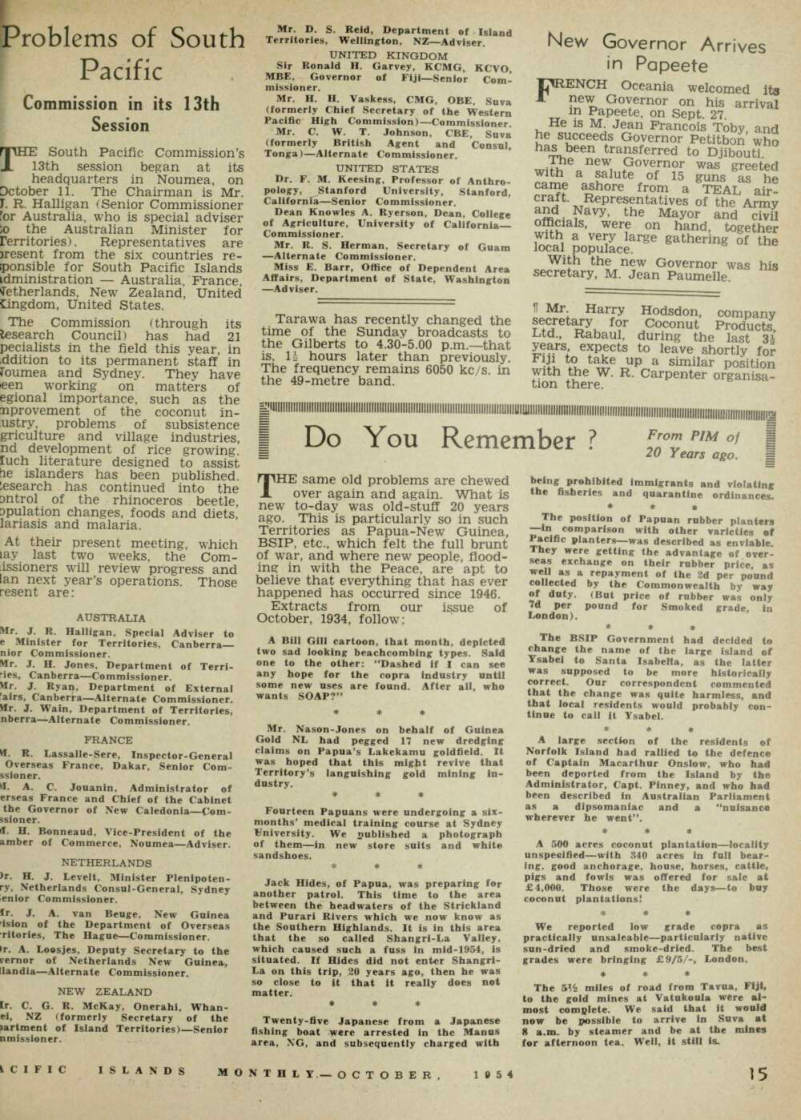
THE same old problems are chewed over again and again. What is new to-day was old-stuff 20 years ago. This is particularly so in such
Territories as Papua-New Guinea,
BSIP, etc., which felt the full brunt of war, and where new people, flood ing in with the Peace, are apt to believe that everything that has ever happened has occurred since 1946.
Extracts from our issue of
October, 1934, follow:
A Bill Gill cartoon, that month, depicted two sad looking beachcombing types. Said one to the other: “Dashed if I can see any hope for the copra industry until some new uses are found. After all, who wants SOAP?” * * * Mr. Nason-Jones on behalf of Guinea Gold NL had pegged 17 new dredging claims on Papua’s Lakekamu goldfield. It was hoped that this might revive that Territory’s languishing gold mining in dustry, * * * Fourteen Papuans were undergoing a six months’ medical training course at Sydney University. We published a photograph of them—in new store suits and white sandshoes. * * * Jack Hides, of Papua, was preparing for another patrol. This time to the area between the headwaters of the Strickland and Pnrari Rivers which we now know as the Southern Highlands. It is in this area that the so called Shangri-La Valley, which caused such a fuss in mid-1954, is situated. If Hides did not enter Shangri- La on this trip, 20 years ago, then he was so close to it that it really does not matter. * * * Twenty-five Japanese from a Japanese fishing boat were arrested in the Manus area, XG, and subsequently charged with
being prohibited immigrants and violating the fisheries and quarantine ordinances. * * * The position of Papuan rubber planters —in comparison with other varieties of Pacific planters—was described as enviable.
They were getting the advantage of over seas exchange on their rubber price, as well as a repayment of the 2d per pound collected by the Commonwealth by way of duty. (But price of rubber was only “d per pound for Smoked grade, in London). * * ♦ The BSIP Government had decided to change the name of the large Island of Ysabel to Santa Isabella, as the latter was supposed to be more historically correct. Our correspondent commented that the change was quite harmless, and that local residents would probably con tinue to call it Ysabel. * * * A large section of the residents of Norfolk Island had rallied to the defence of Captain Macarthur Onslow, who had been deported from the Island by the Administrator, Capt. Pinney, and who had been described in Australian Parliament as a dipsomaniac and a "nuisance wherever he went”. * * * A 500 acres coconut plantation—locality unspecified—with 340 acres in full bear ing, good anchorage, house, horses, cattle, pigs and fowls was offered for sale at £4,000. Those were the days—to buy coconut plantations! * * ♦ We reported low grade copra as practically unsaleable—particularly native sun-dried and smoke-dried. The best grades were bringing £9/5/-, London. ♦ ♦ * The miles of road from Tavua, Fiji, to the gold mines at Vatukoula were al most complete. We said that it would now be possible to arrive In Suva at 8 a.m. by steamer and be at the mines for afternoon tea. Well, it still is.