The Alp Speaks!
p. 117 · Read in the full issue
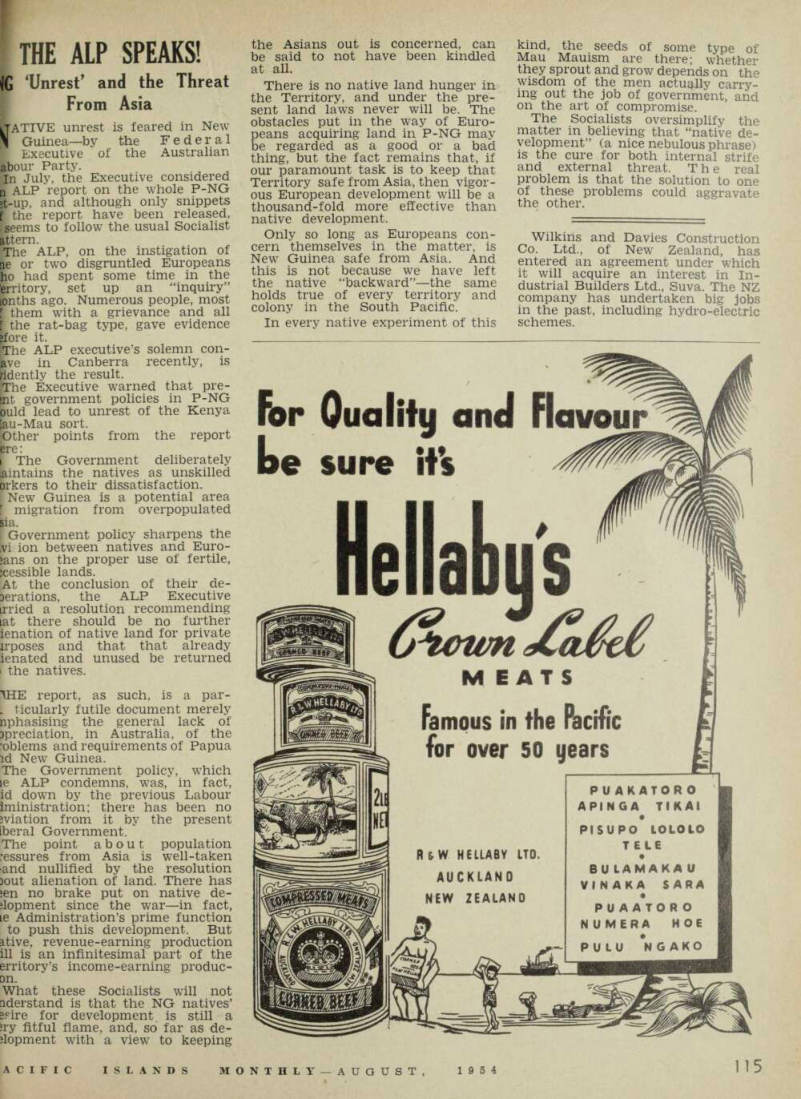
NG ‘Unrest' and the Threat From Asia
ITATIVE unrest is feared in New M Guinea—by the Federal [ Executive of the Australian abour Party.
In July, the Executive considered n ALP report on the whole P-NG »t-up, and although only snippets the report have been released, [seems to follow the usual Socialist ittern. [The ALP, on the instigation of ne or two disgruntled Europeans ho had spent some time in the territory, set up an “inquiry” tenths ago. Numerous people, most [ them with a grievance and all I the rat-bag type, gave evidence
[fore it.
The ALP executive’s solemn con ave in Canberra recently, is ndently the result.
The Executive warned that pre ait government policies in P-NG ould lead to unrest of the Kenya [au-Mau sort. fother points from the report ere: The Government deliberately iaintains the natives as unskilled orkers to their dissatisfaction. [ New Guinea is a potential area migration from overpopulated
|sia.
Government policy sharpens the ivi ion between natives and Euro ;ans on the proper use of fertile, jcessible lands.
At the conclusion of their de aerations, the ALP Executive uried a resolution recommending iat there should be no further ienation of native land for private irposes and that that already ienated and unused be returned i the natives.
IHE report, as such, is a par . ticularly futile document merely nphasising the general lack of Dpreciation, in Australia, of the •oblems and requirements of Papua id New Guinea.
The Government policy, which le ALP condemns, was, in fact, id down by the previous Labour iministration; there has been no wiation from it by the present iberal Government.
The point about population :essures from Asia is well-taken ■and nullified by the resolution lout alienation of land. There has ;en no brake put on native de jlopment since the war —in fact, le Administration’s prime function to push this development. But ative, revenue-earning production ill is an infinitesimal part of the erritory’s income-earning produc on.
What these Socialists will not iderstand is that the NG natives’
BFire for development is still a ;ry fitful flame, and, so far as de ilopment with a view to keeping
the Asians out is concerned, can be said to not have been kindled at all.
There is no native land hunger in the Territory, and under the pre sent land laws never will be. The obstacles put in the way of Euro peans acquiring land in P-NG may be regarded as a good or a bad thing, but the fact remains that, if our paramount task is to keep that Territory safe from Asia, then vigor ous European development will be a thousand-fold more effective than native development.
Only so long as Europeans con cern themselves in the matter, is New Guinea safe from Asia. And this is not because we have left the native “backward”—the same holds true of every territory and colony in the South Pacific.
In every native experiment of this
kind, the seeds of some type of Mau Mauism are there; whether they sprout and grow depends on the wisdom of the men actually carry ing out the job of government, and on the art of compromise.
The Socialists oversimplify the matter in believing that “native de velopment” (a nice nebulous phrase) is the cure for both internal strife and external threat. The real problem is that the solution to one of these problems could aggravate the other.
Wilkins and Davies Construction Co. Ltd., of New Zealand, has entered an agreement under which it will acquire an interest in In dustrial Builders Ltd., Suva. The NZ company has undertaken big jobs in the past, including hydro-electric schemes.