Charlie Loses a Farm Girl
pp. 81-83 · Read in the full issue
By Bill Gill
“T ADY with goitre,” said Charley.
I a I examined the beautiful little glazed pottery figurine more closely.
“Goitre?” I said doubtfully. “The title refers to her ankles, I sup pose?”
“It refers to the fiddle she’s holding,” replied Charley. “It’s written on the bottom.”
I turned the ornament over; a small paper sticker bore the legend in ink; “Lady with guitar, 15 gns.”
I whistled. “Fifteen guineas! Since when has your devotion to Art gone that far?”
Charley sighed heavily and laid aside the cut-throat razor with which he had been whittling down his left foot in a vain effort to get it to fit into the black patent leather shoe lying beside him.
“Art!” he said bitterly. “I wouldn’t give two bob for all the art in captivity. It’s that woman Pat —” and he shook his head.
“So that’s why you’ve been miss ing from your old haunts for this last fortnight? Say no more, old man, now I know the worst. At your age, too!”
“Wait on,” he cried anxiously, as I grabbed for my hat.
“Don’t go yet; I want you to meet her. A tomato blonde she is, pretty as a picture and smart as paint.
But sometimes I think she’s maybe a shade young for me—specially at them night clubs we’ve been in festing. Sit down and I’ll tell you The words froze on his lips and his eyes glazed as they turned to the door behind me. At the same
time the reek of gin and stale tobacco in the room was over whelmed by a powerful feminine perfume. Wheeling, I beheld the cause of his confusion.
She leaned nonchalantly in the doorway. Red hair, plunging neck line and a figure that put Miss Universe in the Mama Katzen jammer class. And she had those candid blue eyes! If there is a point beyond which candour should not go, those eyes were unaware of it. This is a virtuous journal, and has no place for the sort of things those eyes said about me. “Excuse me,” I mumbled and fled past her, down the stairway and out.
That same night I opened my front door in answer to a furtive rat-a-tat on the knocker, and Charley leaped in.
“Quick!” he hissed. “Close the door!” He slammed it to, and leaned against it, gasping.
“Boy, have I had a time!” he said, when he’d recovered some what.
I poured out a drink.
“Here, wrap yourself around this.
Then let your hair down and tell me all.”
“As you know,” he began, “I was never much of a ladies’ man. In the early days in New Guinea Sinabadas were as scarce as hen’s teeth.
“There was one took a fancy to me once; I was just back from the Yodda fields with a shammie like the fender on a tugboat. Tall she was, six foot two as the crow flies, with a mouth like a slot of a letter box and a hat on her like the hanging gardens of Semiramis.
“I was a young fellow then and, as I say, women were scarce. So I entertained her of an evening ex plaining the Japs’ method of gutting fish, and how to skin a goat without using a knife.
“I made good progress until one night I offered to clip off the long hairs growing on a mole she had on her left cheek. She seemed to lose interest in me then, and last I heard of her she’d married the cattleman on Fall River, and was leading him a life of perfect misery.
“That was 40 years ago and since then I haven’t bothered them much.
“So it took the wind out of my sails, I can tell you, when this girl Pat prats her frame on the arm of my chair one morning.
“ ‘Where have you been all my life, honey?’ says she.
(Continued on Page 81)
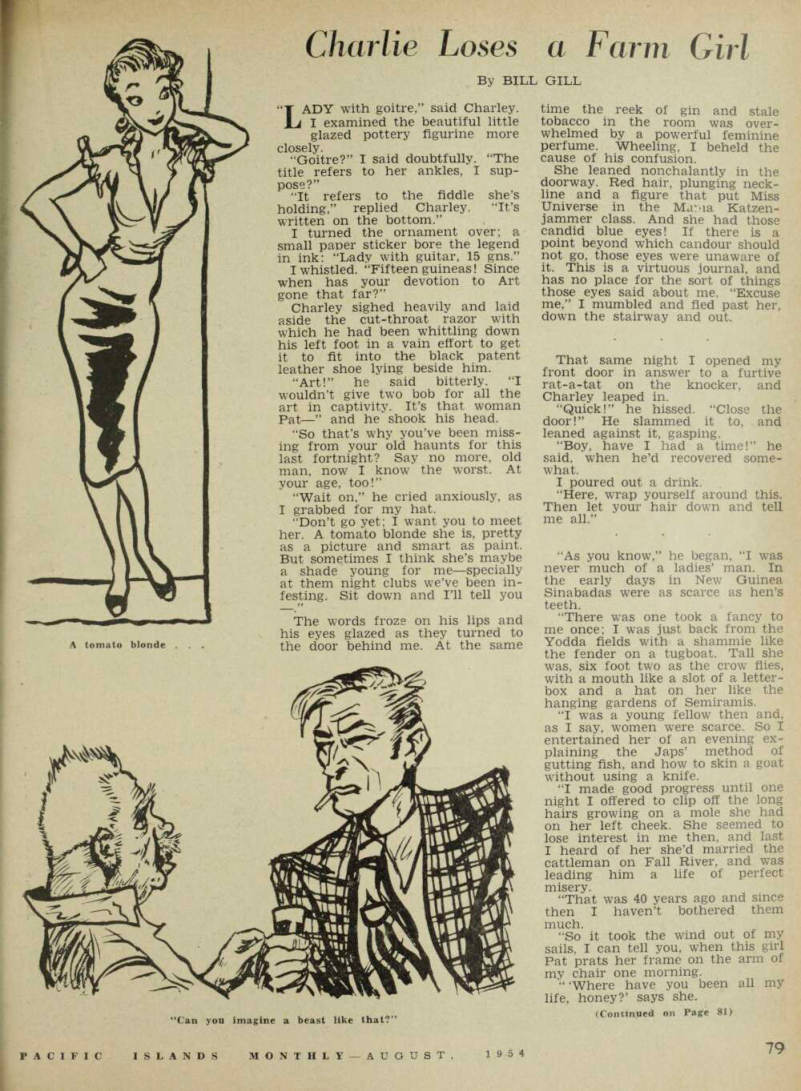
A tomato blonde . . .
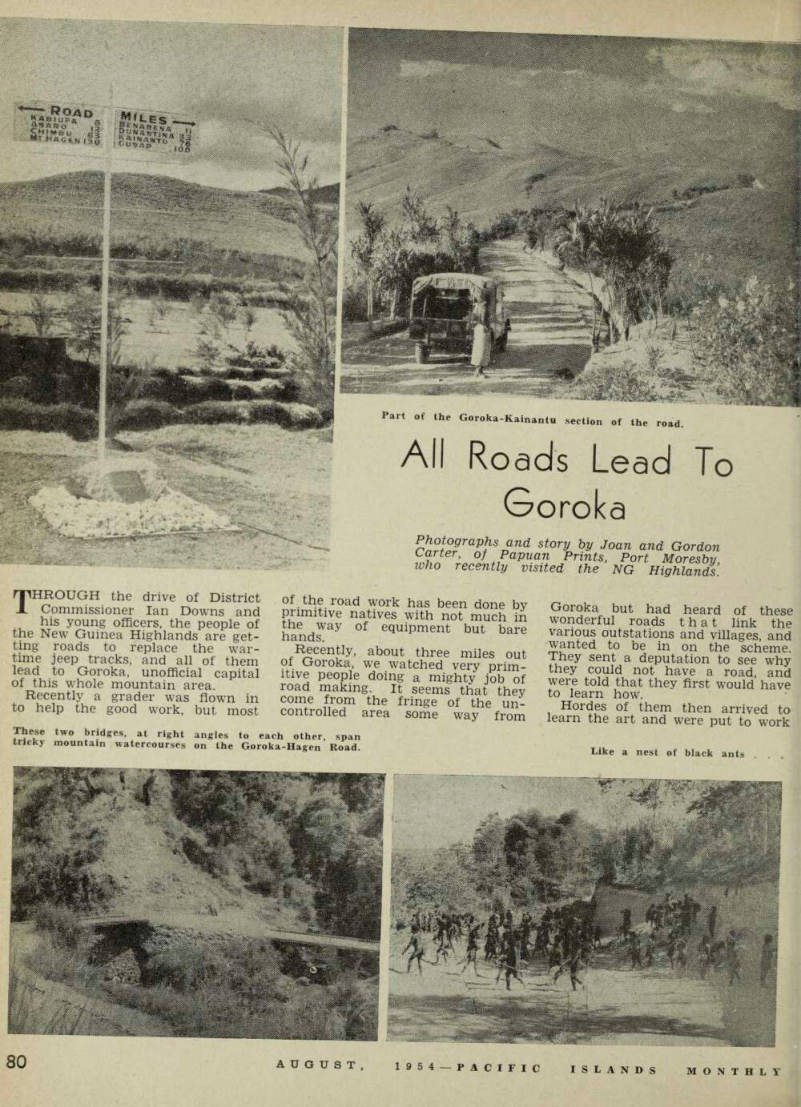
“Can you imagine a beast like that?”
“ ‘You’ve been passing me with your head in the air every day for the last fortnight,’ I tells her.
“ ‘Yes, but why wasn’t I told about all this long ago? My mammy told me about Rubber Barons, Tin Tycoons and Sugar Daddies, but I’ve never heard of Coconut Kings before. Tell me, is it true that you’ve got more mazuma than Tommo’s Two-up School?’
“She never paused to let me get a word in edgewise and, before long, I found myself shassaying all over Sydney with her on my arm.
Nightclubs, barbecues, carnivals and cocktail parties—she had to see them all. For a farm girl she had an extraordinary knowledge of
where to find fun, and it nearly killed me.
“But, after you left this after noon, she told me I could have the night off as she had to meet a friend who’d been away on business and detained longer than expected.
“That suited me fine, and I was just getting set for a good old snore-off when a large young fellah in a zoot-suit slid into the flat. He eyes me in silence for a while, and his eyes were like ice-picks. ‘Seen my wife around here?’ he asks; then, noticing my innocent gaze, he con tinues, ‘You wouldn’t,’ and helps himself to my whisky, sinking the plimsoll by four inches in one suck.
“ ‘lt’s pretty crook,’ he says, ‘that
a man can’t turn his back for a few weeks at Long Bay without some motheaten old haybag starts getting fresh with his wife Can you imagine a beast like that.' and he gives me a vicious look. ‘“lt’s a terrible thing to say,' I answers, ‘but I know exactly wheie to lay my hands on the miscreant you’ve just described, and if you U wait here a jiff I’ll go and get him for you,’ and I ducked out of that flat pronto, and here I am.
“I want to see the shipping lists so I can catch the first boat north.”
“Did you say she was a farm girl?” I asked presently. -So she told me." cha . r , le y h “ ()t t e h d c “Said she kept the wolf from the door working in a pharmacy.