Tropicalities
pp. 79-80 · Read in the full issue
Magazine Section
Village Fashion Decrees?
IS it possible that London, Paris and New York will one day defer to some obscure New Guinea village as a world fashion centre? That a coterie of natives, wearing lap-laps and squatting on grass mats, will design the barbaric dresses which civilised women wear?
That the patterns of the fabrics from which they make their master pieces will be inspired by the tropi cal village scenery?
The possibility, remote as it might seem now, has been raised by two separate news items.
One item announces that New Guinea natives are to be encouraged to enter a dress design competition in 1955, the scope of the competition having been extended in the hope that the natives will provide some fresh ideas for Australian frock de signs.
The second item announces that a missionary couple, Mr. and Mrs.
Cecil Abel, are studying silk screen technique at East Sydney Technical College and will pass on their know ledge of fabric printing to the natives when they return to Papua.
The Christian Diors and William Hartnells of New Guinea are about to get their chance.
Another Tropical Premiere
FOLLOWING British and Ameri can practice of giving films their world premiere at the scene of location, King of the Coral Sea had its premiere at the Torres Theatre, Thursday Island, on July 17. It was seen by the lugger crews and natives who took part in the filming.
The film stars Chips Rafferty, Who also produced it for Southern International Films; Lee Robertson was the director.
It tells a story of pearling and smuggling in the Coral Sea and features underwater scenes photo graphed by Noel Monkman.
The film will appear in Sydney soon.
Triumph Of The Bush
Orange
THERE was once a report in PIM that a former Cl Fruit Control Director had said, “with a grim smile” that the day of the native orange, which has grown un cultivated for over a century since
Captain Bligh supplied the first pips, was over.
That official has been long out of the Group. The grim smile is to day on the faces of those who view the dying-out of introduced Valencias and the continued pro ductiveness of the Bligh-derived item. Nothing can kill the old bush orange”, which, if a little coarser than the fancy imported fruit, re tains all the virtues of its species.
We have had numerous crackpot prophets who predicted its dis appearance—and what we saw was the vanishing of the prophets, not the orange!
The potentialities of Mangaia Island, visited by both Bligh and Cook (in what order is not clear), as an orange supplier are immense.
As things are, millions of the golden fruit go to NZ every season.
Multi-millions could be produced, even from trees sired by local pips.
The consumption, in the deep bush, of banned tipple has been the cause of immeasurable increase in the orange acreage—from thrown
away pips.—E.G.
Island Of Perpetual
Honeymoon
LAST, loneliest and most ex quisitely apart in the Northern Cook Islands is the 300-acre isle of Nassau, 45 miles from over-crowded Pukapuka atoll.
A few years ago the Cook Islands administration arranged for the Pukapukans to buy Nassau to pro vide land for their overflow popu lation. It had been a flourishing
copra plantation in pre-Pacific-War
days, but was then deserted, ex cept for Coast-Watchers, for some years.
When the ship Charlotte Donald called at Nassau in May, 1954, the colonists there had 18 tons of copra, which took five days to get on board owing to a bad reef.
This is how the Pukapukans work their Nassau plantation, according to what they told the visitors: They send a party of young married couples over to Nassau about 40 at a time. These young people stay and make what copra they can; then another party comes from Pukapuka to relieve the garrison on Nassau. The Pukpukans rotate their Nassau settlers about every 12 months.
Commented a Cook Islands
veteran: “This seems far from ideal. It would be better if some people stayed there permanently.
They could make the place a little paradise. They have eaten all the pigs that were there from before 1941. The pigs used to eat copra that was drying, and the people were not enterprising enough to make a large pig pen.”
Those Nice Green Nuts Are
Not For Sale!
BANG goes another South Sea island illusion (carefree plenty from Nature’s tropical abund ance) with a Fijian Affairs Board regulation prohibiting the selling or bartering of coconuts by Fijians to any non-Fijian in areas which will be gazetted from time to time.
Nothing has happened yet beyond the fact that on July 7, the Legis
lative Council approved the regu lation.
The purpose of the regulation is to close loopholes in the application of the law blocking the sale of green copra by Fijians. And that law is a sort of corollary to the Fijian Development Fund Ordinance under which £lO a ton is deducted from all Fijian-produced copra.—S.
Nuts. Drinking, For The Use
OF AS our friend says above, things are not what they were in the Pacific. Time was—or so we are told—when the hospitable natives rushed to get green coconuts for the refreshment of visitors as soon as they appeared in the village.
Personally I have never found it so myself, . . . getting a green coconut out of any native is about the hardest thing this side of entering the Pearly Gates.
I was reminded of this a few weeks ago, up above the Burma Road out of Rabaul, where an ac quaintance had driven me to see the sights. We happened upon a native Co-operative store (they seem to be peppered around the countryside these days) and he suggested a bottle of lemonade.
The store was in a grove of native coconut trees, and, incautiously, I suggested a couple of green coco nuts as a substitute.
We were in a tearing hurry and I was sorry as soon as I had said it —but the ponderous wheels of native life were already grinding, and the inexorable business of Buying a Green Coconut had begun.
A couple of Marys and a small boy had detached themselves from a group under a tree and gone off to the village from which eventually echoed much shouting and yelling and mightly little else.
“What in heaven’s name are they doing?” asked my companion im patiently. Somewhere out of the dim past experience prompted me to say: “Trying to find the owner of the trees.”
Sure enough, a sour looking gent eventually appeared, climbed a tree and threw down a couple of small nuts to the Marys.
More delay while someone flew off to the village again for a bush knife to decapitate the nuts. The nuts themselves cost my companion 1/ — just as cheap, of course, to buy a bottle of lollie-water, and much quicker.
The moral of this story, of course, it that the only way to assure your self of an adequate supply of coco nuts is to buy a plantation, and that it is a mistake to imagine that the coconuts and fruit you see growing along the Islands wayside are there for the picking. Someone always “owns” them and getting possession is as complicated a business as native cussedness can devise.
In Fiji, apparently, European wis dom has now added a further com- i
Heating factor. The logical develop ment of this, of course, is to issue permits for intending drinkers of green coconuts.—J.T.
Goings-On Among The
Blue-Bloods
The first wife of Captain Hugh Frewen well known in Fiji where he owned and operated the small Melanesia— has been in appears (according to f S y dne y .evening paper, anyway) ShL he i S t A at Maria Guinness, widow of the late Benjamin Guinness, of the Irish brew ing family and millionaire half a dozen times over, who recently was described by two Swiss psychiatrists as a menace to society At this writing Mrs. Guinness is languishing in gaol—it appears that she has for years been systematic ally pinching the heirlooms and choice bric-a-brac of all the best famines in Europe, to whom she is related or on friendly terms.
Now Nemesis has overtaken her, but Maria is unrepentant she thought it was a good way of mak money. She has also confessed (it is said) to having a long line of lovers.
Guinness was her third husband —he was living apart from her when he died and cut her out of his will. Captain Frewen was her first; in between times there was an Italian nobleman (and Maria herself seems to have been of noble Italian birth).
As Mrs. Frewen, she had one son, Roger, who is married to a daughter Viscount Selby, who is Anthony Eden s cousin. They live in the Frewen family manor, Brede Place Captain Frewen has lived in Australia for 30 years, but was in England last year visiting his kin.
He has, we understand, now re to his Property at Dorrigo,
■Nsw.
Oh, For A Filet Mignon!
rNGA’S nature-man, Ta v i Kaufmann, who has been living entirely on coconuts, leaves and berries on his island in the Tongan group, was in Nukualofa in June to receive medical treatment for inflamed eyes.
It will be remembered that Mr Kaufmann, a Dane, has a theory that only by reverting to the stone age can man cure his modern ills After building his house on lonely Hunga Is., he proposed to throw his 20th century tools into the sea.
He was not sure whether he would keep any books to read, either.
Latest report is that he has built two huts on the island to accommo date visitors and is at present teaching two Tongans mathematics.
Why? Surely mathematics come within the category of modern ills.
An American mining engineer, Mr.
M. Janitzke, visited Kaufmann re cently. Janitzke, too, is looking for a Pacific paradise. But he has now crossed Hunga off the list of prospects.
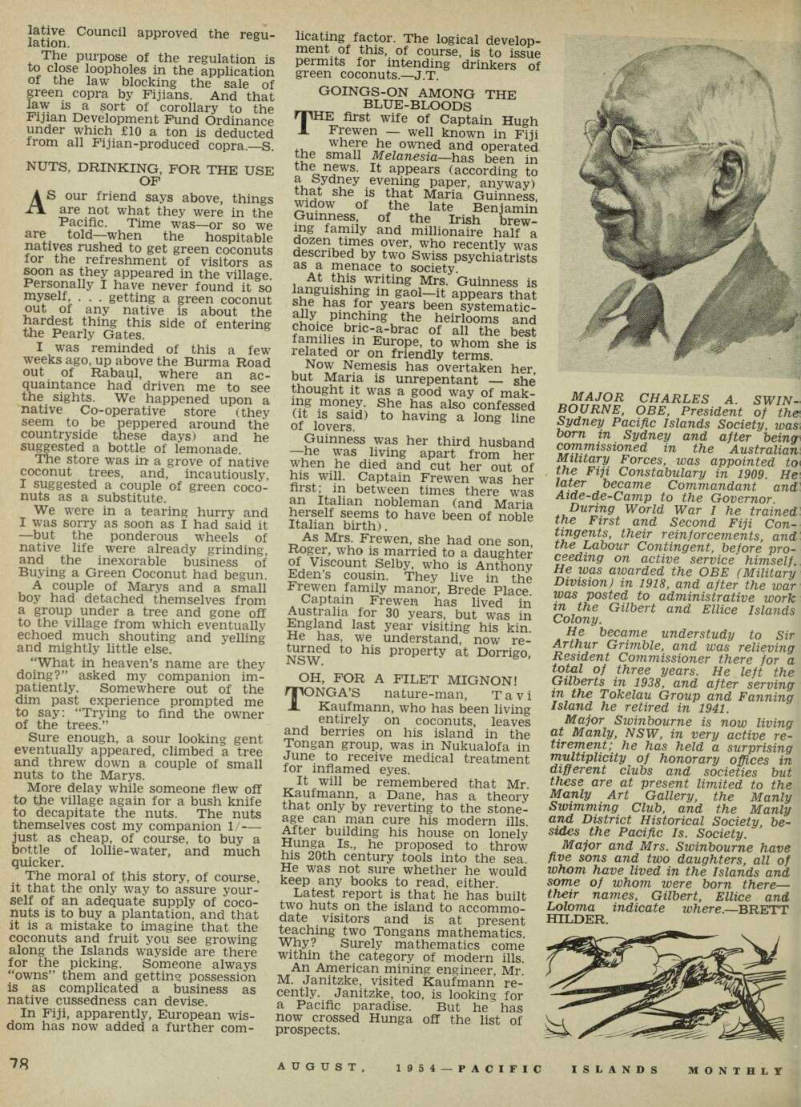
Major Charles A. Swin
BOURNE, QBE, President of thes Sydney Pacific Islands Society, wasi oorn in Sydney and after being\ commissioned in the Australiam Military Forces, was appointed to( the Fiji Constabulary in 1909. He\ later became Commandant and Aide-de-Camp to the Governor During World War I he trainedl the First and Second Fiji Con-ungents, their reinforcements, andl the Labour Contingent, before pro ceeding on active service himself ..
He was awarded the OBE (Military Division) in 1918, and after the war ■ was posted to administrative work in the Gilbert and Ellice Islands Colony.
He became understudy to Sir Arthur Grimble, and was relieving Resident Commissioner there for a total of three years. He left the Gilberts in 1938, and after serving in the Tokelau Group and Fanning Island he retired in 1941.
Major Swinbourne is now living at Manly, NSW, in very active re tirement; he has held a surprising multiplicity of honorary offices in different clubs and societies but these are at present limited to the Manly Art Gallery, the Manly Swimming Club, and the Manly and District Historical Society, be sides the Pacific Is. Society.
Major and Mrs. Swinbourne have five sons and two daughters, all of whom have lived in the Islands and some of whom were born there — their names, Gilbert, Ellice and Loloma indicate where. —BßETT