Territories Talk-Tale
pp. 28-32 · Read in the full issue
By Tolala
Administrator cieiand is calling upon Territorians to show a greater interest in local politics, and especially in the elec tion on October 2 for the three members of the Legislative Council.
I’m afraid there will always be political apathy in the Territory while the present system of legis lation functions. Territorians are suffering from frustration to a great degree where unofficial members of the Legislative Council are con cerned. It has always been thus;
and it’s an uphill battle—remi: iscent, somewhat, of the UNO Ge: eral Assembly—with Canberra hoi. ing the power of veto on ai measure not appetising to Au tralia’s general policy. If anyoi should know the ineffectiveness party politics it should be D I Cleland, with his experiences of tl Liberal Secretariat.
How Many Missions?
Listened to an ABC talk the othi evening by General Secreta.
Gribble, of the Methodists, who w plugging for the potentialities the NG Highlands and the grown of fruits up there, even stra\ berries! I remember visiting Wj in 1934 and Flo Stewart, then the Upper Pub., gave me a ve; dainty dish of strawberries grov in her own garden there.
It wasn’t Mr. Gribble’s stra\ berries that impressed me so muo as the fact that Methodists ai making a bid for the “enlightei ment” of the natives in that are It would be interesting to knc just how many Christian denon inations are making a bid to spres the Good Word amongst the: primitives. Nearly every sect, e; cepting the Salvation Army. An what a following it would have d: it cater for foreign missions, which it doesn’t, but is satisfi? to look after the needy in our ow Western cities. Just imagine ho popular it would become among; the NG indigines: Tambourines an big bass drums, with men i sweaters and girls in poke bonnet Such a set-up would surely appe to the native ceremonial comple
Pigmentation, or What?
An article, which gives one • think, was recently published in til South Pacific Post, entitled “Racii Problem Is On Way,” dealing wit the local situation in P-NG whe the Australian-educated native r< turns to his home-land, and til attitude which will be adopted b the white population. The writt suggests an organisation to be si< up to “condition the European min to those students when they re turn.”
Personally, I think all the organ isations in the world will not maW it possible for the European re sidents to accept the native —how ever highly educated —as an equss Visiting scientists associate wit them out of curiosity, and in patronising manner, and thus collei; anthropological data (always re membering they do not have to liv amongst them permanently). A cer tain type of European accepts thei: for personal exploitation—economi or political reasons. But for tH
average European, the colour bar remains, and may be accentuated towards the native who has mingled with Europeans in Australia as an equal.
The Declaration of Human Rights by UNO cannot change human nature or eradicate the caste system. There is no doubt that there will be a problem, more Especially in a decade or so, when native lawyers appears in court or native magistrates sit on the bench to dole out justice to all colours.
I There is another side of the pic ture, of which we seldom hear, and that concerns the natives who do not wish to be absorbed by our way of life, and have our culture forced upon them. The compulsory adop tion of Western ideas is nothing short of political regimentation: and I contend that, if the native wishes to live his own life —providing it is healthy and not inter fering with other cults —he should be allowed to do so. Western evolution as at 1954, in my opinion, is anything but perfect.
In fact, we seem to be deteriorat ing ethically, economically and
politically.
Paliau’s Territory
Baluan Island in the Manus group, has become accustomed to eruptions of various kinds —volcanic and sociological. It is the home of
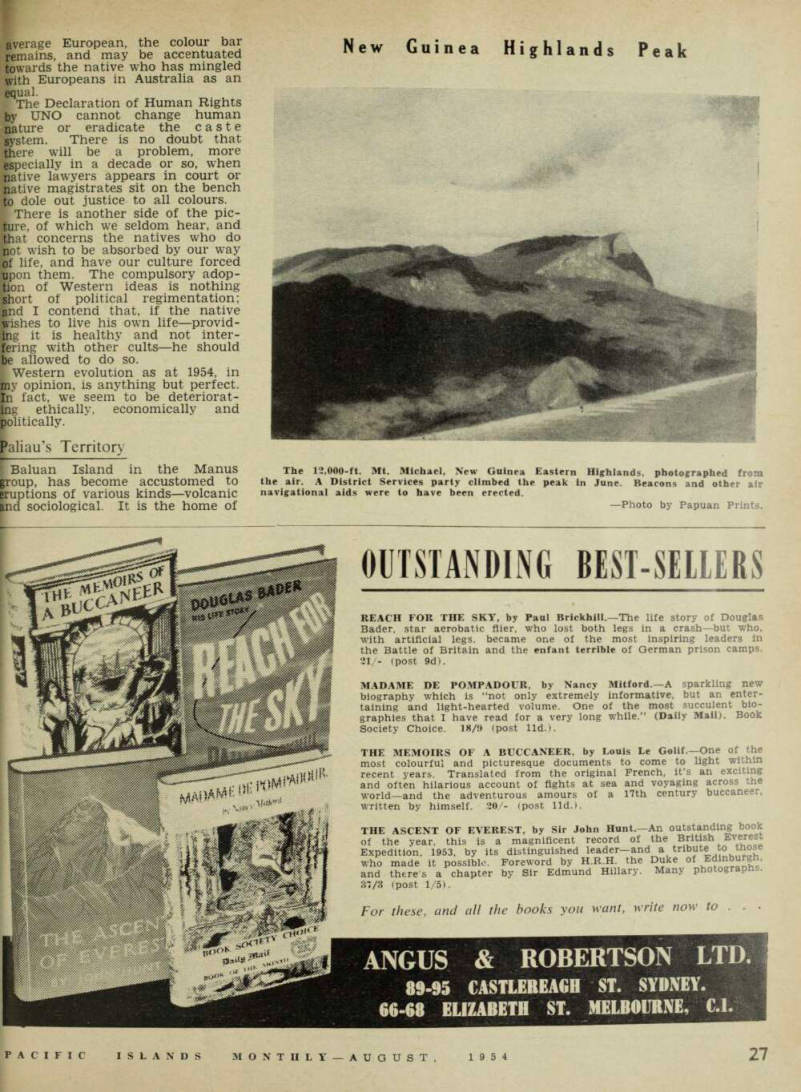
New Guinea Highlands Peak
The 12,000-ft. Mt. Michael, New Guinea Eastern Highlands, photographed from the air. A District Services party climbed the peak in June. Beacons and other air navigational aids were to have been erected. —Photo by Papuan Prints.
the one-time “Cargo Gutter”, Paliau, whose regime has latterly received complimentary criticism. Last year there was much volcanic activity in the neighbourhood. Last month a submarine volcano was again active and a brand-new island has made its appearance (even as Vul- C an did at Babaul) in a night.
Paliau will probaoly take this as
an indication of an extension of his territory by the act of God, and give him an opportunity of estab lishing another model village on the lines of Lipan-Mauk.
Anyway, who owns these newly created islands? Rabaul’s Vulcan a a f e ’ uncovered mass of vol
some but' insight yearslt
was covered with greenery.
Anthropologically Speaking
Following in Father’s footsie; Murray Groves, son of Director Education W. C. Groves, is to ca. out a twelve-months field reseai in Anthropology in P-NG. He ca pleted a two-years’ course anthropology at Oxford, and sii has been serving as lecturer History at Melbourne Universe His father spent much time, dur; the past thirty years, in antlr pological field work in varic parts of the South-west Pacii Surely a second generation anth: pologist, who has lived in t country, should have the edge many of the imported variety fn overseas, whose interests are mer academic, as compared with t personal equation.
Anyway: Who is the P-NG Offic Anthropologist at the moment? pre-war years both Territor could afford one. It seems now have to depend on itinerant : vestigators from other countries, that fair?
Tribute to “J.F.G.”
And so John F. Goldie has gc to his well-earned rest after : many years of pioneer mission wc in the British Solomons for the I Methodists, and later extended Bougainville and Buka. He will remembered in the BSI as havi an astute, practical mind, and i the good work he accomplished a member of the Advisory Coum
k first met JF in 1916, at Falsi, when he showed me the Lady in the Full Moon, replete with picture hat. The Bast time I saw him was in Rabaul [in early ’42, when he was diving [for a slit trench and Jap planes were coming in over the town. He kvas a good worker and organiser, and a good cove.
He Knows It All
[ln Four Months
The latest anthropologist to get his views on natives in the news ■is Dr. Ward Goodenough (repeat Goodenough) of the Pennsylvania University, who after a four [months’ study of the Nakanai (New [Britain) natives reports that they resent having been exploited by [European traders. “Villagers,” he [says, “are also distrustful of the European, from what the European Ihas done in the past. . . . pay these days is much better than before the war.”
I wonder if the Doctor realises that pay for plantation produce also is far better now than before the war. Copra alone is about ten times better. And the question arises here: Have the natives been so informed, or do they think that higher prices for copra are due solely to the fact of the establish ment of native co-operatives and that the Administration is more [than ever “Papa belong all”?
Incidentally, this is the same gentleman whom I heard over the ABC, being quoted as saying that “Cargo Cults” came into operation after War 11. Apparently he does not realise Cargo prophets were busy years before the Japs landed in 1942.
Four months may appear long enough for the Doctor to draw his conclusions on native opinions held in the Nakanai area; but to me it does not seem good-enough. It has the savour of the sort of observa tions made by half-informed mem bers of the UNO Trusteeship Com mittee.
A lot of these touring anthro
pologists remind me of the story told by Sir Hubert Murray, who asked anew acquaintance; “And how long have you been here?”
“Six months,” was the answer.
“And have you written your book on Papua yet?”
Rabaul and Its Volcanoes There is so much regimentation these days that John Citizen has “had” lengthily-worded edicts in officialese Such a situation comes to light in Rabaul, where detailed instruc tions for the evacuation of the town, in the event of an eruption, are claimed to have been circulated.
Yet (to quote Post report) out of 15 householders questioned “none had more than a- hazy idea” of the drill.
Much the same situation existed in 1937-38, following Vulcan’s eruption, when all sorts of emerg ency rules were laid down “in the event of an emergency.” Car tanks to be kept full; emergency rations to be handy, together with first
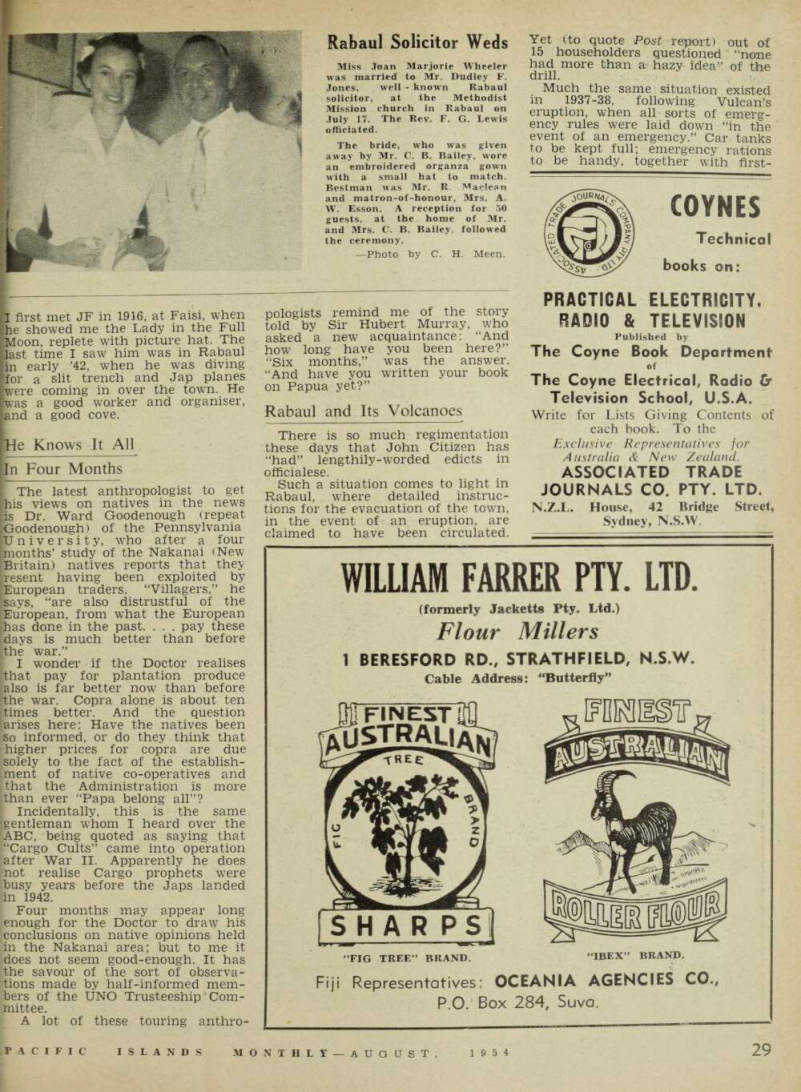
Rabaul Solicitor Weds
Miss Joan Marjorie Wheeler was married to Mr. Dudley F.
Jones, well - known Rabaul solicitor, at the Methodist Mission church in Rabaul on July 17. The Rev. F. G. Lewis officiated.
The bride, who was given away by Mr. C. B. Bailey, wore an embroidered organza gown with a small hat to match.
Bestman was Mr. R. Maclean and matron-of-honour, Mrs. A.
W. Esson. A reception for 50 guests, at the home of Mr. and Mrs. C. B. Bailey, followed the ceremony. —Photo by C. H. Meen.
aid kit, bedding and what-have-you.
But few, if any, of the residents observed the rules. And they were folk who had experienced the May ’37 eruption and knew the horrors of that Saturday and Sunday.
There still are many who remem ber the various plans devised prior to the Jap invasion of Rabaul— plans for this, that and the other.
What happened at the eleventh hour? A last-minute order from the Top Brass: “Every man for himself Anyway, Administrator Cleland has ordered an “investigation” into alleged ignorance of a plan pre pared for the Rabaul residents and, in time, we shall probably hear the result.
From extracts of the instructions issued by VECCO (Volcanic Emerg gen c y Command and Control Organisation) it would appear to me that theorists rather than practicians have been employed on the job.
Miscellany
“Calling Capt. Keller!” Carlton Younger (“Editor’s Mailbag,” July) apparently has not accepted Capt.
Haug’s statement that Fehr and Keller met in NG in 1920. I suggest there might have been another Capt. Keller killed in Malaita. (See “Mailbag” this issue).
I am pleased that the memory of • H - L - Waterhouse, who did such fine educational work at Nodup before the War, is to be perpetu ated. Late in July, the Waterhouse Memorial School was officially opened at Nodup by District Com missioner Foldi. During JHL’s term the Nodup school was always a show place for visitors, and an always pleasing item on the programme given by the small boys was the singing in English of some of the old-time ballads. He also trained a fine bugle band, which always attended the raising and lowering of the colours at sunrise and sun set. If my memory serves me right it was from amongst this bugle
band that the first recruits ca: for the Rabaul Police Band The truest words from P-NG : a long time came from Gene; Cariappa, High Commissioner : India, on his departure fr« Rabaul recently. “It is a pity,” said, “that so little of the exc; lent work done here is not suffix ently publicised.” Actually, PNG h about the worse press in the woi when it comes to letting the peor know what goes on there. Seei to be a suggestion of censorst somewhere in the offing.
The P-NG Coronation Fund don tions have reached £9,099. Of tl amount £2,199 has come fro Madang. Good going, Madar