Britain Avoids
p. 17 · Read in the full issue
Indian Problem
Fiji's Plea for Inquiry About
Over-Population
From Our Own Correspondent SUVA. August 3.
CRITICS of the British official at titude towards Fiii’s population problem (created by the pheno menal increase in the introduced Indian population) will see in the published correspondence between the Governor (Sir Ronald Garvey) and the former Secretary of State for the Colonies (Mr. Oliver Lyttel ton) only another example of Lon don evasion.
I The Governor, on March 3, 1953, sent to the Secretary of State a record of the debate (December 16, 1952) on the Legislative Council re solution calling for a commission of inquiry from the United King dom. The resolution asked for the appointment of the Commission [forthwith — “to inquire into and ad ‘vise what steps should be taken to [ensure that this Colony will not suffer from over-population to the detriment of the standard of living of all races in the Colony.” [ “There is no doubt,” Sir Ronald [wrote, “that the majority of the unofficial members of the Council are gravely perturbed by the pros pect of population outstripping the [resources of the Colony and, for [this reason, the motion was given Government support. It was made [clear by the Colonial Secretary, [however, that the word ‘forthwith’ in the motion was not to be taken absolutely literally. . .” [ The Governor also mentioned his [suggestion that the International Bank for Reconstruction and De velopment might be invited to undertake an inquiry into the economic potential of Fiji and to [make an objective study of its de velopment requirements, with special reference to the growing population; this to be followed by more specific and detailed exam ination by industrial consultants and other overseas experts. \ The Secretary of State replied ithat he was not convinced that either suggestion would be the most helpful course at this juncture. “I consider that in Fiji there are at present too many unknown factors, such as the mineral potential, the forestry potential, the soil and ecology of the interior, and the basic data as to the development of hydro-electric power, for a mission of this kind (International Bank), which would stay in Fiji only for a short time, to be able to form definite conclusions. . . The same consideration applies to the appoint ■ment of a commission of inquiry from this country. . . : “I consider, therefore,” the Secretary of State continued, “that
the immediate need is for detailed surveys to supply the basic infor mation about the economic potenti alities of the Colony. . . and that these should be carried through be fore consideration can usefully be given to the appointment of a more general commission of inquiry.”
With the addition of some general observations on the desirability of agricultural expansion, where pos sible, these extracts give the gist of the London reply, which was dated May 25, 1954.
The protagonists of the motion in the Legislative Council in 1952 have, from first to last, been open to the charge that, with the laudable hope of avoiding a rumpus, they whittled down their proposal to innocuous ness by omitting all reference to the crux of Fiji’s population problem— the steadily growing fear by non- Indians that the swamping Indian increase can result only in the virtual Indianisation of Fiji in the fairly near future: or —as what is claimed to be the only foreseeable alternative—an angry reaction by Fijians and others against the threat of Indian political and economic domination, overt or covert.
Editorial Note
WE may take comfort in the fact that this Mr. Lyttelton now is gone from the Colonial Office.
The pity is that he did not go sooner —or that he ever was there—he was one of the feeblest Secretaries of State for the Colonies we have seen in decades.
The newcomer perhaps can be in duced to hide his —that is, the aver age British Minister’s—terror of Nehru, and to deal with the Indian problem in Fiji on a basis of facts, racial justice and realism.
Mr. Lyttelton obviously decided to shelve the subject. There are enough sound men in the Legis lative Council of Fiji, including the Indian representatives, to see that the difficult problem is not kept hidden away. It is capable of solu tion, if boldly faced. This is their opportunity. Only very rarely do they get a Governor like Sir Ronald Garvey, whose policy is based on a long personal knowledge of Fiji conditions and history, who has a keen appreciation of the racial qualities of Indians as well as of Fijians, and who is a realist.
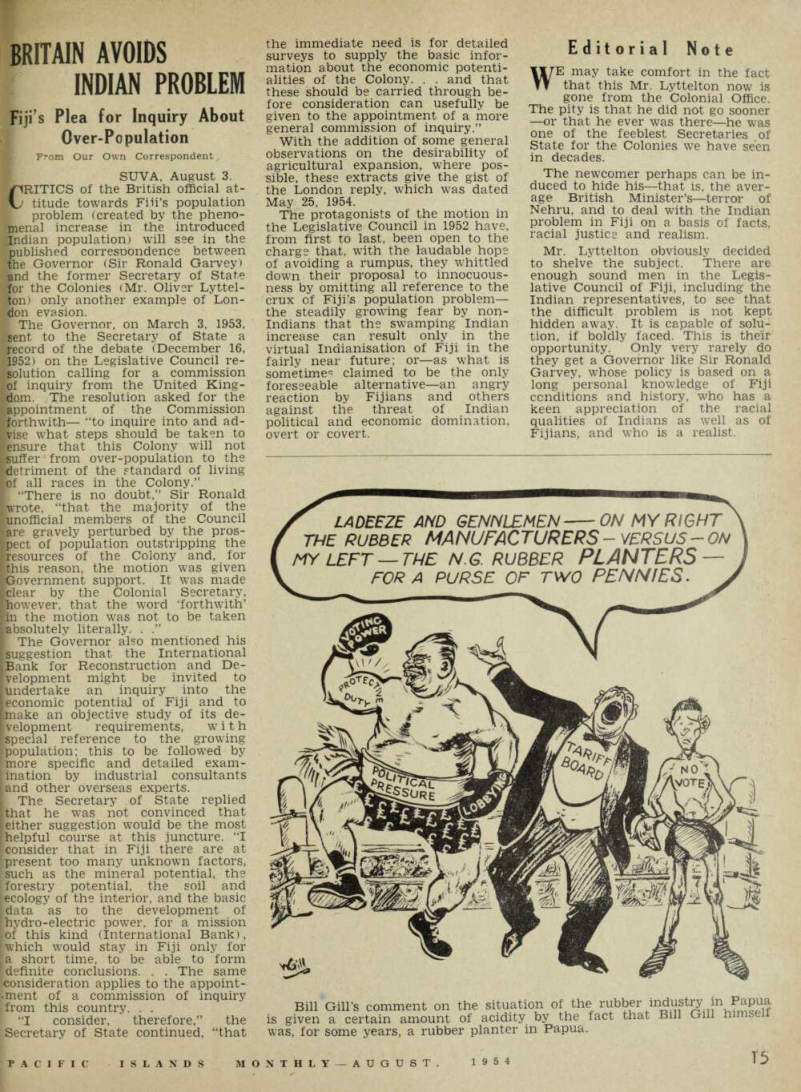
Bill Gill’s comment on the situation of the rubber . ir i?.V l s^-,} n Vl is given a certain amount of acidity by the fact that Bill Gill himsel was, for some years, a rubber planter in Papua.