News of the Small-Ships
pp. 105-121 · Read in the full issue
Down—And Up:—Mv Ralun
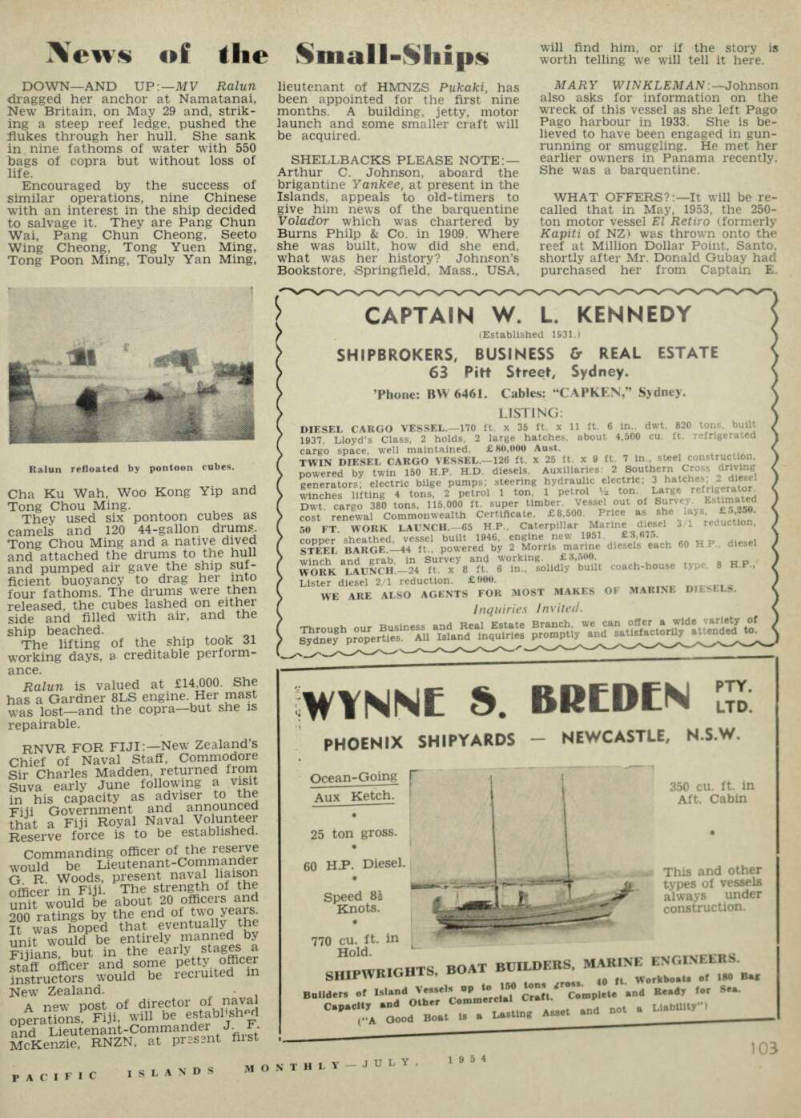
dragged her anchor at Namatanai, New Britain, on May 29 and, strik ing a steep reef ledge, pushed the dukes through her hull. She sank in nine fathoms of water with 550 bags of copra but without loss of life.
Encouraged by the success of similar operations, nine Chinese with an interest in the ship decided to salvage it. They are Pang Chun Wai, Pang Chun Cheong, Seeto Wing Cheong, Tong Yuen Ming, Tong Poon Ming, Touly Yan Ming,
Cha Ku Wah, Woo Kong Yip and Tong Chou Ming.
They used six pontoon cubes as camels and 120 44-gallon drums.
Tong Chou Ming and a native dived and attached the drums to the hull and pumped air gave the ship sui ficient buoyancy to drag her into four fathoms. The drums were then released, the cubes lashed on either side and filled with air, and the ship beached. . . 01 The lifting of the ship took 31 working days, a creditable perform ance.
Ralun is valued at £14,000. She has a Gardner BLS engine. Her mast was lost—and the copra—but she is
repairable.
RNVR FOR FIJI:—New Zealand’s Chief of Naval Staff, Commodore Sir Charles Madden, returned frp l ?} Suva early June following a visit in his capacity as adviser to the Fiji Government and announced that a Fiji Royal Naval Volunteer Reserve force is to be established.
Commanding officer pf the reserve would be Lieutenant-Commander G. R. Woods, present naval liaison officer in Fiji. The strength of the Snit would be about 20 officers and 200 ratings by the end of two years.
It was hoped that eventually the unit would be entirely manned by Fijians, but in the early stag s a staff officer and some P etty . instructors would be recruited in New Zealand.
A new post of director pf operations, Fiji, will be established and Lieutenant-Commander J. F.
McKenzie, RNZN, at prssent fhst
lieutenant of HMNZS Pukaki, has been appointed for the first nine months. A building, jetty, motor launch and some smaller craft will be acquired.
Shellbacks Please Note;
Arthur C. Johnson, aboard the brigantine Yankee, at present in the Islands, appeals to old-timers to give him news of the barquentine Volador which was chartered by Burns Philp & Co. in 1909. Where she was built, how did she end, what was her history? Johnson’s Bookstore, -Springfield, Mass., USA,
will find him, or if the story is worth telling we will tell it here.
Mary Winkleman:— Johnson
also asks for information on the wreck of this vessel as she left Pago Pago harbour in 1933. She is be lieved to have been engaged in gun running or smuggling. He met her earlier owners in Panama recently.
She was a barquentine.
WHAT OFFERS?:—It will be re called that in May, 1953, the 250ton motor vessel El Retiro (formerly Kapiti of NZ) was thrown onto the reef at Million Dollar Point, Santo, shortly after Mr. Donald Gubay had purchased her from Captain E.
Ralun refloated by pontoon cubes.
Savoie for use as a salvage vessel there. She has been hard and fast on the reef ever since. It is now reported that she is for sale “as is, where is*’ for £4OO Australian.
Her machinery is reported still in the ship. She is partly flooded to about the load-water line.
SANTO WHARF:—This wharf can be considered a total loss fol lowing serious damage to the already dilapidated structure by a tanker.
It is understood, however, that a lighterage service will shortly be in operation on a commercial basis, re placing the wharf which, incident ally, was free to all comers to use at no charge—a relic of the military occupation during World War 11.
Bought At Guam:—Peter
Throckmorton, of the Reliable Engine Repair Service, Honolulu, who toured South Pacific groups last year looking for ship-sale busi ness, reports that his ex-serviceman organisation has made a purchase in Guam. He and others were leav ing Honolulu in June to bring back a convoy of four vessels —a 450-hp tugboat, one LCT hull, one 250-ton steel barge, and another wooden barge of the same tonnage.
Old Photos Wanted;—Union
Steam Ship Co. are seeking photos of their former vessels Kakapo (1900), Fijian (1889), Brunner (1900), Snark (1905), Boojum (1887), and Lady Bird (1881). They are prepared to buy them through local Island shipping managers.
Monique Loss Official:
A communique issue by the Mer chant Marine Ministry in France declares the motorship Monique to be officially lost, and her passengers, captain and crew to be dead. The Justice Department has announced that the families of the victims may claim damage whatever may be the result of the inquiry into the disaster, and that both the owners of the ship and the captain may be held responsible.
Monique, of 240 tons, left the island of Mare, in the Loyalty Group, at 4.15 p.m. on July 31 last year to sail the 50 miles to New Caledonia. She was never sighted again. More than 120 people, in cluding 20 Europeans, were on board.
Brothers Delayed: — Seven
Little Brothers and owner Willis, are reported not to have got away on the Pacific drift voyage in May. A mid-June despatch from Callao indicated that the voyage would, however, commence before the end of June. A few other de tails were supplied. The raft has a keel and a steering wheel as well as tiller, to ease the work.
A radio transmitter is being carried but no details of radio plans or frequencies are known. Most probably the set is a Gibson Girl operating on 500 kc/s with kite aerial and hand-turned power gen erator.
A parrot and a cqt have joined the crew. Based on Kon-Tiki ex perience, first possible landfall
would be made about the end of September, but Willis insists that he’s heading for Samoa, not French Oceania, so another month might be added—possibly much more.
For Services Rendered:—
Crowning a life-long career as a master in sail and steam, Captain L. C. Boulton, master of the NZGS Maui Pomare, received the award of OBE in the Queen’s Birthday Honours last month. He expects to retire soon from the command he has held for many years. He has served in vessels running to all parts of the South Pacific. His present charge has been serving the Cook Islands since World War H,
with occasional calls at Niue and Apia.
More Drifter Sas The
American Willis set out from Callao, Peru on his expected drift to Samoa, late in June, it was learnt that an other 6-man raft expedition was preparing to drift from California to Hawaii.
La Urabada For Scuttling;
' historic 160-ton Papua Admin htration yacht Laurabada, built in 1 14 and handed over to the Port I Moresby Sea Scouts four years ago, if .0 be officially destroyed by fire “a her a fitting ceremony.” Apart Lam her historic associations, . . rabada did some most valuable work in World War II evacuating people from behind the Jap lines, a ;ood many owing their lives to her. For a long time she was skip ped by Mr, Ivan Champion.
Charles H. Gilbert Re
PORT:—The US fish and wildlife research vessel Charles H. Gilbert recently cruised Polynesia and re ported favourably on tuna fishing possibilities in the Marquesas on re turning to Honolulu. Large quant ?ties of a sardine-like fish of an real size for tuna bait were found in the many bays there, and the surrounding waters contained numerous tuna schools. As many as 20 large schools were sighted with in an hour, mostly identified as 10-30 lb yellow-fin.
FROM NOUMEA:—Under command of Captain Louis Jego, and with Captain Robert Souprayen . Societe oc?
Loyaute s 260-ton vessel Rosalie came south from Noumea for refit in Auckland late June. With 18 aboard, the Auckland-built ship came down in ballast in 8 days against fresh southerlies.
Chief Officer Souprayen, normally master of the ship on the inter island run, said the company has an 800-ton vessel being built in France „ ■ dU x. m N ! w Caledonia before the end of the year. This will replace their Monique, lost without trace last year, Captain Jego expected to clear
Auckland for Noumea before the end of July.
Rabaul Cofferdam:—A
cofferdam, capable of taking 300 tonners, was built in Rabaul, NG, in May by local engineer Mike Morgan and confounded the numerous sceptics by successfully raising the
Kulu and allowing her “A” brackets to be repaired. As the photograph shows, it is like a welded-steel tank, in which the stern of the ship sits. Water is pumped out of the tank so that repairs can be made.
For years Rabaul owners and agents have been under the expense of sending ships to Moresby, usually empty, maintaining an idle crew on board, paying daily wharf charges and slipping and rental charges (2/6 a ton), and suffering long de lays. Early in January Steamships Trading Co. advised that tne Moresby slipway would n ot be a vari able for the Kulu job until the end of March. The price Quoted for changing the “A” brackets was £2.000, and this wouid probably have grown to £3,000 with the delays other expenses.
Nothing more need be added to ™S^ the advantages of the new cofferdam. It is believed that Burns Philp will soon use the dam to change the Katika s brackets. a t ATT * NUKALAU LOST:—A no th e r Pacific trader rang the Lutine bell at Lloyds in mid-June when South Pacific Shipping Co.’s Nukalau took the big plunge on her first working voyage for her present owners.
The 400-ton, Italian-built, wooden ship, after months of delay in delivery from Cyprus to Suva and more months in improving and extending the accommodation, left Auckland in May for Australia and was returning to New Zealand with
a cargo of hardwood poles from Goff’s Harbour, NSW, when she foundered. The ship happened to sail from Coffs Harbour on' a Friday, there were thirteen persons aboard, and w was June 13 when she sank.
She had also had her name changed and mis-spelt in the process, and— let’s admit it—ships which her chief engineer and second officer, part owners, have been associated with, have had unfortunate histories.
Karoro, just sold by them, promptly nosed up on to Aitutaki reef, and Alexander, their next purchase, with equal promptitude put herself, by some extraordinary fluke, on the same reef a little later, Nukalau seems to have opened up
Top: Mr. Mike Morgan, inside the cofferdam, at work on the “A” brackets.
Lower: The Kulu with her stern supported by the cofferdam.
when 200 miles off the NSW coast in moderate weather. Her master, Captain D. K. Matheson, an experienced mariner of high professional standing, sent out a distress call on the evening of June 12. Colonial Sugar Refining Co.’s Fiona, 65 miles away, was diverted to the scene, arriving in time to take off all hands in the early hours of the following morning as Nukalau went down.
The crew, including seven Fijians or part-Fijians, was landed on Lord Howe Island and flown back to Sydney.
South Pacific Shipping Co. is registered in Suva, but the vessel was still registered in Famagusta, Cyprus. Shareholders included Mr.
J. Turner, Suva small-ship owner; Captain Jack Mc.K. Arnot, of the Fiji trader Altan; and Mr. Lew Graham, chief engineer, and Mr. C.
Harrison, second officer, both of
Auckland. The vessel was under charter to Hong Kong & Eastern Shipping Co., a subsidiary of Tas man Steamship Co., of Auckland, with headquarters in Sydney, and was reported to be fully insured.
Messrs. Graham and Harrison had put a great deal of hard work into preparing the vessel for service, Ma t e of Nukalau at the time of her sinking was Captain McLeod, we ll known in the Cook Islands as former master of Te Aroa.
Toil And Trouble;—A Few
days before Nukalau foundered. Cap tain E. Savoie s Jacques del Mar ( ex-Holmburn of NZ) put on a per formance seaward from Port Mac quarie, NSW. Following a serious engine breakdown, the Master sent out a call for help and the salvage tug Woona was despatched from Sydney and returned with the 48-
year-old veteran in tow. The motor was described as “a little dicky" when Captain Savoie purchased this and the Colorado del Mar (ex Hokitika ) in New Zealand ports last January.
Gone Fishing:—The 69-Ft
trawler Lucy Star, which saw service in the Islands during the war, has
Kokoda, one of the smallships purchased a few months ago by Burns Philp (NG), Ltd., from the P-NG Government Shipping Service.
/ydney for New Zealand’s South Island, where she will be used for Ushing, She is powered by a 160hp diesel.
' lELL-52: —Built by Millers Ltd., , his 75-foot welded steel oil rge was recently delivered to Shell Oil Co. for use on the Suva- Laut-oka run, carrying 84 tons of in four tanks. Full details . .'.’ed in this column last August.
.In Other Operation:
tonald Johnson, who last year twice r i Sydney on an island yacht a but each time sold the yacht ■ival at Honiara, was heading v l : from Hongkong in June with ner. This time, however, he tmt his yacht were aboard the Eastern Glory.
Johnson hoped to sell the 32- :. outer en route to Sydney, possibly NG. Freight alone was cost -1; 1500. Completed to his own irements, the craft looked a ‘ ul sort of shallow-draft, centre j-oird fishing boat. /.OMBARD ILL: Frenchman - p Alain Bombard {The Bombard Kiory), who made a darling drift oyage across the Atlantic last year prove his theory that a ship vlocked seaman can survive en ;; y PJ 1 food and drink obtainable om the sea, is reported now to be enously ill of a bone disease The ': J seas f> is believed, is the result '5 ma J n utrition and loss ■ weight caused by his experiment.
Noumea R/T Radio
WATCHES;—Noumea’s radio watch for R/T calls has recently been re vised and the frequencies altered to conform with international require ments. Coast station and ships now use 4100 and 8200 kc/s. Watch is maintained on 4100 kc/s from 2100- 2330 GMT and from 0330-0500 GMT, and on 8200 kc/s from 2200-0400
GMT, service on the two frequencies thus overlapping.
RESHUFFLE; From Nukualofa it is reported that the Government’s 108-ton auxiliary ketch-rigged Hifofua will shortly be offered for sale, and that she will be replaced as a personnel-shifting vessel by the A’oniu, Suva-built 80-ton ketch
at present employed by the Tongan Copra Board. A’oniu in turn will be replaced by a new steel vessel, probably of 600 tons, for the copra Hifofua was built by Chas. Bailey, Auckland, in 1927, and can carry 50 tons of cargo, 10 cabin passengers and 80 deck passengers. She had an extensive refit in Auckland last year.
Southern Cross:—The Mel
anesian Mission ship Southern Cross was due to leave Honiara on June 21 on her last voyage for the Mission, with Bishop Hill, new Bishop of Melanesia, on board. She will call at ports in the Eastern Solomons, the Reef Islands, Santa Cruz Utupua, Vanikoro, Tikopia and Espiritu Santo, after which the Bishop will visit the New Hebrides.
Banks and Torres Islands. The Southern Cross will then proceed to Ballina, NSW, and will be sold.
In the course of her 21 years| ser vice to the Mission she has visited most of the islands of Melanesia, including New Britain and Papua, and during the Japanese war she saw service with the: R AN. Her pre sent captain is Lt.-Cdr. °^ eill j *? S S’
RNZN (retired). Her mate, H.
Woods, served more than 50 yeais ago in an earlier Southern Cross and is well known throughout the islands.
The Mission held a farewell service on board on Sunday, June 20. pSSlfv oo^' l . lll Lloyds 1953 Register of Yachts, Southern Cross was built by Cammell Laird & or£>’’ ® irkeia head, i n 19 33 and is 298 gross tons, 143 nett. She is powered by a pair of Gardner diesels. Mission headquarters in have a price ticket of £15,000 Australian on the ship.
Funds are being collected for a new ship for the mission. Meantime, chartered tonnage or regular trading vessels will be employed to move personnel and cargo.
Changes Coming:—Suva Post
Office, which operates the coastal and inter-island radio service in Fiji waters, reports that frequency
changes are likely to come into fore? there about August. Instead of using" 6,300 kc/s (4200 kc/s as an altern ative), local shipping will shift to 4073.9 kc/s (8262.3 kc/s) and the Post Office station will reply on 4445 kc/s (7360 kc/s). The latter trans mitters will also be used for inter island communication.
Voice-equipped vessels approach ing Fiji from overseas will still call the Cable and Wireless overseas radio station, which listens on 6280 kc/s at 0400 GMT and 2300 GMT, replying on 5887.5 kc s.
NOW IN TASMAN:—Japanese tuna boats have lately been suc cessfully operating their long-line fishing methods in the central Tas man sea, midway between Aus tralia and New Zealand, and have
taken large catches of albacore this autumn, according to American fish ing interests. It has not been gener ally appreciated in the South Pacific that Japanese fishing vessels — modern 18-knot craft —had extended their operations so far south, though tuna are known to migrate still further south on the Australian coast. The Japanese vessels are operating in pairs, one hauling in while the other re-baits, the line being lifted every 10 to 12 hours.
Special Charter; —To Take
Cook Island labourers home from Makatea phosphate island and re turn with a new gang, M/v.
Orohena, largest vessel in the French Oceania inter-island trade (532 gross tons) made a charter voyage in May for Compagnie Francaise Phosphates d’Oceania, owners of Oiseau des lies. The latter vessel also made a voyage to the Cooks a few weeks earlier.
Orohena is owned by Andre Biouin & Cie., Papeete.
Itc Vessel Lost—The Micro
nesian Island Trading Co.’s AKL vessel Metomkin, was lost on a reef outside Ponape Harbour early this year. Despite efforts by the US Coastguard vessel Planetree, and the Pacific Micronesian Line ships Terry, Baker and Roque, the stranded vessel could not be refloated and became a total loss. The 36 passeng ers and 80 tons of copra aboard at the time were safely landed.
Salvage In Micronesia.—
Some time ago we reported that Japanese firms were keen to obtain salvage rights covering wartime wrecks in Micronesia. We learn that the Trust Territory Government has signed a preliminary contract with the San Francisco firm of J. H.
Pomeroy & Co. in which they have been given 120 days to survey and determine whether operations would be technically or economically feasible. That firm will then have the right of carrying out salvage under terms to be decided, if the survey proves favourable.
TO SAIL AGAIN—The Catholic mission schooner Romace, which operates in Micronesia and which went ashore near Truk late last year, now seems likely to sail again.
A US Navy salvage team abandoned efforts to refloat the schooner taut the mission authorities, convinced that the job was not impossible, carried on the salvage work them selves. The vessel was gradually shifted nearly 1,000 feet across the reef, extensively replanked, and was ready to be relaunched in April.
Watch That Shlrt—Marine
authorities have issued a warning that under certain circumstances a nylon shirt worn by the helmsman can cause a deviation of the com pass. A recent case was noted where a man wearing a shirt made
of orlon—one form of nylon—caused the steering compass to oscillate in a peculiar manner. The effect was traced beyond shadow of doubt to the shirt.
H-Bomb Excitement.—Water
side workers in Australia during May were refusing to work cargo in vessels arriving from the Far East without their first being checked for radio activity. One vessel affected was the Swedish ship Citos, which came from Japan via Hong kong, Borneo and Rabaul to Sydney.
Another was the Chinese vessel Hai Chang, which the ship agents de clared had never been nearer than 2,000 miles to the scene of the H- Bomb tests. Watersiders in Cairns refused to handle the cargo of Jap anese cement until tests were made.
With greater reason, natives of Rongelab and Uterik, in the Marshall Islands, accidentally affected by radio-active dust from the tests, appealed to the UN to have further tests halted.
Nukualofa Radio; Further
to the details given in April PIM, Nukualofa Radio now reports that speaker watch is maintained for Smallcraft on the International dis tress frequencv of 2182 kc/s from 0540-0950 GMT and from 1140-1240 GMT, daily, including Sundays.
Nukualofa is thus the first Islands station to establish an almost con tinuous watch on this frequency.
Furthermore the station, like Suva,
provides a R/T service from ship
to any person ashore in Nukualofa connected to the telephone system.
Conversations are restricted to
ship’s business. The charge is 5/-
for the first three minutes and 16 per minute thereafter. Messages to other parts of Tonga not available on the R/T service are accepted at 4Jd per word. • The former luxury schooner IDALIA was abandoned by an amateur crew 180 miles north of Honolulu mid-June. Navy transport LT. ROBT. CRAIG found her by chance, a drifting derelict, and took off the crew.
Nine men and women amateurs com prised the crew. They spent 25 days trying to take IDALIA to San Pedro, California, without auxiliary power or radio and with a minimum of seaman ship.
The log said the vessel became be calmed in the Molokai Island channel “and was tossed like a cork, causing flimsy mainsail and jib to rip to ribbons’’.
On the third day sails were repaired and a fresh breeze rose, but bad seamanship endangered the vessel. There were days of heavy seas, and the other log entries were:— Fifteenth day: Mainmast broke in two places. Lower half fell in sea and beat against side. Upper half secured to fore mast, but broke and fell into sea. Took water at increasing rate.
Sixteenth day: Hull split under pound-
ing of heavy seas. Three hours a day pumping out bilges.
Nineteenth day: Crew on starvation rations. Pumping difficult.
Twentieth day: Food withheld from crew to make them go back to pumping.
On the twenty-fifth day a light was seen on the horizon, flares were shot off and the LT. ROUT. CRAIG came along side.
Final log entry—“ Rescue accomplished smoothly under difficult conditions. Even saved ship’s cat’’.
The above vessels have put in at Papeete recently Top: CHARLES H. GILBERT, research vessel of the US Fish and Wildlife Service.
Centre: Lieut. Fester’s TERN II, called en route from England to Auckland.
Lower: American yacht NORDLYS.
• The 56-year-old gaff rig ketch CARIAD arrived at Port Moresby on June 6 and left a few days later for South Africa. She has been on a world tour—the second—with her 66-year-old owner, Mr. W. Flitton, a SA business man.
Mr. Flitton expects his hobby will get less of his time in future. He was return ing home the short way, via Cocos and Mauritius, following the death of his business partner, a friend for 40 years.
• PRIMAVERA, American 5-ton sloop, manned by owner Paul Hurst and three companions, arrived in P,p * e ' "” keß from Hilo. Hawaii. The yacht had taken part in the Trans-Pacific and Ensenada raC es last year. Now out on a five-months cruise, she will call at various islands in French Oceania before returning to Honolulu. • SOLACE, a 30-foot, English, Alden designed ketch, cleared Balboa May 3 I course of a circumnavigation The yacht is owned by Commander Victor - RN.Tetd., a y well-known English yachts man, who is accompanied by Stan y Mathurn. Calls were planned at
pagos, Marquesas, Societies and on to Auckland, thence via Torres Strait, the total voyage taking about three years.
En route to Panama from Lymington, England. Commander Clark had a number of different companions for various stages of the voyage. The Commander served in HMS REPULSE at the time of the BISMARCK chase. He received the DSC at Narvik and a bar to it in Malaya. He was a prisoner of war for Ste years in Sumatra. • ARTHUR ROGERS, after a lengthy rest in Auckland, pointed her nose to the Islands again June 6. Aboard the 70-foot Brixham ketch with owners Tom and Diana Hepworth were five young women who had joined, on an expense sharing basis for the present cruise. First port was to be Nukualofa, with a possible
call at Raoul Island, Kermadees. At Tonga. Manase, the Tongan boy who has been with the ship since she cleared there last year will leave. After Nukualofa the cruise will include Vavau, Fiji, New
The attractive Chilean schooner SERVA LA BARI at present at Papeete.
The sloop PRIMAVERA at present in Oceania waters. It is owned by Mr. Paul Hurst, of Lanikai.
Hebrides, Noumea, and back to Auckland by early summer.
The round - trippers are Elizabeth Worley, Auckland, Allison Goodwin, South Island, Marjorie Pannett, a Christchurch nurse, June Cabeena, a nurse from Aus tralia, and Dr. Thelma Johnson, of England—who recently came out as doctor in a Port Line vessel. • LADYBIRD, 31-foot Auckland ketch, with owner Cyril Hill, his wife, and Peter Edmonds who last year sailed his own TAURANGI on a cruise through Polynesia, cleared Auckland early June on a similar cruise. LADYBIRD was expected to head : r French Oceania, then circle back to the westward and return home from Fiji in the early summer. • ARIES, American tobacco baron R. J.
Reynold's 92-foot ketch, is not coming to Tahiti this year. The yacht crossed the Atlantic, then headed back for the Mediterranean. Mr. Reynolds last year acquired a property with its own jetty in Tahiti, and was expected to spend a large part of his time there with ARIES in the future. The new English-built yacht was expected there early this year. m RCC Awards: The Coveted Royal Cruising Club Award this year went to a number of yachtsmen seen in the Pacific last year. The Challenge Cup was awarded to MOONRAKER, 60-year-old 10ton gaff cutter, sailed by Peter and Ann Pye from England to Vancouver via Polynesia.
BEYOND, T. C. Worth’s alloy motor cruiser, drew the Romola Challenge Cup.
This boat sailed out to welcome the Royal Yacht GOTHIC at Direction Island in the Cocos-Keeling Group. It was the only yacht present.
STORTEBECKER 111 Dr Franklen
Ev^nsfEum
awarded the Founders Cup in recognition 3 StoU ' efr ° r ' b 5 * Small ”«■ -
sailing from Auckland to Vancouver via Polynesia. ® awa ™ s are, we believe, made on h 6 ° submitted b y c,ub mem
lZr
Not for years have there been so manv »' bigger Cuss 'ga.Ms
Pacific waters. This month there is news of more. • MAREVA, a 55-ft., hand-designed motor-sailer, built in 1939, cleared Balboa May 8 according to our Canal Zone correspondent. This is the vessel we re ported in February under the name of SEARCH. Now registered in St. Louis, USA, she had Papeete on her transom on clearing Balboa and will be registered there on arrival via Galapagos, and Mar quesas. She is being delivered to Mr.
James McConnaughey, an American who has acquired property in Tahiti. The de livery crew of five is headed by Captain Walter Kupiec, who will remain in the vessel for a while to break in a Tahitian crew. Next year, it is understood, the MAREVA will be engaged on some sort of scientific expedition in the Islands.
Mr. McConnaughey has written several books, mainly historical fiction, among them “Three for the Money’’, a book on the Islands which is said to have caused some adverse criticism by the French in Tahiti. Mrs. McConnaughey is also a writer.
• Gloria Dalton, An 86-Ton
schooner from California, dropped in to Papeete May 18, having cleared from Ensenado, Mexico. She was to return to that port after a short sojourn in French Oceania. The vessel is owned by Charles H. Otterman, who is accompanied by a son and eight other crew members. The yacht was built at Long Beach in 1930. • SERVA LA BARI, 80-ton, 92-foot, two-masted schooner from Quintero, Chile, was another surprise arrival in French Oceania. Chilean deep-water yachts are few in these waters. This attractive clipper-bowed, counter-sterned steel vessel is owned by Jorge de Giorgio, Jr„ and she carried a crew of eight. Calls had been made at Valparaiso, Callao and Rikitea in the Gambiers en route to Papeete, where she arrived May 7. The owner plans a three months’ stay in French Oceania. The yacht was built in Holland in 1938 and has a 90 hp diesel auxiliary. She carries a permanent yard and squaresail on the foremast. de Giorgio is prepared to take six pay ing guests on a voyage back to Chile via Mangareva, Pitcairn, Easter and Juan Fernandez to Valparaiso, price 2,500 dollars each, or its equivalent. Interested parties could contact via cable to Oceanic Papeete. • YANKEE, Capt. Irving M. Johnson’s big brigantine was reported in the New Hebrides in May. In her third post-war circumnavigation YANKEE had so far made calls at a large number of islands with her crew of college students. (See story June PIM.) They will next visit the Solomons, to the north coast of New Guinea. Borneo, Siam, Singapore, Jakarta. Bali, Christmas Island, Cocos Keeling. Mombasa, Zanzibar Capetown, St. Helena. Ascension, the West Indies, Bermuda and back to Gloucester.
Mass., at 2 p.m. Sunday. May 1. ««■ Based on past experience, YANKEE will be right there on time. • RAKOA, 47-foot sturdy motor sailer from Wellington, NZ, received a hammer ing in May on the run south homeward
bound from Suva. This yacht is owned by the three Tomkies brothers with Mr.
Eric Tomkies as skipper. Also aboard when she left Wellington were Messrs.
W. H. Leighton, E. A. Owles, R. T. Wallis and K. E. Niven, all Wellington business men. At Suva, Mr. Wallis became ill and returned to New Zealand per MATUA, Mr. Lloyd Jensen, an employee of Millers.
Ltd.. Suva, gave up his berth in that ship and joined the crew of Rakoa.
Earlier, calls were made at Sunday Is. (Raoul) in the Kermadecs. Nukualofa, Namuka, Lifuka, Vavau, Suva, Lautoka and the Yasawas, the yacht returning thence to Suva to clear for home. On the .. , run south she struck heavy weather and arrived in Whangarei, NZ, after an 8-day passage.
Some of the crew plan to return to Fiji next winter but. to save time taken up in the longer passages, have arranged
for the use of a cruising yacht in Fiji waters. . * NAITAMBA should be heading south from San Francisco for New Zealand by * he J ime thls a PP ears - American owner R> K- Slmth ’ now ,ivin S in Wellington, selected two men in response to an a dvertisement, and they went north in ™J ack ®° bs °" ,f s a passen e er *" and Mr HlUon by air ’ with 4 Ml \ ? mith ; There were 150 a PP ,icants he, P “ !1 the yacht south, the terms bem& that men would pay their Plages to the States. Dimensions heliev'Jd h aFC Q«°f ”° Wn Ut she is believed to be a 36-footer, • Eric and Susan Hiscock, of England, had a tough slug in their WANDERER HI up the Queensland coast with head winds and currents and and poor anchorages. Never again, they say. Make
for Torres Strait from the eastward if you’re heading thataway. • The 40-foot Coronado, Cal., ketch TROPIC BIRD was at Galapagos Islands in May on a special charter delivering films and materials to a Walt Disney unit working there. The yacht was to return to Balboa. Manned by Leo and Pat Miner, this one may be seen in Polynesia some time. • STORTEBECKER 111, Dr. Franklen- Evans’ English yawl, according to Seven Seas Cruising Association, has now about turned, and instead of heading back for New Zealand this year is on her way for a summer cruise in Alaskan waters. • GEMINI, Jack and Leah Wheeler’s 34foot steel welded ketch which last year cruised French Oceania, was still in the Hawaiian Islands early May but about to head for Portland, Oregon, the home port, via Alaskan waters. GEMINI caused a deal of interest for radio amateurs in the South Pacific as Jack is a keen Ham and had permission to operate under a French call-sign while in French Oceania waters but based ashore. • KONA, leaving Papeete April 6, gave her next ports as Raiatea, Bora Bora, Maupiti, then down to Rurutu, Rimatara, and across to Mangaia in the Cooks, thence Rarotonga, Pago Pago. Anyone seen Skipper Blackford and his 40-foot schooner of late? • Tahiti Yacht Club is showing con siderable revival after years in decline.
It will be remembered that the Club was
reorganised last year. Since then there are signs of some racing events develop ing. Latest of these was a race in which 12 small sailboats took part on April 11, the course being from Papeete to Moorea.
The race began at noon and the yachts were escorted by the large visiting American yacht NORDLYS which acted as Commodores ship. The race was com pleted without incident, the contestants being entertained at a native feast with dancing. They returned to Papeete next day, where prizes were presented later by His Excellency Governor Petitbon, Patron of the Club.
Further club races are planned during the July celebrations.
The original Tahiti Yacht Club, formed between the Wars, included in its initial membership the following well-remembered citizens: The late Captain E. Lucas, M.
Walter Asmus, M. Alec Sturgios, Mr.
Eugene Overton, Mr. L. A. Norris, Mr.
“Pop” Wilson, M. Selover, Mr. L. T. Piver, M. Martial lorss (present Commodore), Mr. "Painless” Parker, Mr. Bud Hawks, M. S. Bissell, Mr. O. G. Nordman. and M. Fontana—and possibly others. • SKYLINE, which cleared Auckland last winter for Vancouver, making calls at Rarotonga, Tahiti and the Hawaiian Islands, arrived at her destination dur ing May after a very rough 42-day passage from Honolulu. Accompanying owner Denis Ryan on the last leg of the cruise was Rod Helmer, a chemical engineer from Canada. His original two companions left the yacht at Papeete and Honolulu respectively.