For Pacific Radio Amateurs
pp. 103-104 · Read in the full issue

Onducted By Ex Zk-1-Ac/Vr-2-Ak.
Address notes to P.O. Box 5179, Wellesley Street, Auckland, N.Z.) ISLAND HAMS: Let your Pacific
eighbours know you’re active by
hecking in on your favourite band nth a CQ at 0100/0700 1900 z. Use f a known time will help you—and hem.
"XUR Ham news collecting service has been disrupted by recent travels and lis month’s notes are fragments from II points.
Ere this appears, there should be a fw Fiji station on the air—VR2BD, W’.
McMillan, ex-ZL-l-88, now attached to »e technical staff of the Fiji Broadcast ig Commission’s station ZJV in Suva, t first he’ll be heard on 40 m. CW/phone, >ubling with a 3584 kc/s crystal—7l6B :/s —but later there will be VFO with ►0 watts of carrier-controlled phone. r e’re picking that this will be an active ation.
We hear that Don Franklin—Vß2CU »s departed for ZL.
ZL-l-VI reports that Ray—VR3A on anning is now heard with an excellent 1 m. sig on 3511 kc/s —50 watts input id a long-wire.
From Apia ZM6AS and ZM6AP have >th been heard on 80 m. phone.
From the Cooks, ZK’s 1-BG/BH/BI have 1 been active—the latter with very fine lality phone, but all three using phone id CW. Doug Berry—ZK-l-BG has now iised his 80 m. tally of countries to 19 last reported bein'g PY6FI.
Another phoney seems to have sprung up the form of VR6AH—or is he a phoney? hat goes on at Pitcairn is still a ystery, though certainly some signals e coming out of the island. Incidentally, could be that VR6AH and ZK4AC are ie. The latter says he’s at Tongareva— mrhyn Island in the Northern Cooks, e have it on the best of authority that ere is no ZK-4 station in existence— :cept this illegitimate one with “Paul” the controls.
From Niue, Eddie—ZK-2-AC is now itive on 40 m.—working with his ZL onies. We believe that ZL2HY is build g him another (possibly lower powered!) ansmitter at present. Strangely enough.
when BERS-195 heard him working in April there was not a single DX station in the queue. Maybe the beam points south-west! Listener Eric also reports that French Oceania stations FOBAC FOBAK have been active on 20 m. with good CW sigs in daylight hours.
There is reason to believe that Palmyra Island, long silent, might find itself a voice again. Phil Palmer VR3C on Fanning reports much activity at KP6 with the arrival of a tuna fishing organisation and the reopening of the airfield—and where there are inhabited islands there are radio men, and they usually turn out to be Hams in places like that—so keep a lookout on 20 m.!
Incidentally, in this connection, we hear KG6AEX at Guam is very much alive on 20 m. phone. He was formerly that very active Palmyran KP6AA, well known in the South Pacific 7 or 8 years ago, when the island still had an ionisphere station operating.
A New T Guinea phone sig that finds
its way well down to ZL on 80 m. at times is VKDFN—frequency 3620 ke/s.
A new station up there is VK9EB, K. S.
Mullan, C/O. AWA Aviation Service Depot, Lae—QSL address P.O. Box 13, Lae. Also noted is a change of address from Bulolo to Wau for VK9RM.
What can be made of this YJ-l-AC man, who says he’s a US Navy meteor ologist in the New Hebrides? A quick check with some people just down from that area failed to shed any light. We’d like to hear some details from him.
From Raoul, where it’s always Sunday, in the Kermadecs, we hear ZL-l-AHC patting out a powerful 80 m. phone signal. Not a DX prefix—but an island never-the-lcss.
"There are no licensed amateur stations
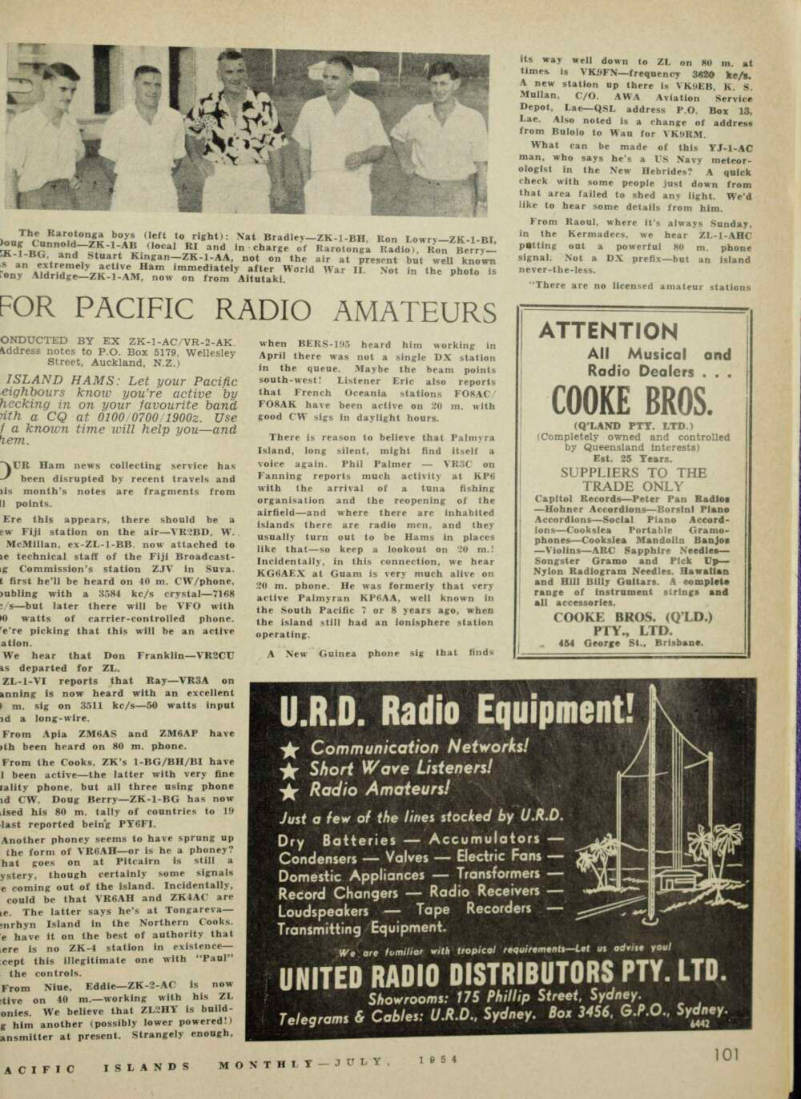
The Rarotonga boys (left to right): Nat Bradley—ZK-1-BH, Ron Lowry—ZK-1-B [?]ug Cunnold-ZK-1-AB (local RI and in charge of Rarotonga Radio) Ron Berry- K- 1-BG, and S tuart Kingan-ZK-1-AA, not on the air at present but well known an extreme ly a ctive Ham immedi at ely after World War II. Not in the photo is ny Aldridge—ZK-1-AM, now on from Aitutaki.
ia Tonga, ’ reports Radio Superintendent Simmons in a recent letter. Pity! So if one shows up without warning you’ll know him for what he is.
This month we present a photo of the Rarotongan gang. We cordially invite photos of other groups of Hams— especially from the French territories and New Guinea. W T e believe they’re of general interest. Notes from all quarters are also solicited.