Britain Ignores
pp. 95-99 · Read in the full issue

Fiji’S
Vital Problems
The following was written for the “Pacific Islands Monthly” by a special correspondent in Lon don. It does not necessarily ex press the opinion of the PIM ; but it does show how deeply some people, who are concerned for the welfare of Fiji and the Fijians, resent the attitude of the British Colonial Office towards Fiji’s population problems.
London, June 11.
THE PIM, expressing doqbt about whether the Colonial Office ever will do anything to accede to the Fiji Government’s request for a formal inquiry into Fiji’s population problem, is absolutely right. From what I have seen and learned here that problem—and others, too, in the Pacific —is in fluenced almost entirely by India; and anything that might offend India is not. even considered.
That is the cornerstone of Britain’s Colonial policy and, I fear, of her Foreign policy, too. She is creating thereby a dangerous situation —more dangerous than need be —but nothing seems to shift her from it.
As we see it here, the best way
of dealing with the menace of Asia is to bring strong outside pressure, if possible from Australia and New Zealand, whose safety and security can be seriously endangered if Asiatic Communism spreads further south.
India’s idea is to tighten her grip on Fiji to such an extent that she presently will be able to turn around and order the Europeans out of the Colony—and the same with other colonial territories around the Indian Ocean.
New Zealand, especially, is very deeply affected by this situation.
She should take over Fiji as soon as possible—inconvenient though it may be —in the interests of her own security. In fact, the only reply to Indian penetration is the with drawal of the Colonial Office in favour of New Zealand and Aus tralia—-and woe betide them both if they do not realise this in time.
Indians from Fiji are clamouring to be allowed to settle in NZ, but are kept out now by NZ’s immigra tion laws —an affront to India which NZ does not mind risking.
For this reason, I hope Britain never gets into the ANZUS Pact.
An historical survey of the South Pacific would reveal the bad record of the British Colonial Office. It would show, too, how this Office is carrying on the old traditions.
Appeasement of Germany was all the rage once. Now it is Asia, par ticularly India.
fl The engagement was announced in Sydney on June 6 of Miss Barbara Payne and Mr. Bruce Blackwell, of New Guinea. Miss Payne is the principal of the Barbara Payne Academy, a finish ing and grooming school for girls.
The couple will live in NG after their marriage.
had penetrated sufficiently into the cotyledons, otherwise super-acid ification produced an acrid bitter flavour in the finished product.
With the equipment available in those days the theory was not put to much practical use.
Equipment
The equipment used in the fer mentaries of the Reparation Estates is as follows:
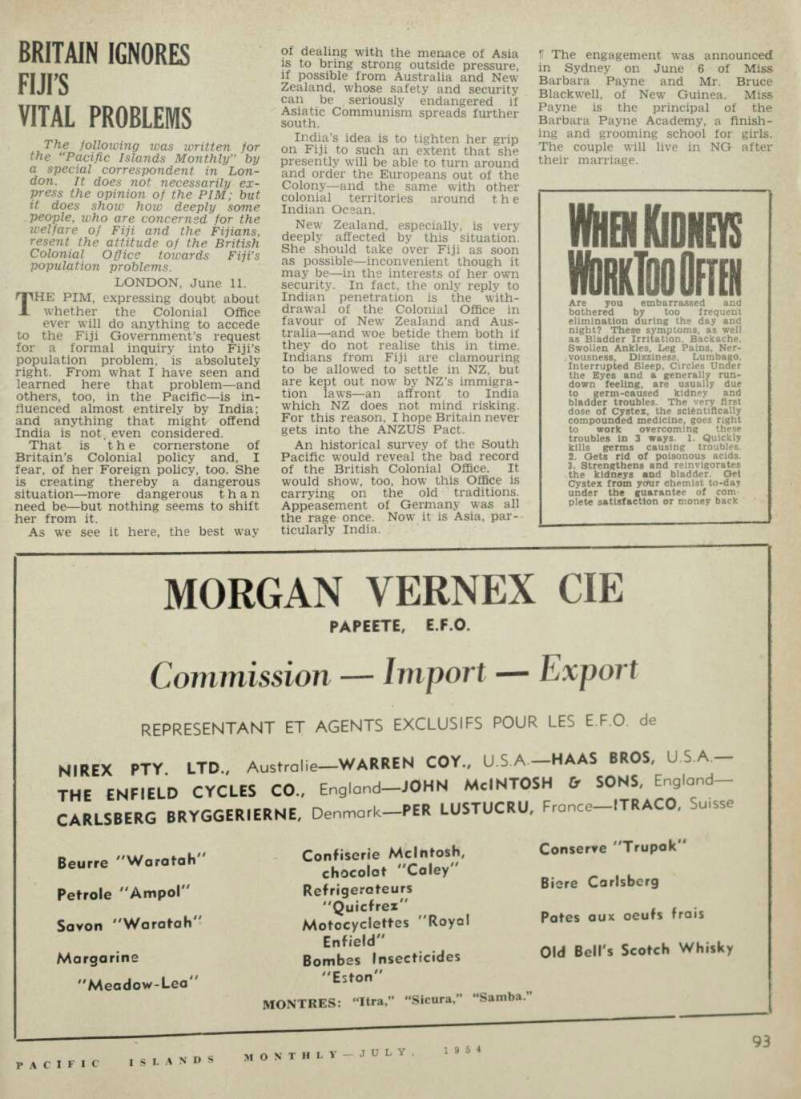
• Twenty wooden boxes line each side of the fermentaries. They are 5 ft by 4 ft and 3 ft high. They are constructed of movable planks fitted into slots. Each holds 3,000 lbs of wet cocoa when full. To pre vent overheating in the fermentaries. the roof is constructed of bright aluminium to reflect the sun’s rays and the walls above the boxes are built of slats with 2-inch spacing to allow air to escape. (Over>
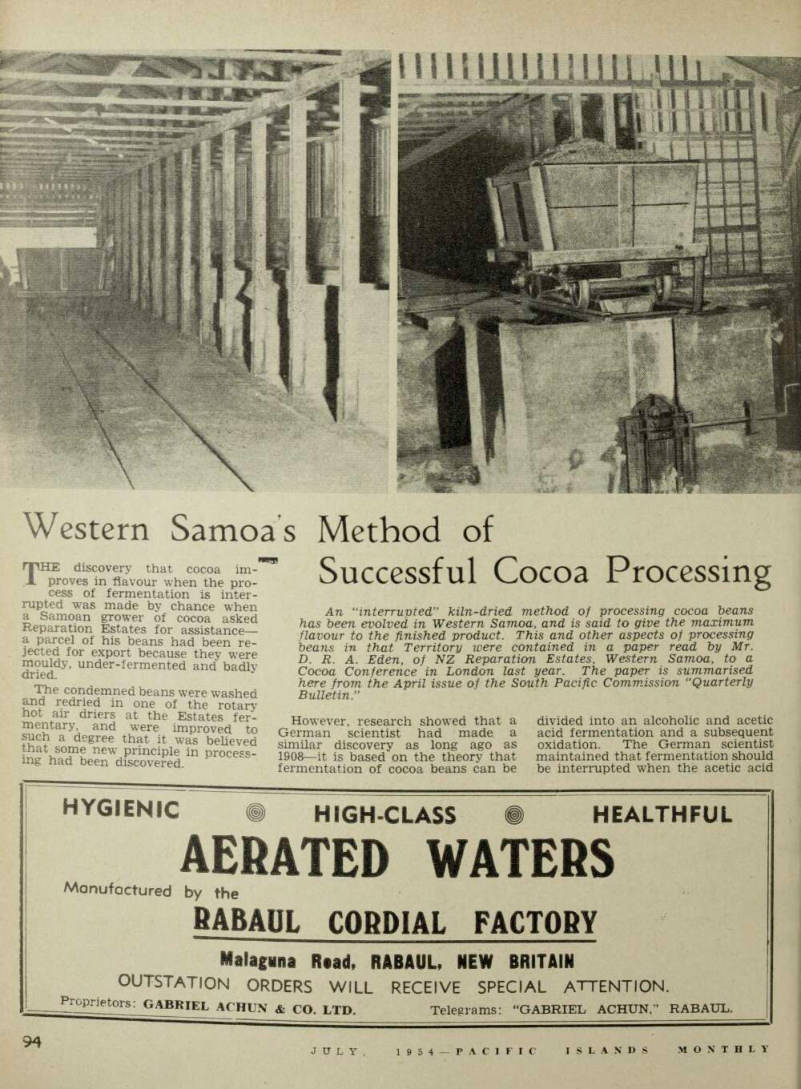
Photographs show, from left to right: Some of the 20 wooden boxes which line both sides of the Reparation Estates’ fermentaries.
Beans are taken from the fermenting boxes after 5[?] days and passed through the washing tank.
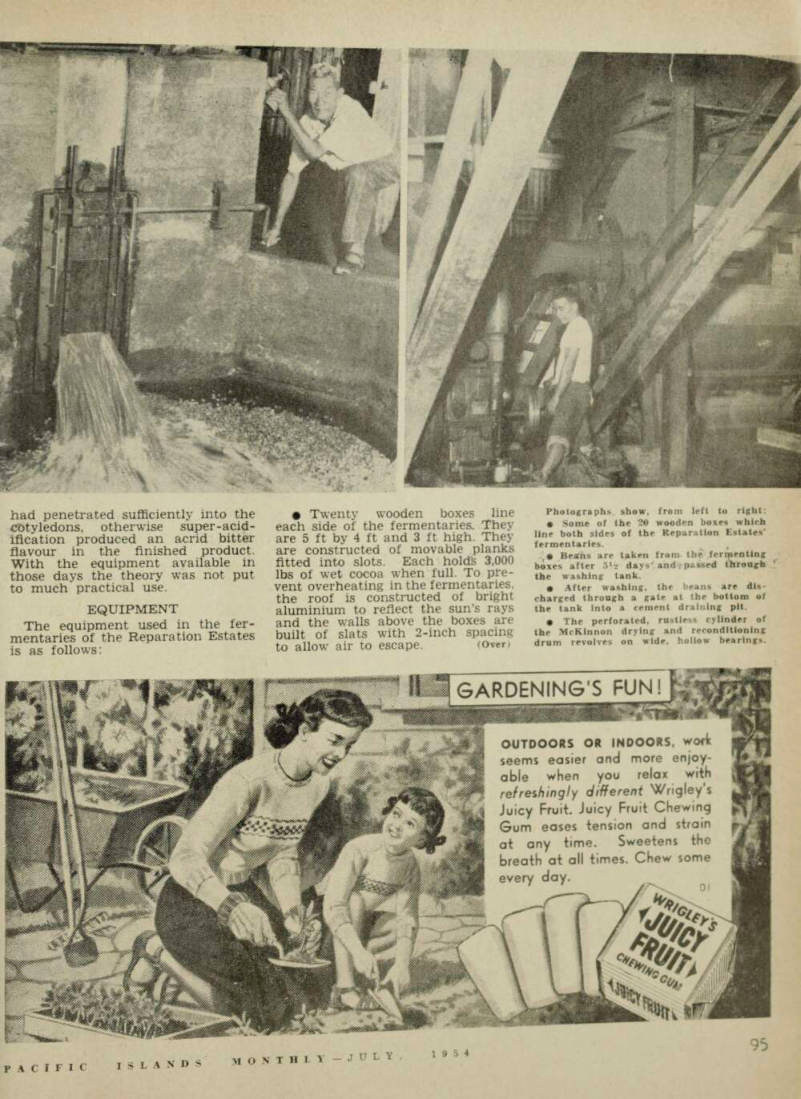
After washing, the beans are dis charged through a gate at the bottom of the tank into a cement draining pit.
The perforated, rustless cylinder of the McKinnon drying and reconditioning drum revolves on wide, hollow bearings.
• Washing drum and draining pit. • A platform hot-air dryer con sisting of a wooden grating, which holds 12,000 pounds of wet beans.
It is heated by benzine flue pipes leading from a brick furnace lying eight feet below the drying surface.
This dryer has an aluminium roof which can be wound back so that the sun’s rays also assist in this
preliminary drying.
• A McKinnon drying and re conditioning drum which revolves mechanically and which completes the processing of the beans.
Method Of Processing
The sequence of processing in Estates fermentaries is as follows; • The beans are placed in the boxes and fermented for 51 days.
Under Samoan conditions it is found that this produces, in the finished product, a bean that is light cinnamon in colour, of good aroma and even break.
After the first 12 hours the cocoa is turned daily—by shovelling each boxful into an adjoining box. Pod cores of placentas, and black in ferior beans are picked out. As soon as a new box is filled, it is covered with banana leaves and sacking. • After days the beans then pass through the washing drum where three changes of water re move the contracted pulp.
• Beans are then discharged into a draining pit. • When drained, they are re moved to the drying platform of the hot-air dryer and here remain for approximately 12 hours before drying is interrupted at a point where all surface moisture has been removed, but where a certain amount of dampness (not free moisture), is present in the cotyle dons. Accuracy in judging this stage comes by experience.
The partly dried beans are then cooled to avoid sweating and are stored until a full load for the McKinnon rotary drier is ready. • The McKinnon rotary drier is never used in the Estates fer mentaries as a complete drier. It was designed as a coffee drier, and the small holes in the surface of the stainless metal drum become easily clogged with the sticky residue
of the freshly washed beans if no pre-drying has been done. • Before the beans are loaded into the McKinnon, they are lightly hosed until they are evenly moist ened. The commencing tempera ture in the drier should be about 200 degrees Fahr., and should be held at this for the first 6 hours.
After this, it should be evenly de creased until the contents of the drum are at room temperature. The fire should be extinct by this stage but the drum should be kept re volving until the cocoa has lost all heat. Ten hours in the McKinnon drum should complete the drying process if the pre-drying on the platform kiln occupied 12 hours and the beans were not soaked too thoroughly during the dampening process. Slow drying in the McKinnon is believed to be the secret of success.