Youwiga
pp. 80-81 · Read in the full issue
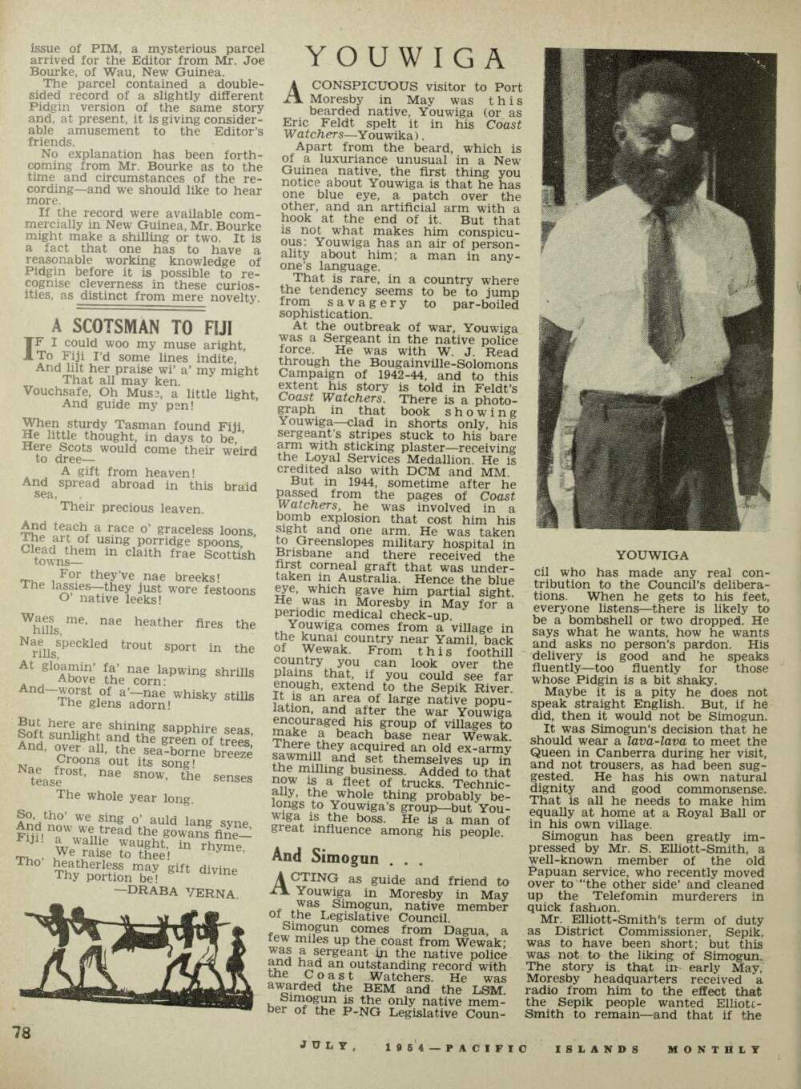
A CONSPICUOUS visitor to Port Moresby in May was this bearded native, Youwiga (or as Eric Feldt spelt it in his Coast Watchers —Youwika).
Apart from the beard, which is of a luxuriance unusual in a New Guinea native, the first thing you notice about Youwiga is that he has one blue eye, a patch over the other, and an artificial arm with a hook at the end of it. But that is not what makes him conspicu ous: Youwiga has an air of person ality about him; a man in any one’s language.
That is rare, in a country where the tendency seems to be to jump from savagery to par-boiled sophistication.
At the outbreak of war, Youwiga was a Sergeant in the native police force. He was with W. J. Read through the Bougainville-Solomons Campaign of 1942-44. and to this extent his story is told in Feldt’s Coast Watchers. There is a photo graph in that book showing Youwiga—clad in shorts only, his sergeant’s stripes stuck to his bare arm with sticking plaster—receiving the Loyal Services Medallion. He is credited also with DCM and MM.
But in 1944. sometime after he Passed from the pages of Coast Watchers, he was involved in a bomb explosion that cost him his sight and one arm. He was taken to Greenslopes military hospital in Brisbane and there received the first corneal graft that was under taken in Australia. Hence the blue eye, which gave him partial sight.
He was in Moresby in May for a periodic medical check-up. Y 9 uwi g a comes from a village in * „V nai coun try near Yamil, back of Wewak. From this foothill country you can look over the plains that, if you could see far enough, extend to the Sepik River.
It is an area of large native popu lation, and after the war Youwiga encouraged his group of villages to Su 0 £ beach base near Wewak. i here they acquired an old ex-army sawmill and set themselves up in the milling business. Added to that n £ w it a fleet of trucks. Technic ally, the whole thing probably be longs to Youwiga’s group—but You wiga is the boss. He is a man of great influence among his people.
And Simogun . . .
ACTING as guide and friend to Youwiga in Moresby in May was Simogun, native member of the Legislative Council.
Simogun comes from Dagua, a few miles up the coast from Wewak; Wa f t ® er £ ean t in the native police ana had an outstanding record with t* lo Coast Watchers. He was awarded the BEM and the LSM. . Jp m -°su n is the only native mem ber of the P-NG Legislative Coun-
cil who has made any real con tribution to the Council’s delibera tions. When he gets to his feet, everyone listens—there is likely to be a bombshell or two dropped. He says what he wants, how he wants and asks no person’s pardon. His delivery is good and he speaks fluently—too fluently for those whose Pidgin is a bit shaky.
Maybe it is a pity he does not speak straight English. But, if he did, then it would not be Simogun.
It was Simogun’s decision that he should wear a lava-lava to meet the Queen in Canberra during her visit, and not trousers, as had been sug gested. He has his own natural dignity and good commonsense.
That is all he needs to make him equally at home at a Royal Ball or in his own village.
Simogun has been greatly im pressed by Mr. S. Elliott-Smith, a well-known member of the old Papuan service, who recently moved over to “the other side’ and cleaned up the Telefomin murderers in quick fashion.
Mr. Elliott-Smith’s term of duty as District Commissioner, Sepik, was to have been short; but this was not to the liking of Simogun.
The story is that in early May, Moresby headquarters received a radio from him to the effect that the Sepik people wanted Elliot c- Smith to remain—and that if the
Youwiga
(From previous page)
Administration had not the money to pay his salary, Simogun and his group were willing to do so.
At the Legislative Council meet ing in mid-May. Simogun renewed his plea that Elliott-Smith should remain for two or three years All the luluais, tultuls, and chiefs of his district desired it, he said.
The plea must have been beard.
Shortly afterwards, Elliott-Smith was posted to Wewak— although he and his family had been packed up and ready to go elsewhere.
The fact that there are men of the calibre of Youwiga and Simo gun in New Guinea is in spite of, rather than because of the vari ous theorists and advisers who have be°n abroad in the country in re cent years. It is useless spending vain regrets on the days when a native was a native, and Judged only as he behaved in a labour line; for good or ill th0 t se n^ a f y o s if® gone. And as things to-day in New Guinea, it is a great pity that there are not 10,000 more Simoguns and Youwigas Insiteadlrf the countless big-headed, take all
and-glve-nothing who
have emerged in the P-Nt» versio.i of the Welfare State. —J-i-