Vicious Circle
pp. 67-73 · Read in the full issue

The Land of the Vicious Circle
A Cook
Islands Tour
With Jps
rE tourist visiting the Cook Islands finds them full of interest and attraction.
It would be hard to find a lovelier place than the main island of Rarotonga. As well as representing a blessed escape from the Maui Pomare, there can be no more pleasing prospect than the ap proach to this rugged, green gem on a clear, fine morning.
First, the jagged outline through the blue haze; then the individual valleys and peaks sorting them selves out: the dense coconut groves of the coastal plain with the white line of surf breaking on the encircling reef; and, finally, the twin settlements of Avatiu and Avarua behind their separate reef passages.
There is the exciting disembark ing by winch-hoisted basket to a lighter at the ship’s side, and ashore, the prospect—at first sight, anyway—is scarcely less pleasing.
For the visitor, the Rarotonga Hotel is as pleasant a stopping place as any in Polynesia—and the drive round the island’s lovely, shady, 21mile roadway can be repeated again
and again, and never palls.
Along the byways, in towards the mountains, the orange groves are green and pleasing, the rough surfaced little lanes edged with red hibiscus; and a climb by foot up one of the inland valleys, past the taro swamps and along the banks of some mountain stream, through the semi-tropical forest, is sheer delight.
BUT that is about the extent of the pleasant prospects in the Cook Islands to-day.
Dominating everywhere is an over-riding air of depression, dis content and dead-endedness which
pervades every aspect of native life.
There is no village leadership: no village pride; practically no village life or even real family life; no discipline; little respect for any thing; and only one visible ambition —to get to New Zealand.
That is not to say that nothing is being done to improve this situa tion. The Further Education Scheme is one effort in the right direction: and Mr. Ron Thorby’s experimental farm on Mauke could be another. But, at the moment, the foregoing is roughly the situation in the Cooks.
This malaise is reflected in the citrus replanting scheme apart from a box-wood timber scheme, the only enterprise of any import ance in the Cooks Lower Group.
The citrus scheme is a 90 per cent..
Government industry. The peoples’ part is merely to have grudgingly permitted the Government to use the land. It is surveyed by the
Government, ownership is decided by the Land Court, and the owners are required to nominate a “mana ger” who deals with the Depart ment of Agriculture.
The Department’s paid labour gangs move in and clear the land of bush and scrub, plant the trees, spray and cultivate them, and bring them up to bearing—in four to five years.
During this period the owners, almost to a man, sit on the side lines and show no interest. Most are then prepared to pick the fruit * after the cases have been delivered to the orchards) but they are not compelled to pick. The Department will arrange that, and, of course, the transport to the packing sheds.
This is fruit growing de luxe: heads we win. tails you lose!
Once the orchards start produc ing. the Department deducts the charges which have accrued at the rate of 75 per, cent, of the takings, the other 25 per cent, going to the land owners. Eventually (in theory after about 10 years) the orchards become free of debt and pass en tirely into the hands of the land owners. But even the owners admit ln actual Practice, the day that most plots are turned over to the owners, they will immediately start reverting to jungle. * f .. , the ul De P artmen t values its considerable investment, and all the Government effort that has
been put into the scheme, it will never allow the plots to become entirely free of debt. Most of the owners will not want them to be handed back entirely to their care anyway.
The citrus scheme aims at a target production of 75,000 cases
per month for the four months of April to July. Half of this should be reached by 1964, from plantings now completed.
Rarotonga now has 212 li-acre 90-tree plots. Aitutaki has 209 1acre 45-tree plots, Atiu 156 and Mauke 112 of the same size. The
plantings will, it is hoped, expand at the rate of 50 plots per annum until 825 acres in all have been planted up on the four islands.
Probably New Zealand could buy cheaper and better oranges else where —these cost about £3 per 70lb case by the time they reach the oublic —but the scheme is designed to give the Cook Islanders an in centive to become private pro ducers; and as a means of improv ing their standard of living.
It is true, of course, that a few islanders have responded favour ably. have provided the labour themselves, and have already freed their plots of all debt, but for all practical purposes there is no in terest whatever in the citrus scheme—except on pay day, when a good percentage of the pay-out goes into the making of a bush beer binge.
IN Rarotonga, especially, there is a large influx of people from the northern atoll islands who are, of course, landless in Rarotonga- They depend largely for their liveli hood on the precious tomato crop for which no shipping is guaran teed.
Landowners permit them to grow tomatoes, on a profit-sharing basis, but these people often lose, after having put a lot of hard work into the crop, if it happens to ripen between ships.
The Administration has not been prepared to arrange a guaranteed shipment.
In addition to these northern “aliens”, a few of the keener Raro tongans the same men who manage their own orchards also take a gamble on tomatoes. But tomatoes are not a Government scheme. The Administration has decided that the citrus investment is enough to gamble on for the present.
For it it a gamble: It costs from £250 to £3OO to bring a 90-tree plot to the bearing stage, and a great deal of money has been laid out in field and packing : shed equip ment. Rarotonga has just installed a £1,200 grading machine in each of its seven packing sheds. Other equipment is coming. Any year a hurricane could cause great des truction to the orchards.
WJHAT then is wrong with the W Cook Islanders?
The islands are a dead loss to New Zealand. This year New Zea land taxpayers will pour out funds }o the extent of £25 for every one of the 16,000 persons in the; Cook OrouD plus a further £50.000 or more to offset the loss sustained by the operations of the Maui Pomare.
New Zealand is not making a nennv or gaining in any way what ever by administering these islands.
The people are living on charity and making no effort to help them selves.
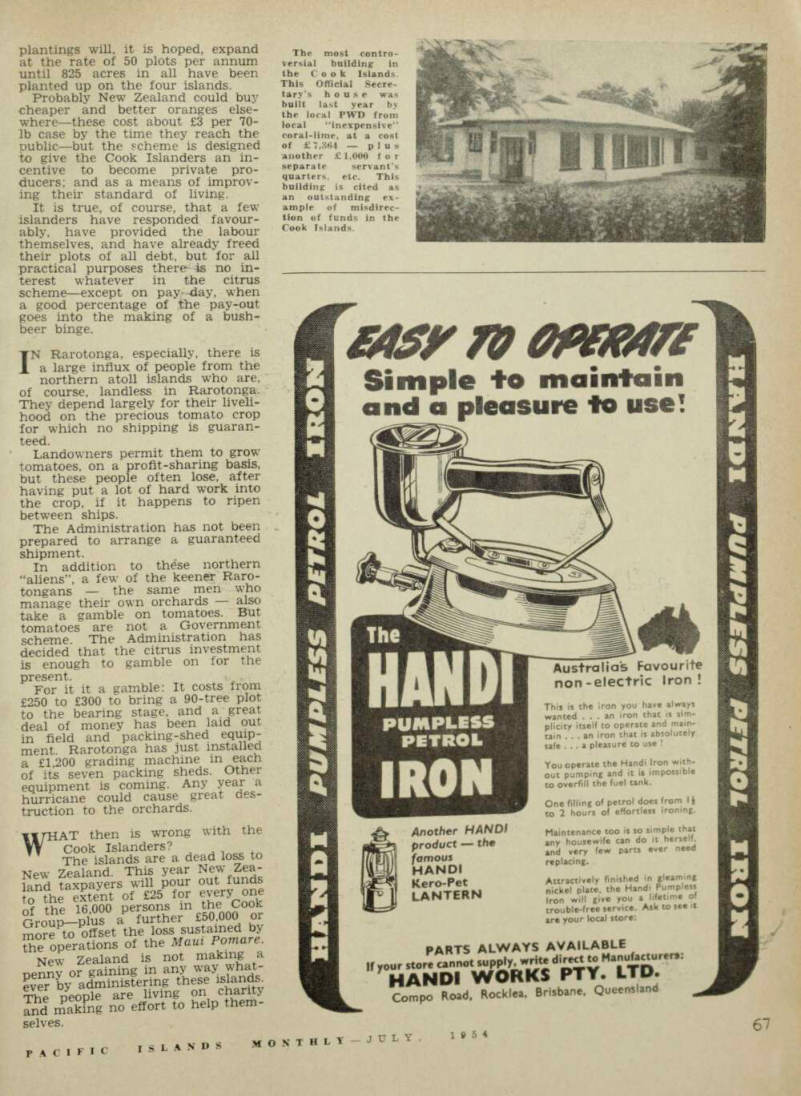
The most contro versial building in the Cook Islands.
This Official Secre tary's house was built last year by the local PWD from local “inexpensive” coral-lime, at a cost of £ 7,364 - plus another £ 1,000 for separate servant’s quarters, etc. This building is cited as an outstanding ex ample of misdirec tion of funds in the Cook Islands.
How they came to that state and whether or mot it was in any way the fault of New Zealand is another question entirely.
The Cook Islanders of to-day point to the houses of the Adminis tration officials and calculate what they cost. But, after all, who paid for these houses? The NZ taxpayer.
The roads are dusty. But are the villages forming working bees to help improve them?
The water supply is bad! So it is—but, after all, why should the New Zealand taxpayer be interested in a modern water supply for Raro tonga when there are plenty of places in New Zealand, in produc tive areas, where the water supply is just as bad?
Can the New Zealand taxpayer be expected to continue to pour out charity to a people who are not even able to reorganise their system of land ownership so that they can rebuild broken-down, unhealthy wrecks of semi - European - type houses; or re-roof the old stone buildings that are scattered through every village?
So many people claim ownership of one piece of land or a house that it is impossible for them all to get together to agree to rebuild. So the houses drift from bad to worse.
Altutaki is possibly the most dis graceful example of this housing deadlock, although the American troops during the late war, provided such a rich harvest the owners
could well have afforded to re build. rE system of communal owner ship is the major stumbling block between the old and new ways of life. There is absolutely no incentive for a Cook Islander (or for that matter for any Pacific Islander) to venture into some in dustry. Even where he can obtain clear title to a piece of land, his relatives will milk him of the pro ceeds of his enterprise. Why work for a bunch of lazy brothers and cousins? So why work at all?
In fact, there is only one way out; Escape from the whole mess to New Zealand where a man can earn as much in a month as he could ever hope to earn in a year, in the Cooks: and where he can do what he likes with what he earns. Even after grub-staking the lazy brothers back home, there is still plenty over.
Viewed from a practical business point of view it would pay New Zealand to leave the Group and to take all the Islanders who wished it, along as well. About 80 per cent, of the people would jump at the chance of resettlement in New Zealand. Those who wished to re main in the Cooks could look after themselves.
Otherwise, if New Zealand hopes to retain trained or even un trained administrative staff in the Group, it will be necessary to pay New Zealand rates of pay or, alternatively, to completely ban all emigration from the islands.
At the moment, the Administra tion offices, schools and workshops are training grounds for emigrants and this situation is rapidly becom ing a major problem.
Scholarship students are refusing to return to Cook Islands conditions and rates of pay once they have
completed their courses in New Zealand.
Some believe that payment of New Zealand rates of salary would not halt the drift, and might even speed it up, as improved education is doing.
The emigration problem is dis couraging to the European adminis trative staff and to private enter prise. Most European administra tive staff have the interests of the Cook Islanders at heart. They do not blame the Cook Islanders for trying to escape from it. But they continually see their efforts in training a staff member thrown away after a few months or years, and have to start from scratch again with a new trainee—with the sure knowledge that the same thing will happen again.
The Administration has said that there are no positions filled by Europeans in the Cook Islands to day that can be filled by Islanders.
That is true, but the Islanders sel dom remain in those positions with their low native-scale salaries.
The present Government salary scale is unjust in that an Islander with qualifications equal to a Euro pean can never receive anything like the same salary, housing con ditions, etc. Thus, he leaves and
ew Zealand—whereupon
another European has to be im ported and housed, and an im- Works Department nas to be established to provide the
houses and the other facilities that the European demands before he will agree to come to the job. rIS is the broad problem that New Zealand faces in the Cook Islands to-day. Whatever decisions are made, short of quit ting the Islands entirely, costs are
going to increase year by year.
If the present trend continues, the Group will eventually be popu lated by a large staff of well housed Europeans and a mere handful of Islanders. There will be 800 acres of citrus orchards, main tained by labour demanding New Zealand rates, plus tropical allow
ances, and producing oranges at several times the cost that they could be obtained from elsewhere.
The Islanders will all, or nearly
all, have escaped from the land that Europeans frequently try escaping to!
Some of them, due to the hope lessness of the environment of their upbringing, will never adjust them selves in New Zealand. They will waste every penny they earn. But the majority, once away from that Limbo that the Cook Islands have become to-day, will find new hope, new incentive. They frequently obtain good positions, save their earnings and send their children to good schools where they, in turn, are treated as 100 per cent. New Zealanders, with the same oppor tunities when they leave school.
The Cook Islands Lower Group is fertile and could provide all manner of tropical produce, but so
long as the present situation exists, the islands will continue to lie idle, non-productive, and a temptation to the hungry hordes to the north west. fl The Mayor of Suva, Mr. D. M. N.
McFarlane, opened a new wing to the Suva Merchants’ Club in May.
The new extension was formerly the Masonic Lodge Building.
Dr. Norma McArthur left Can berra at the end of June to study population trends in Australian and Dutch New Guinea and the Solo mon Islands. It will be the second part of the survey she began last year. She will be away about four months, mainly studying records at Administration centres and missions.
Recent travellers between the Cook Islands and New Zealand included (top to bottom): Dr. and Mrs. J. H. Saunders, of Auckland. Dr. Saunders and Mrs. Choate, of the Crippled Children’s Society, made a June survey of crippled chil dren in the Cooks Lower Group to choose those to be taken south for treatment.
Miss Poko Utanga, of Rarotonga, now studying at Ardmore Teachers' Training College, Auckland, and Miss Taiti Cuthers, of the same island, now training as a nurse at Auckland Public Hospital.
Mr. P. T. Karika was farewelling Mr.
U. Utanga, Rarotonga school teacher who returned after six months' leave in NZ.
Miss Rita Fortes and Miss Doris Daia, both of the Cook Island and now resi dent in New Zealand, farewelled friends leaving on June "Maui Pomare". With them is Mr. Norman Truscott, of Auck land.