East of 170 deg.
pp. 45-47 · Read in the full issue

Why There is No Malaria East of 170 deg.
Two Years’ Work Completed By NZ Couple
TWO years’ research into the reasons why malaria-bearing mosquitoes do not appear south of 20 deg. S. and east of 170 deg.
E. in the Oceanic Pacific were com pleted in April.
The project was initiated by the RNZAF and supported by a grant from the NZ Department of Scientific and Industrial Research.
It was carried out by a NZ couple,
Dr. Marshall Laird, MSc, PhD, and his wife, who acted as technical assistant, photographer and secre tary.
Dr. Laird concentrated his studies around the southern and eastern perimeters of the malaria zone.
From headquarters in Suva a laboratory in the Colonial War Memorial Hospital made available by the Fiji Government —he made frequent visits to other islands in RNZAF planes.
In 1952 the couple spent a month in New Caledonia and visited Belep Island, north-west of New Cale donia. Although Belep is situated north of 20 deg. S., within the malaria zone, it has no anopheles mosquitoes—a distinction shared by several groups of islands within the malaria zone. .
In February, 1953, Dr. Laird vorked at Futuna, the nearest malaria-free island to the perimeter >f the zone. It is the only island ;ast of 170 deg. E in the New lebrides, which makes its immunity he more remarkable.
Later in 1953 the couple went to iellona (Solomon Is.) and Tutuba New Hebrides), and to the Poly lesian outliers Rennell and Sikiana
Is. Both of these were considered free of anopheles till the 1930’5; malaria is now prevalent on both islands.
The Lairds also visited the Loyalty Island, G & EIC, Tonga, Cook Island, Norfolk Island, W.
Samoa and Tokelau Island. A month was spent at Aneityum, New Hebrides, the most southerly—it is south of 20 deg. S.—Pacific island with malaria. Last year they tramped 8 hours daily on an 8-day trek into the interior at Guada canal.
Dr. Laird believes that his wife was the first white woman seen in those parts. Most of the route lay above 2,000 feet. The journey was part of their high-country research, which they also conducted in Fiji,
into the altitudinal range of mos quitoes, about which very little is known.
Discussing the project before he left Suva for Singapore in May, Dr.
Laird said: “A part of its signific ance is to evaluate chances of the introduction of anopheles into the Pacific’s malarie-free area. It is the largest malaria-free tropical area in the world, so the spread of the anopheles would be a major disaster.
“Our visits to the malaria-free zone have been made primarily to study breeding conditions and assess suitability of available breeding places for the anopheles. We travelled on aircraft with a small portable laboratory that included a micro scope with built-in, battery-operated lighting, enabling observations to
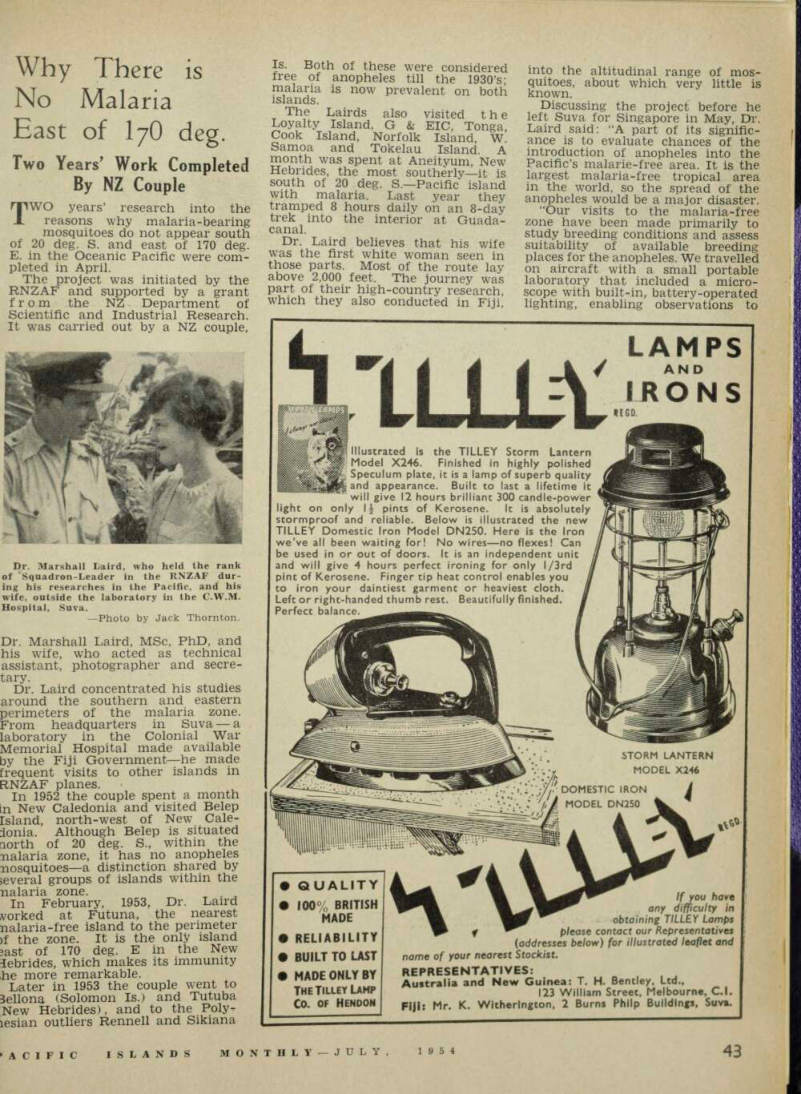
Dr. Marshall Laird, who held the rank of Squadron-Leader in the RNZAF dur ing his researches in the Pacific, and his wife, outside the laboratory in the C.W.M.
Hospital, Suva. —Photo by Jack Thornton.
be made under difficult field condi tions. We have a card-indexed microfilm library of about a thousand scientific reference works packed in two suitcases.”
In pursuit of the bug, the couple contracted malaria in the Solomons.
Early this year Dr. Laird was awarded a doctorate of science in recognition of parasitological and entomological research over a period of years. More than forty papers, resulting from his researches in the Pacific, have been published by various scientific bodies. On com pletion of his most recent work in the islands he accepted a research and lecturing appointment with the University of Malaya, situated in
Singapore.-