Now Judged for their Football
pp. 43-44 · Read in the full issue
1954 Rugby Union Tour: The Sentiment is Out—Fijians
T7M FTEEN uhns in 17 matches, a record aggregate points score lor J/ a visiting team, and 10 per cent, of the expected record gate takings of £15,000 in their pockets I
THAT is how the Fiji Union foot ballers finished their 1954 Aus tralian tour. They played their last match in Orange, NSW, on June 29, and left Sydney by plane on July 2, to play one match in Auckland the following day at the request of the NZ Rugby Union.
They left Auckland for home by TEAL on July 4.
Their two defeats in Australia were in the first test and in one of the two matches against NSW.
They won the second test 18 points to 16 in a ragged but sensa tional game on the Sydney Cricket Ground on June 26, the second-last match of their tour. They also won one of the test matches during their 1952 tour, but whereas they played a “gentlemanly” game in that earlier series, they gradually adopted the more forceful Australian tactics in the series just concluded, and it was in the second test that these tactics were most apparent. With Australia fighting to win both tests, and the Fijians determined to even the test score, there were fights and
brawls on the field, hooting of the Fijians by the crowd of 33,099, and argu ment over doubtful tries and a penalty after the full-time bell which gave the visitors their victory by a narrow margin.
Until that final bell the Fijians were trailing 15-16.
After the match everybody was wondering why three tests had not been included i n th e itinerary, and there was some agitation for the third to be played. But the itinerary had been agreed upon before the tour began and there was no extra match. . .
The hooting in the second test was not vindictive. That is the Australian fashion. It is a fair summary to say that the Fijians are accepted now, in Australia, for their football —and not as novelty visitors from some other world.
This is probably a good thing, all round.
Throughout the tour, the visitors were fully as popular as they were in i9o/ and they drew even bigger crowds
through the gates. The gate takings proved their popularity, because the English Rugby League players were in Australia at the same time, and League has a bigger following j n the two main Rugby States, NSW and Queensland.
The English and Fijian teams did not play on the same day in the same city, each itinerary being made to avoid a clash of matches, but when the Englishmen arrived the newspaper publicity had to be shared. In the earlier tour it was all the Fijians.
Although the financial result of the tour will not be known for some weeks, officials expected before the last game at Orange that the takings would be about £30,000 for all 17 matches. Half of this covered the expenses.
The Fijians atoned for both their
defeats, beating NSW by 24 to 19 in the return match on June 19.
They had no difficulty in beating Victoria and South Australia, the lesser States in the Rugby world, and they had runaway wins against NSW country teams. They beat Queensland 53 to 16, and Brisbane 34 to 9 in a night match—their first, played under floodlights.
At the end of the second test, S.
Vatabua was the highest individual scorer with 100 points. A. Nawalu was next with 84, then G. Cavalevu with 36.
VTC;rr nu iujnga vibii The NSW Rugby Union announced late in June that it would not finance a team to visit Tonga in the near future, as had been sug gested. The expense would be too great. Afterwards it was said that
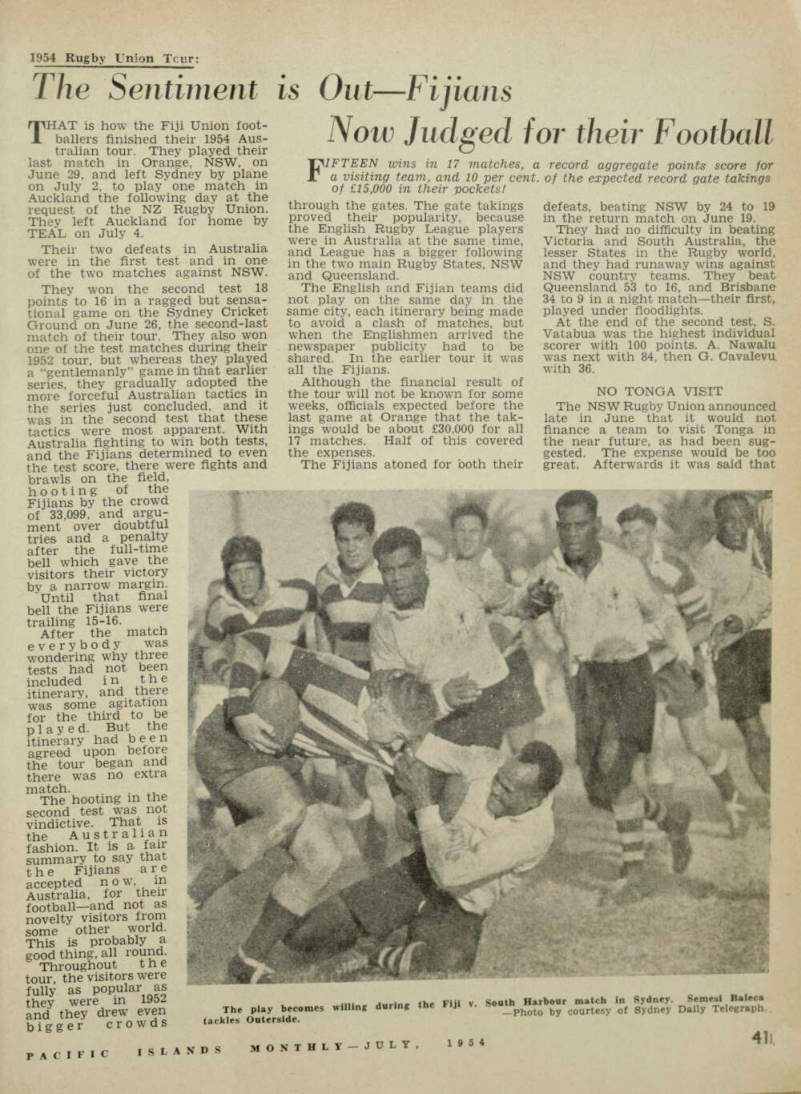
The play becomes willing during the Fiji v. South Harbour match in Sydney. Semesl Baleca tackles Outerside. -Photo by courtesy of Sydney Daily Telegraph.
an Australian team might tour Fiji next year.
Newcastle Rugby Union endorsed a proposal to extend its team’s tour of New Zealand by three matches in Fiji provided the additional ex pense was guaranteed. Mr. A. E.
Goodsir, manager of the touring Fijian team, was reported as saying that three matches in Fiji would nett at least £1,600, sufficient to cover the expense.