Territories Talk-Talk
pp. 26-30 · Read in the full issue
By Tolala
/COMMERCIAL firms are drawing on NG these days for names for various trade lines. A brand of ladies’ foundation garments re vels in that mutilated word “Lap Lap,” and I recently saw some Angora knitting wool labelled “Fuzzy-Wuzzy.” Actually neither word is of NG origin. “Lap Lap” comes from the Polynesian “Lava lava” and t’other was popularised : r Kipling in his poem “Fuzzy- T.'uzzy” about the bravery of the Cudaneser.
Not for a moment do I suggest that the lines advertised are as synthetic as their names.
The word “lap-lap” always re minds me of the resident of Rabaul who, some years ago, in explaining to her visitor from South who asked for the derivation of “lap-lap”, said: “It covers the lap, my dear.” * * * The Army Education Corps has sent an officer to P-NG to train the
PIR in English. This should please the UNO Trusteeship Committee, which has no love for Pidgin. Nearly 20 years ago Bandmaster Crawley started training his Rabaul Police Band, not only to read music, but also the rudiments of theory; and he proved to the sceptics that the technical details were not beyond his pupils.
It was only in the May issue I mentioned that Walter H. Lucas was still his dynamic self. On June 12 he passed to his long rest, and his remains were cremated in Syd ney’s Northern Suburbs Crema torium on June 15. Sydney news papers, apparently, had no space to even mention the passing of one whose influence was greatly felt in the immediate post-War I years in the Pacific. “W.H.” had many critics, especially after he was appointed Chairman of the Ex propriation Board in 1920—but he did his job conscientiously, as he saw it. As BP’s Islands manager he was averse to employing married men on Islands plantations. “They spend too much time in the house, and planting flowers,” he used to say. Returned Diggers from the First War, who were engaged as plantation men for the Exproboard, didn’t appreciate this policy; and when the RS League was formed in Rabaul in 1921, with Business Man ager Fred Jolley as chairman, and Frank Saunders as Secretary, a strong protest was registered against the Lucas ruling of no wives for Board employees. I was appointed publicity officer and managed to get some space in the southern papers, with the result that “Billy”
Hughes, then Prime Minister, had the ban lifted, and conjugal happi ness reigned supreme. I don’t sup pose many Diggers who attended that meeting are still up there.
One thing WH did accomplish, with good results, was to make all the plantation men coconut pest and disease conscious. There was never any skimping where pest gangs were concerned on Board plantations. * * * I see that the annual conference of the NSW ALP recommends the abolition of the indenture system among the P-NG native workers.
One might justifiably ask; What’s the difference between the present day indenture system and com pulsory unionism? The less P-NG has contact with modern unionism for the next decade or so, the better for all concerned. The enlighten ment of the P-NG natives will all come in time. And we must be careful, too, of our definition of “en lightenment.” * * * News of the discovery of “100,000 Lost Natives in NG” by Alan Roberts and John Arthur recently, when cruising around the Mueller and Karius ranges, has brought
some satirical remarks from Eng lish journalists. Said one London columnist: ‘‘lmagine a people so uninformed that they haven’t the faintest idea of how to kill each other by blast, fire, gas and atomic radiation!
Their plight in Papua must be terrible .”
It would seem that the wheel of civilisation has taken a full turn and at least some people realise that our present-day Western set up is not, after all, such a blessing as the starry-eyed theorists would have us believe. If we could pass on to these primitive people only the advantages of civilisation (of which health and hygiene are the outstanding parts) without the ad versities (atomic warfare, power politics and confusion of sectarian dogmas) we might be justified in our studied, self-righteous pro gramme of thrusting our Way of Life upon these dwellers in “un discovered” NG. At least they should have the option of living their own lives if they so desire it. * * * Australia has been having more brick-bats hurled at it by members of the UN Trusteeship Council, especially India and Syria, of all places. “P-NG’s educational pro gramme for natives is inadequate and what is to become of the Nauruans in 60 years’ time when the phosphate deposits are worked out?” Judging by press reports it would seem that Bert Jones, our special representative at these meet ings, is quite capable of holding his own against the critics, and his re plies to questions have been about the best I have read during the last thirty-odd years of these assaults on Australian administra tion. s’; * * Capt. Carl Haug’s enquiry for old shipmates of the Garnet . Hill (June Editors’ Mailbag) brings to my mind dapper Capt. Keller (who wore his cap at the Beatty angle and was a skipper of Government steamers during the Military Occupation in TNG in the early ’2o’s). I think he was in the Meklong or Star. He had an at tractive wife. Seaman Fehr would be K. Fehr, who owned a planta tion south of Kieta, in Bougain ville. I think it must have been Iwi. He, was “expropriated” and went back to Germany about 1923. * ♦ ♦ Apropos the war memorial to be erected in Rabaul (“Do You Re member?” PIM, June), it was de signed by the late R. L. Clark, who was then State President of the NG RSL, and a photo of the model appeared in a PIM issue. There was, however, a memorial erected on this same site —but by the Japanese, in 1943, to commemorate their “con quest” of NG, and it consisted of a well-shaped soft-wood log, about 15 ft high, covered with Japanese
lettering, and set in an elaborate concrete foundation. ± * * There was a lot of good meat in an April editorial in the SP Post anent World Health Organisation and Australia’s generosity towards under-privileged nations. The writer asked: “What has WHO ever done for NG which, logically, should be one of the first claimants for a hand-out from coffers filled by world subscription?”
One can safely ask; “What bene ficial action has T-NG ever received from the two world organisations under which it has been ruled for 30 years? I can call to mind only the very effective survey made by Dr. Lambert in 1921 against hook worm. And that was under a Rocke feller grant.
If Australia contemplates con tinuing in the role of airy god mother to P-NG indigenes on such an extravagant scale, then some of the monies now being spilled into the coffers of UNO for other under-privileged peoples should be diverted to the native races under our own care, and thus some relief afforded to the Australian taxpayer. * ❖ Jack Chipper, of Rabaul, a couple of months ago, summed up the pre sent situation in a faithful descrip tion of conditions at a meeting of the Rabaul Chamber of Commerce.
There are scores of residents who have aired the self-same opinions, but are not fortunate or fearless enough to have received the same publicity.
He deprecated the practice of “giving something for nothing” to the natives. And one heartily en dorses his argument. The NG native is not naturally a mendicant in any sense of the word. From the crack of dawn native tradition has been “something for something” —a fair exchange; payment in some form or other.
Their old native markets have in stilled this principle in their customs, whether it was a taro for a fish or a head for a head. Cer tainly, there are some mendicants — the “spivs,” who cadge and beg at every opportunity—but they are not characteristic of the native way of life, and it is up to the Europeans to see they do not develop and be come a menace. They require to be slapped down even as our own “spivs” are treated. And let not the fact that the UNO has its eyes on NG as a deterrent to slapping down. * * * The possibility of the rehabilita tion of the Botanic Gardens at Rabaul not being carried out (May PIM, p. 9) is sorry news. That area —pre-war —was one of the Terri tory’s main attractions, where flowers, fruits and trees from every tropical country bloomed in pro fusion. It was second only to the gardens at Buitenzorg, the social
capital of Java in the Dutch time, once described as the “most beautiful in the world."
But in these years beauty must be sacrificed to “progress” and now modern pre-fabricated houses will replace the stately avenues of palms, the open green spaces, and the exotic trees. The Diddimans of the past will turn in their graves when they realise what may happen to Rabaul’s Garden of which they were all so proud. * * * A Melbourne report recently re ferred to the fact that government control “over the purchase and dis tribution of woolpacks would cease from January 1, 1955, and over cornsacks from February 1, 1955 ”
This might be a help to the kenaf producers of NG. To assist in the change-over the trade would be allowed to start buying operations six months in advance. * * * I enjoyed the Canoes and Ships stamps-article by KN in April PIM, but was surprised he made no men tion of the steamer series of the old German Colonial government, which was issued for all German colonies, merely the name of the colony being changed. The “Deutsch Neu Guinea” series, overprinted “GRI,” after the Australian occupa tion, had a good value. So much so that a “smart Alec” started over printing the old German stamps himself and flooded the market. * * * The changes wrought by Time:
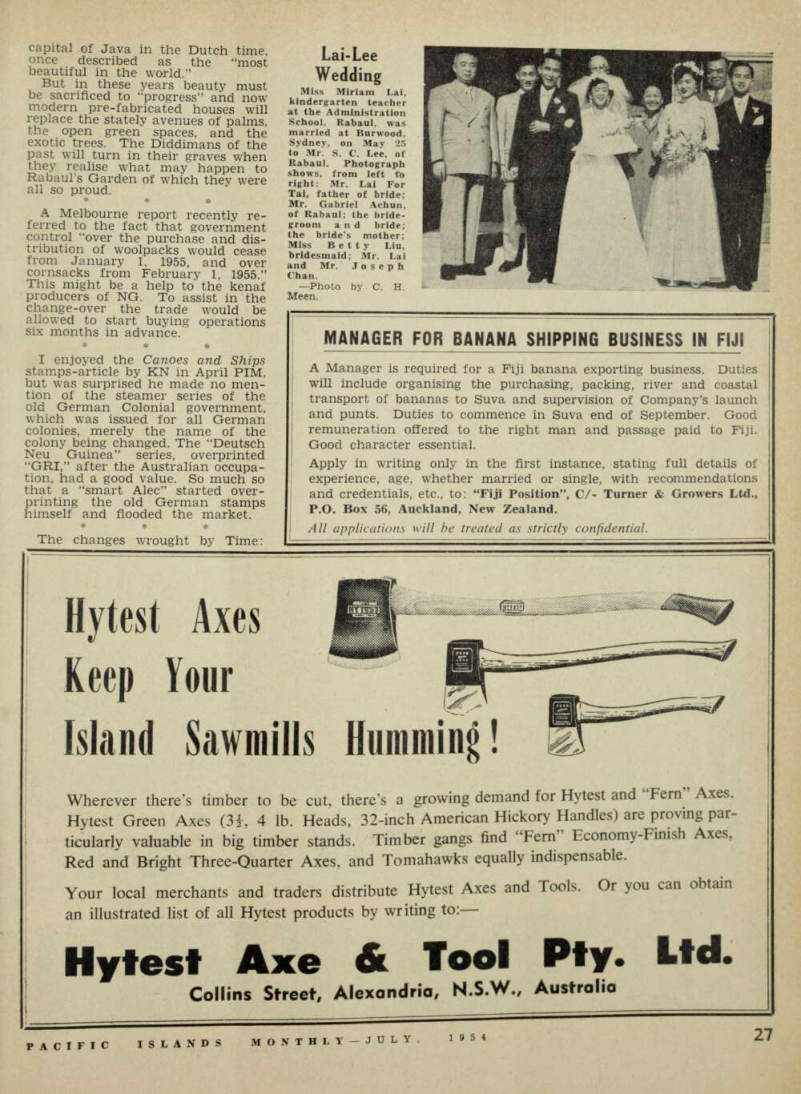
Lai-Lee
Wedding
Miss Miriam Lai, kindergarten teacher at the Administration School, Rabaul, was married at Burwood, Sydney, on May 25 to Mr. S. C. Lee, of Rabaul. Photograph shows, from left to right: Mr. Lai For Tai, father of bride; Mr. Gabriel Achun, of Rabaul; the bride groom and bride; the bride’s mother; Miss Betty Liu, bridesmaid; Mr. Lai and Mr. Joseph Chan. —Photo by C. H.
Meen.
Recently a Moresby message to Syd ev Press quoted Patrol Officer Keogh as having made a trip to he Chimbus at Chauve in the .-tern Highlands, and the natives took no interest in his patrol at all.
“Most of the population hid—none olunteered as guides—and all re fused to return with the patrol to the world.” That was in April, 1954. de Hagen-Sepik patrol touched Chauve in February, 1938. Said e leader, J. L. Taylor, in his port; On January 29, the journey n Bena Bena to Mount Hagen an. It was marked by a great •: siasm of the people along the ■ . ite and the hundreds of volun to join the party. I quote from 7 diary of February 3: ‘At Chauve t 2,000 people at the station, o ;s greeted me with cheers of ’come, outstretched hands and ailing faces. Every here and there i prominent man and sometimes a le child would kiss my hand, andreds asked to be allowed to go vvith us. Unfortunately, I could only ike a few from each. Food in abundance.’ ”
After 16 years it seems as though he Pax Britannica policy is work ing in inverse ratio. * * * About the same time there appeared in Sydney newspapers a story, released by that mythical in di dual, ‘‘a government spokes man,” which told of another Patrol
Officer—J. E. Wakeford—who had completed a 58-days patrol through the country of the Kukukukus (usually accepted as the “bad boys” of NG) who were described as a “kind and generous people with a wonderful sense of humour.” Wakeford said the tribesmen’s notorious reputation was now unwarranted.
Well< time wiu tell whether the Kukukukus have changed their spots, or whether it is a new tech nique injected during the School course at Mosman. * * It was encouraging to hear Cardinal Gilroy, on his return from a visit to P-NG, remark that “New Guinea is now wide awake, although
before the War it could be described as a country asleep.”
I don’t know that His Eminence’s remarks are quite fair in this re gard. New Guinea has been awake for some years. It is the Australian people who have been asleep and are now only realising the potential ities at their northern door — economically, socially and strategic — The engagement has been an nounced of Miss Patricia Wiseman Clarke, elder daughter of Mr. and Mrs. E. A. Clarke, of Brae Street, Inverell, NSW, to Mr. Alex Hopper, of Belik Plantation, New Ireland, Miss Clarke has been for some time at the Regional Library, Lae