English-Speaking People
pp. 15-16 · Read in the full issue
IN TAHITI: Another Aspect of the Asian Problem in the Pacific
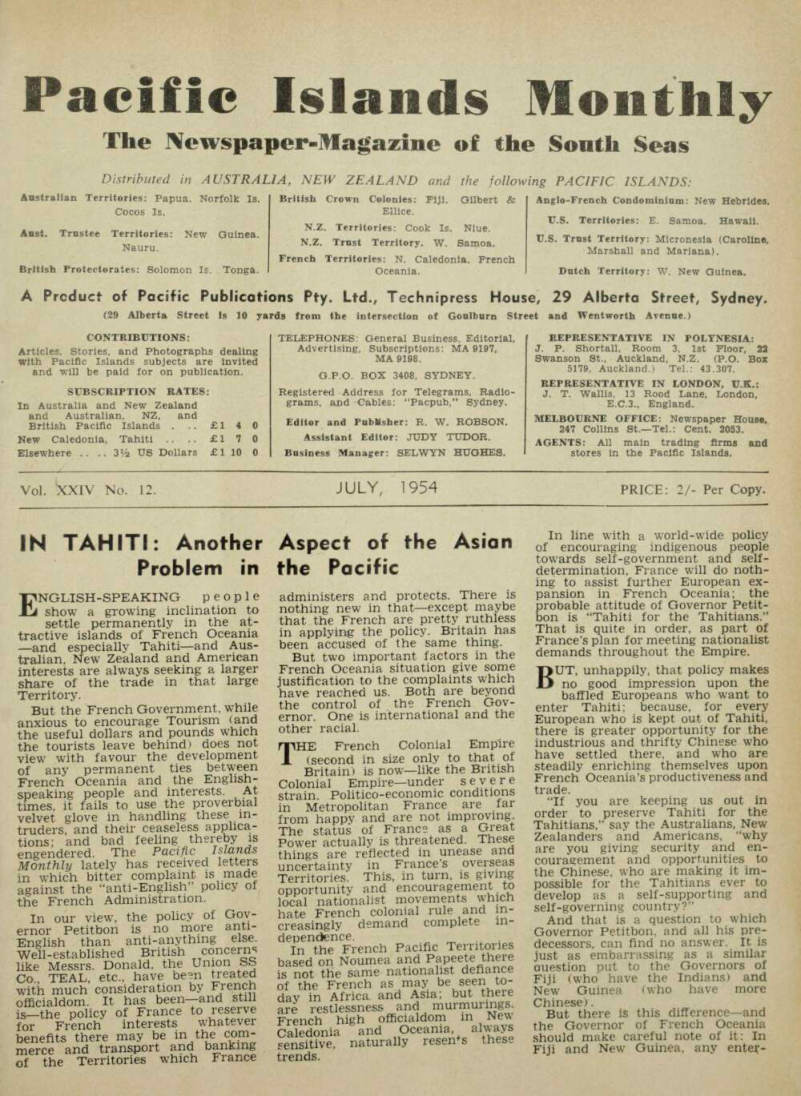
show a growing inclination to settle permanently in the attractfve islands of French Oceania especially Tahiti—and Australian. New Zealand and American interests are always seeking a larger share of the trade in that large Territory.
But the French Government, while anxious to encourage Tourism (and the useful dollars and pounds which the tourists leave behind) does not view with favour the development of any permanent ties between French Oceania and the Englishspeaking people and interests. At times, it fails to use the proverbial velvet glove in handling these intruders, and their ceaseless applies.tions - and bad feeling thereby is engendered. The Pacific Islands Monthlv lately has received letters S wlfich bitter complaint is made agatost the "anthEnglish” policy of the French Administration.
In our view, the policy of Governor Petitbon is no a^ 1- English than anti'- anything else.
Well-established British concerns like Messrs. Donald, the Union SS
fs-theTlicyot h FraSTo fese S r‘ve
merce and transport and banking of the Territories which France
administers and protects. There is nothing new in that —except maybe that the French are pretty ruthless in applying the policy. Britain has been accused of the same thing.
But two important factors in the French Oceania situation give some justification to the complaints which have reached us. Both are beyond the control of the French Gov ernor. One is international and the other racial.
THE French Colonial Empire (second in size only to that of Britain) is now—like the British Colonial Empire—under severe strain. Politico-economic conditions in Metropolitan France are far from happy and are not improving.
The status of France as a Great Power actually is threatened. These things are reflected in unease and uncertainty in France’s overseas Territories. This, in turn, is giving opportunity and encouragement to local nationalist movements which hate French colonial rule and in creasingly demand complete in dependence.
In the French Pacific Territories based on Noumea and Papeete there is not the same nationalist defiance of the French as may be seen to day in Africa and Asia, but there are restlessness and murmurmgs.
French high officialdom in New Caledonia and Oceania, always sensitive, naturally resents these trends.
In line with a world-wide policy of encouraging indigenous people towards self-government and self determination, France will do noth ing to assist further European ex pansion in French Oceania: the probable attitude of Governor Petit bon is “Tahiti for the Tahitians.’’
That is quite in order, as part of France’s plan for meeting nationalist demands throughout the Empire.
BUT, unhappily, that policy makes no good impression upon the baffled Europeans who want to enter Tahiti; because, for every European who is kept out of Tahiti, there is greater opportunity for the industrious and thrifty Chinese who have settled there, and who are steadily enriching themselves upon French Oceania’s productiveness and trade.
“If you are keeping us out in order to preserve Tahiti for the Tahitians,’’ say the Australians, New Zealanders and Americans, “why are you giving security and en couragement and opportunities to the Chinese, who are making it im possible for the Tahitians ever to develop as a self-supporting and self-governing country?”
And that is a question to which Governor Petitbon, and all his pre decessors, can find no answer. It is just as embarrassing as a similar Question put to the Governors of Fiji (who have the Indians) and New Guinea (who have more Chinese).
But there is this difference —and the Governor of French Oceania should make careful note of it: In Fiji and New Guinea, any enter
prising European, irrespective of country, is encouraged to go in and settle and compete in trade and industry with the established Asian community, for the general benefit of the indigenous race; but in Tahiti there are sharp restrictions upon of all kin ds of Europeans, ft for the benefit, not of the Tahitians, but of the 10 000 now esta blished there. That SnSrtfiS can be described as stupidity m governmental policv and a bad thing for the Talfitians.’
THE establishment of the Chinese in Tahiti—like that of the * nc ? lans m —was a Euro pean sin against the natives. But the gentlemen who ought to be hanged for it are long since dead JJJf. are faced with the results— which are that the Asians are there SSvS* ° r in ’ and cann °t be I re-’ f JFbe orfiy thing to be done now for the protection of the indigenous peoples, is to open wide the § doors
of all these big archipelagoes—Fiji, New Guinea, Solomons, French Oceania, etc —to European immigra tion and enterprise, in the confident belief that, wherever a hard-work ing, exploiting Asian race has been established (as in Tahiti and Fiji) the Europeans will hold the balance fairly between the communities, and provide the indigenous race with the protection and help which it must have if it is to survive.
The biggest problem in Tahiti is not the discontent of excluded Europeans, but to find the most
News Items appear also on page 9, this issue, at the end of the plane schedules.
effective means of controlling the Chinese community which now is nibbling away at the life-roots of the indigenous people. The solution to both may lie in introducing Europeans to hold the Asians in check.