Deaths Of Islands People
pp. 138-141 · Read in the full issue
“Yorkie” Booth Passes On
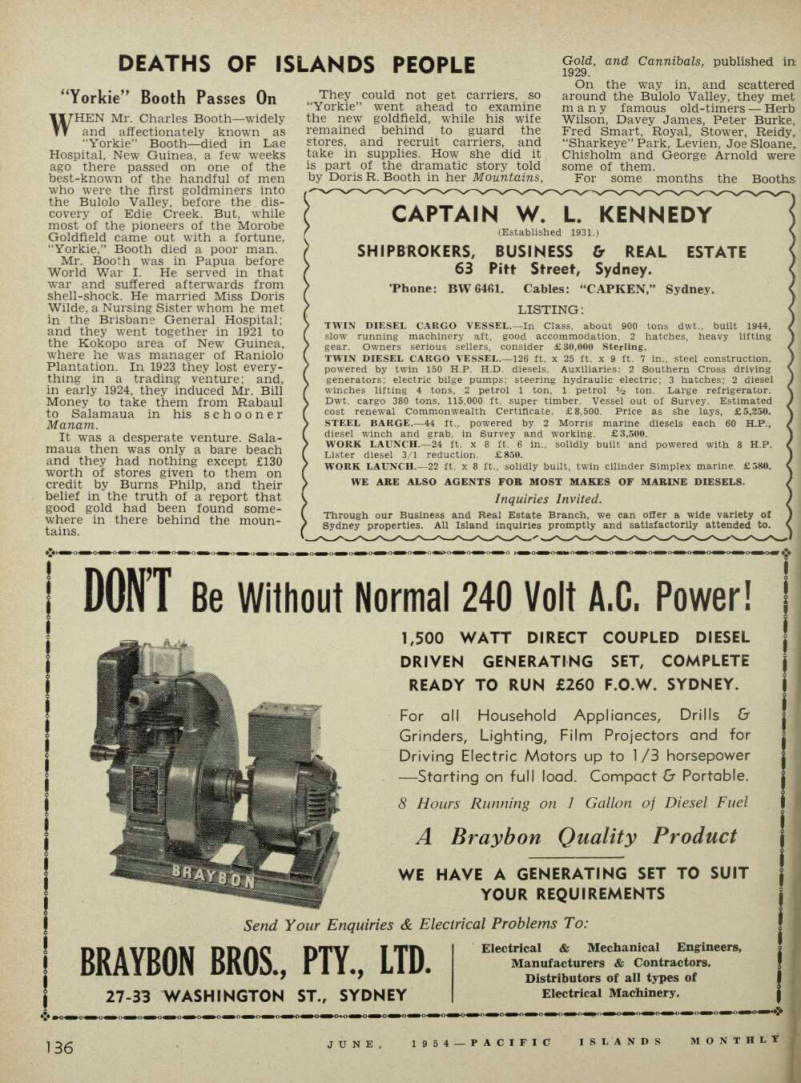
WHEN Mr. Charles Booth—widely and affectionately known as “Yorkie” Booth —died in Lae Hospital, New Guinea, a few weeks ago there passed on one of the best-known of the handful of men who were the first goldminers into the Bulolo Valley, before the. dis covery of Edie Creek. But, while most of the pioneers of the Morobe Goldfield came out with a fortune, “Yorkie,” Booth died a poor man.
Mr. Booth was in Papua before World War I. He served in that war and suffered afterwards from shell-shock. He married Miss Doris Wilde, a Nursing Sister whom he met in the Brisbane General Hospital; and they went together in 1921 to the Kokopo area of New Guinea, where he was manager of Raniolo Plantation. In 1923 they lost every thing in a trading venture; and, in early 1924, they induced Mr. Bill Money to take them from Rabaul to Salamaua in his schooner Manam.
It was a desperate venture. Sala maua then was only a bare beach and they had nothing except £l3O worth of stores given to them on credit by Burns Philp, and their belief in the truth of a report that good gold had been found some where in there behind the moun tains.
They could not get carriers, so “Yorkie” went ahead to examine the new goldfield, while his wife remained behind to guard the stores, and recruit carriers, and take in supplies. How she did it is part of the dramatic story told by Doris R. Booth in her Mountains,
Gold, and Cannibals, published in 1929.
On the way in, and scattered around the Bulolo Valley, they met many famous old-timers Herb Wilson, Davey James, Peter Burke, Fred Smart, Royal, Stower, Reidy, “Sharkeye” Park, Levien, Joe Sloane, Chisholm and George Arnold were some of them.
For some months the Booths
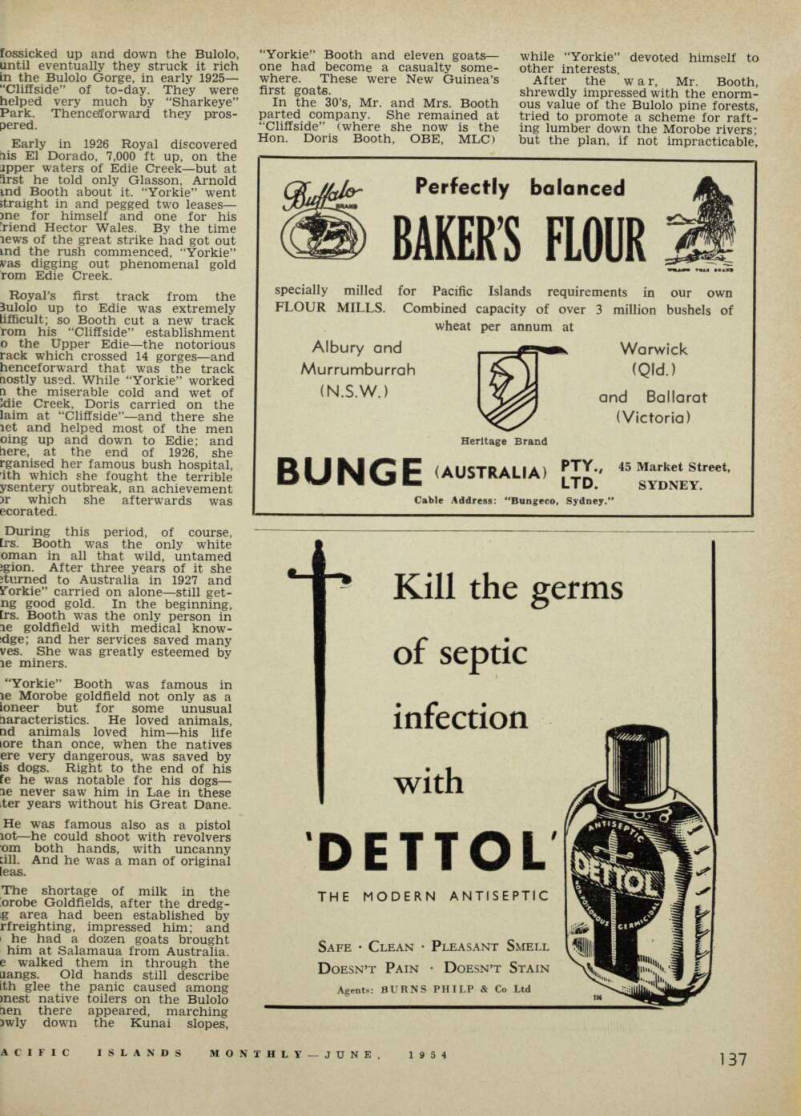
fossicked up and down the Bulolo, until eventually they struck it rich in the Bulolo Gorge, in early 1925 — “Cliffside” of to-day. They were helped very much by “Sharkeye”
Park. Thenceforward they pros pered.
Early in 1926 Royal discovered Pis El Dorado, 7,000 ft up, on the jpper waters of Edie Creek —but at first he told only Glasson, Arnold ind Booth about it. “Yorkie” went »traight in and pegged two leases — me for himself and one for his Tiend Hector Wales. By the time lews of the great strike had got out ind the rush commenced, “Yorkie” vas digging out phenomenal gold rom Edie Creek.
Royal’s first track from the Bulolo up to Edie was extremely lifficult; so Booth cut a new track rom his “Cliffside” establishment 0 the Upper Edie—the notorious rack which crossed 14 gorges—and henceforward that was the track tiostly used. While “Yorkie” worked a the miserable cold and wet of Idie Creek, Doris carried on the laim at “Cliffside”—and there she let and helped most of the men oing up and down to Edie; and here, at the end of 1926, she rganised her famous bush hospital, ith which she fought the terrible ysentery outbreak, an achievement ir which she afterwards was ecorated.
During this period, of course, [rs. Booth was the only white oman in all that wild, untamed ;gion. After three years of it she ;turned to Australia in 1927 and Sforkie” carried on alone—still get ng good gold. In the beginning, [rs. Booth was the only person in le goldfield with medical know tdge; and her services saved many ves. She was greatly esteemed by le miners.
“Yorkie” Booth was famous in le Morobe goldfield not only as a ioneer but for some unusual Paracteristics. He loved animals, nd animals loved him—his life lore than once, when the natives ere very dangerous, was saved by is dogs. Right to the end of his fe he was notable for his dogs— le never saw him in Lae in these -ter years without his Great Dane.
He was famous also as a pistol lot —he could shoot with revolvers om both hands, with uncanny dll. And he was a man of original leas.
The shortage of milk in the forobe Goldfields, after the dredg g area had been established by rfreighting, impressed him; and 1 he had a dozen goats brought him at Salamaua from Australia. e walked them in through the aangs. Old hands still describe ith glee the panic caused among mest native toilers on the Bulolo Pen there appeared, marching iwly down the Kunai slopes,
“Yorkie” Booth and eleven goats— one had become a casualty somewhere. These were New Guinea’s
first foats.
In the 30’s, Mr. and Mrs. Booth parted company. She remained at “Chffside” (where she now is the Hon. Doris Booth, QBE, MLC)
while “Yorkie” devoted himself to other interests After the ' w a r, Mr. Booth, shrewdly impressed with the enorm ous value of the Bulolo pine forests, tried to promote a scheme for raft ing lumber down the Morobe rivers but the plan, if not impracticable,
was premature, and came to noth ing. In the later years he suffered much ill-health and resided mostly in Lae.
All old-timers, who knew the Booths in their halcyon days in the Bulolo Valley and Edie Creek, be tween 1924 and 1930, will regret the passing of one who was held in esteem, did much good among his fellows, and no deliberate harm to anyone.—RWß.
Sir Charles Rosenthal
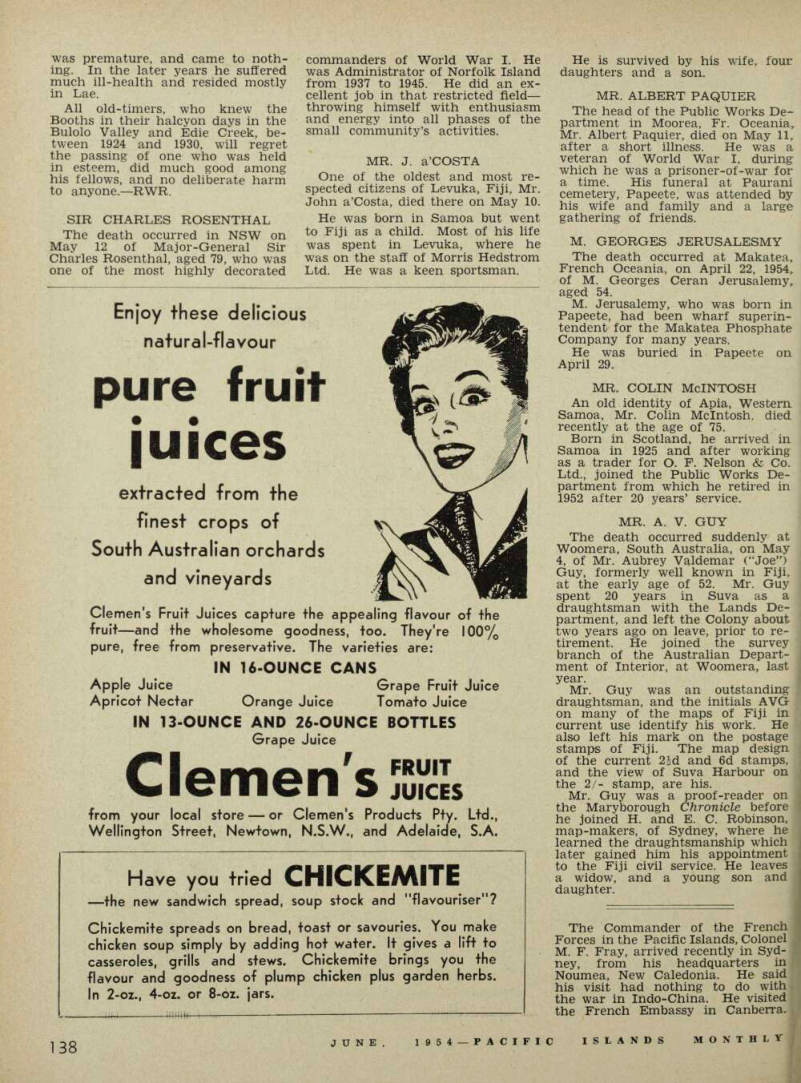
The death occurred in NSW on May 12 of Major-General Sir Charles Rosenthal, aged 79, who was one of the most highly decorated
commanders of World War I. He was Administrator of Norfolk Island from 1937 to 1945. He did an ex cellent job in that restricted field — throwing himself with enthusiasm and energy into all phases of the small community’s activities.
Mr. J. A’Costa
One of the oldest and most re spected citizens of Levuka, Fiji, Mr.
John a’Costa, died there on May 10.
He was born in Samoa but went to Fiji as a child. Most of his life was spent in Levuka, where he was on the staff of Morris Hedstrom Ltd. He was a keen sportsman.
He is survived by his wife, four daughters and a son.
Mr. Albert Paquier
The head of the Public Works De partment in Moorea, Fr. Oceania, Mr. Albert Paquier, died on May 11, after a short illness. He was a veteran of World War I. during which he was a prisoner-of-war for a time. His funeral at Paurani cemetery, Papeete, was attended by his wife and family and a large gathering of friends.
M. Georges Jerusalesmy
The death occurred at Makatea, French Oceania, on April 22, 1954, of M. Georges Ceran Jerusalemy, aged 54.
M. Jerusalemy, who was born in Papeete, had been wharf superin tendent for the Makatea Phosphate Company for many years.
He was buried in Papeete on April 29.
Mr. Colin Mcintosh
An old identity of Apia, Western Samoa, Mr, Colin Mclntosh, died recently at the age of 75.
Born in Scotland, he arrived in Samoa in 1925 and after working as a trader for O. F. Nelson & Co.
Ltd., joined the Public Works De partment from which he retired in 1952 after 20 years’ service.
Mr. A. V. Guy
The death occurred suddenly at Woomera, South Australia, on May 4, of Mr. Aubrey Valdemar (‘‘Joe”) Guy, formerly well known in Fiji, at the early age of 52. Mr. Guy spent 20 years in Suva as a draughtsman with the Lands De partment, and left the Colony about two years ago on leave, prior to re tirement. He joined the survey branch of the Australian Depart ment of Interior, at Woomera, last year.
Mr. Guy was an outstanding draughtsman, and the initials AVG on many of the maps of Fiji in current use identify his work. He also left his mark on the postage stamps of Fiji. The map design of the current 2|d and 6d stamps, and the view of Suva Harbour on the 2/- stamp, are his.
Mr. Guy was a proof-reader on the Maryborough Chronicle before he joined H. and E. C. Robinson, map-makers, of Sydney, where he learned the draughtsmanship which later gained him his appointment to the Fiji civil service. He leaves a widow, and a young son and daughter.
The Commander of the French Forces in the Pacific Islands, Colonel M. F. Fray, arrived recently in Syd ney, from his headquarters in Noumea, New Caledonia. He said his visit had nothing to do with the war in Indo-China. He visited the French Embassy in Canberra.
Mullaly Wooller Wedding
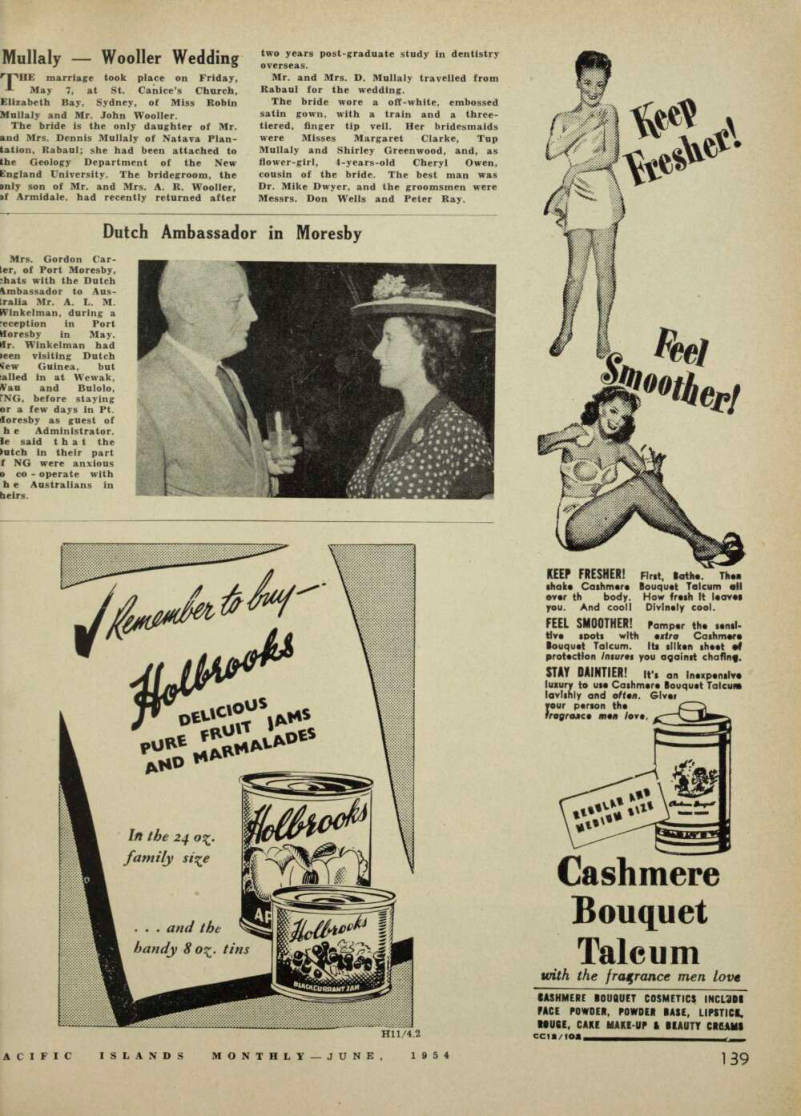
THE marriage took place on Friday, May 7, at St. Canice’s Church, Elizabeth Bay, Sydney, of Miss Robin Mullaly and Mr. John Wooller.
The bride is the only daughter of Mr. and Mrs. Dennis Mullaly of Natava Plan tation, Rabaul; she had been attached to the Geology Department of the New England University. The bridegroom, the »nly son of Mr. and Mrs, A. R. Wooller, *f Armidale, had recently returned after
two years post-graduate study in dentistry overseas.
Mr. and Mrs. D. Mullaly travelled from Rabaul for the wedding.
The bride wore a off-white, embossed satin gown, with a train and a three tiered, finger tip veil. Her bridesmaids were Misses Margaret Clarke, Tup Mullaly and Shirley Greenwood, and, as flower-girl, 4-years-old Cheryl Owen, cousin of the bride. The best man was Dr. Mike Dwyer, and the groomsmen were Messrs. Don Wells and Peter Ray.