Treatment Of
pp. 125-127 · Read in the full issue
Coral Ulcers
By Edwin Pyle, Md
AS the doctor on the brigatine Yankee (on which Commander and Mrs. Irving Johnson are cruising in the Pacific with a crew of 21) I have been studying ulcers (particularly ulcers of the lower legs) as the result of coral scratches, cuts or abrasions. I must admit that my experience in treating these tropical ailments has been limited, but it has been very extensive in treating similar ulcers from other causes.
As ulcers developed by the crew have responded so rapidly to what I am going to suggest, I am in fluenced to write to the PIM in the hope that this simple sugges tion will be tried by someone who has more cases to treat, and cases more chronic in nature.
There is no doubt that constant wetting retards the healing of all
wounds. It is also well known that the circulation, both of the blood and the lymph, is not as good in the lower legs, particularly in those past middle age, as it should be; and, since prompt healing depends very much on this tactor, it should be borne in mind when treating lower-leg ulcers.
My suggestion is that all ulcers or wounds of the lower leg be treated by large compression band ages from the toes to just below the knee, over a copious dressing.
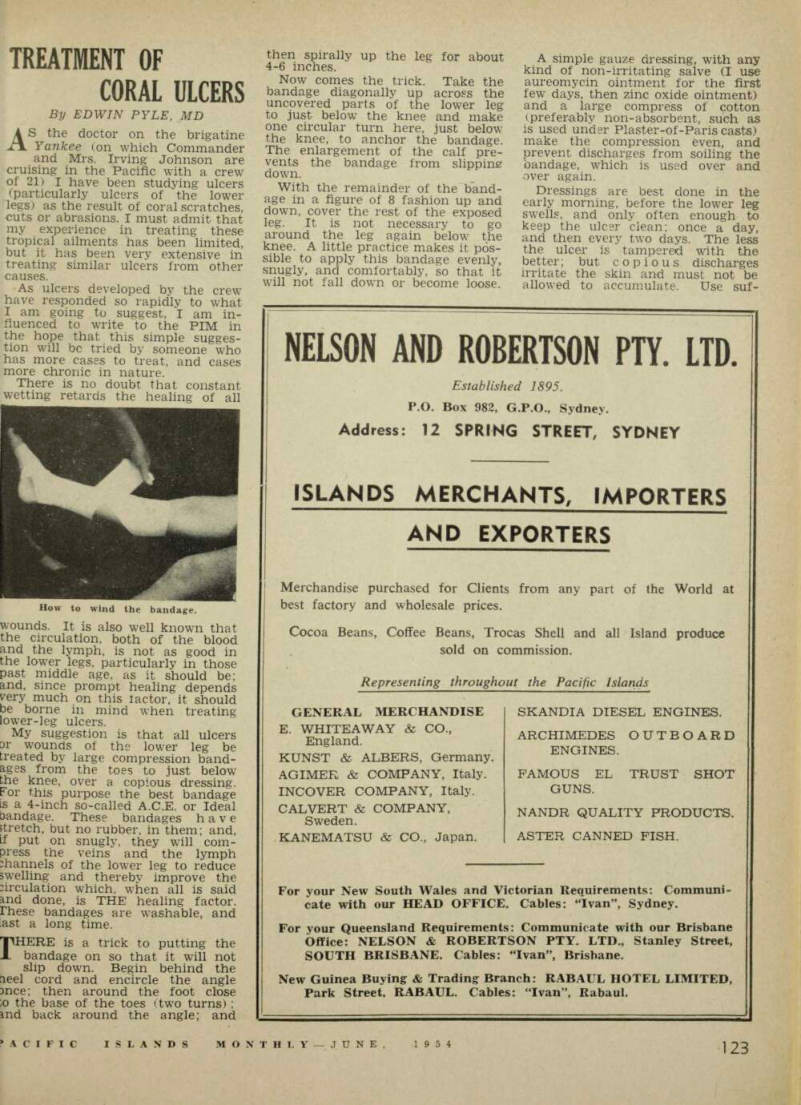
For this purpose the best bandage is a 4-inch so-called A.CJE. or Ideal bandage. These bandages have stretch, but no rubber, in them; and, if put on snugly, they will com press the veins and the lymph channels of the lower leg to reduce swelling and thereby improve the circulation which, when all is said and done, is THE healing factor, rhese bandages are washable, and ast a long time. rHERE is a trick to putting the bandage on so that it will not slip down. Begin behind the aeel cord and encircle the angle ance; then around the foot close ;o the base of the toes (two turns); md back around the angle; and
then spirally up the leg for about
4 "k, mcnes ‘
Now comes the trick. Take the bandage diagonally up across the uncovered parts of the lower leg to just below the knee and make one circular turn here, just below the knee, to anchor the bandage.
The enlargement of the calf prevents the bandage from slipping: down.
With the remainder of the bandage in a figure of 8 fashion up and down, cover the rest of the exposed ieg. It is not necessary to go around the leg again below the x Mtle practice makes it possible to apply this bandage evenly, snugly and comfortably, so that it will not fall down or become loose.
A simple gauze dressing, with any kind of non-irritating salve (I use aureomycin ointment for the first few days, then zinc oxide ointment) and a large compress of cotton (preferably non-absorbent, such as is used under Plaster-of-Paris casts) make the compression even, and prevent discharges from soiling the bandage, which is used over and over again.
Dressings are best done in the early morning, before the lower leg swells, and only often enough to keep the ulcer clean; once a day, and then every two days. The less the ulcer is tampered with the better; but copious discharges irritate the skin and must not be allowed to accumulate. Use suf
How to wind the bandage.
ficient salve to prevent the gauze dressing from sticking and causing bleeding when removed.
When healed, continue with the use of the bandage for a short period to allow firm healing. Of course, the leg is kept dry during all this course of treatment.
Edwin Pyle, Md,
Brigantine Yankee.