H vetn
pp. 81-89 · Read in the full issue
The
Mystery
Of The
Red
Prawns
OF
Vatulele
By
Frank Exon
IHAVE nevei been unduly interested in prawns. My household was therefore surprised w’hen I set off across the open sea at dawn just to see a poolful of th ! r^ d T dy thm S s - And I mean ruddy—really rufous —the exact hue of the cooked variety, though alive and kicking, Kicking gracefully and somewhat languidly, it is true, as becomes prawns that are sacred and have been aware of it for generations.
For these are King prawns in a truly regal, sense. They have a pool of their very own, remote and cool and rockbound; and they come out of their palatial cracks and crannies at the call of the maidens w to hover like humming birds at their (the maidens’) fingertips with their delicate whiskers (the prawns’) exploring delicately f All these strange things I can vouch for—all except the maidens, Perhaps it would be wiser to regard the term as purely a courtesy title, even though all Fijian legends are most positive as to the preference and h turtles Cr for Ton^fid^Xldlns 8 They do not exnlaii? however d how thM seafood can r?cognTse a con dltlon which is seldom obvious e?en to man—a provocative line of thought which has made me (credulous as I am where women and whimsey are concerned) a little sceptical of the bulk of Fiji’s totemistic tales J Txito , - T , , .tils legend the expurgated one, not the delightfully bawdy
version I should like to give you—tells of that very beautiful princess, Yalewa ni cagi hula, which means “maiden of the fair wind” (I you) who was so comely that every man throughout the land desired her.
Whenever the wind was fair, chiefs sailed Vatulele-wards from all directions in the hope of persuading the maiden to forsake her amateur status: but without avail.
Not even the most renowned of them—whose strength was so great that he could dispense with the fair wind by heaving rocks into the water large enough to serve as stepping stones all the way from the mainland—had any luck.
Probably, he spoiled his chances by overlooking the customary gifts —an oversight which he did little to correct when he offered her the miserable bundle of cooked prawns, wrapped in a leaf, which he had brought to eat should no invitation to breakfast be forthcoming. Such a gift, while it might have found favour in Mayfair, proved unacceptable in Vatulele.
So she sent him scuddin £ before the wrath of th . ( L not-so-fair-wmd, and threw his glft after him ' The stones the leaves and the Prawns, the Fijians say—and perhaps the maiden’s descendants, if that isn>t a contradiction in terms — are there t° this day. For the prawns, though cooked, revived when they fell into a nearby pool: and there they remain, sacred and inviolate. The leaves in which they were wrapped took root, and the
resulting tree still shades the pool, Remnants of the stepping-stones have also survived though only within the fringing ’ reef It is not DO ssible the <?torv phpr
toTLw thfnrawn?
t?ied and th fll P have' bln' V shin SpHtp*? d 11 h b shlp "
TfcECAUSE there is usnallv a rieh
H vetn
13 Fiiian legend U those Coloured prawns arousld mv interest The accentld exnllnation that their Ved cSr is ?o i??n olide in the S d d not a™V If is p gJ me d tlfe doo? P is ’ tidal there 31 no chance of its Li £
uv a worthwhile coAlentOaSon
a nmv do orawns e? ?ed
h ’ ivOn P nxide—and has
anyone evw tested these Vatulele for their iron content? seemfngly no one eve? has Tor the stOOnfn? stones was th ® a clue there? Was there bv
anvchanc?VVSbmpiwd ride? that
oncelinked vSSlele wfth the
mainland of Viti wlth th 6 An Admiralty chart and mv obliging friend the Sailor cleared up the last point. Between Vatulele’s fringing reef and the mainland there is no b°«° m shown at a thousand fathoms, So Vatulele is a limestone chunk thrust up from the ocean bed, more than a mile below. Could it be that it had brought its exclusive, full-technicolor ocean fauna with it? At anything over 1,500 feet all prawns are red—vividly so—for at that depth all red light has been
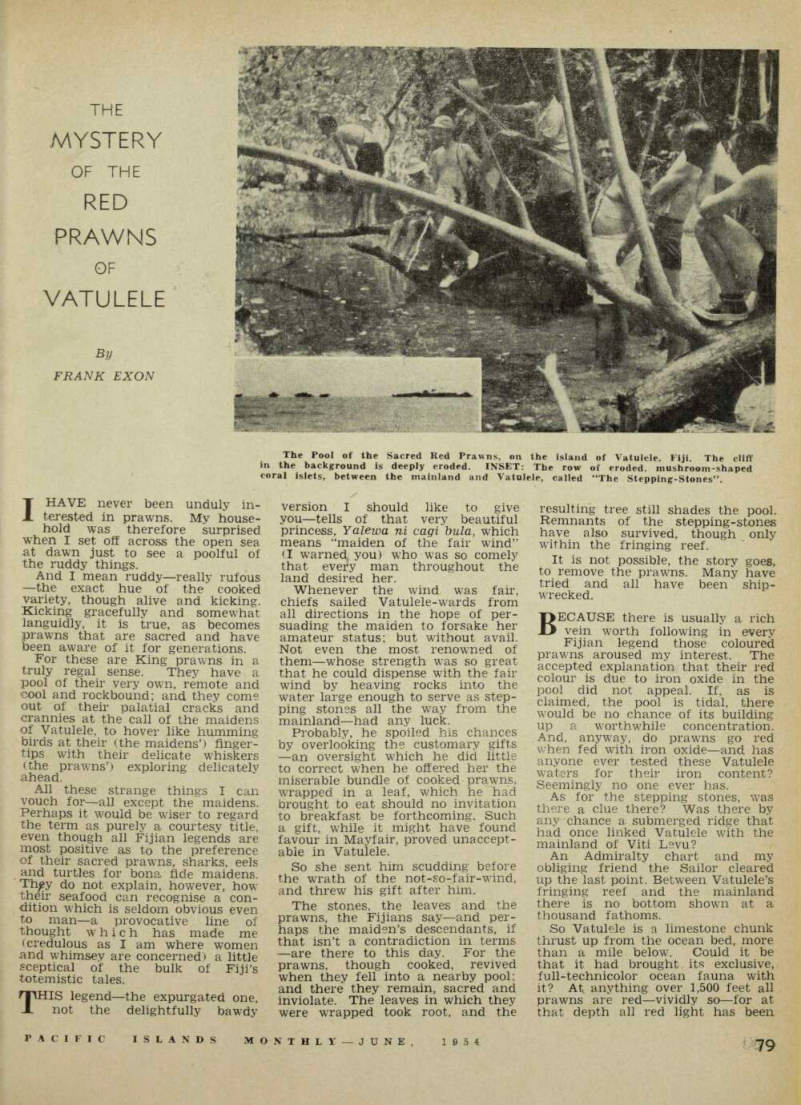
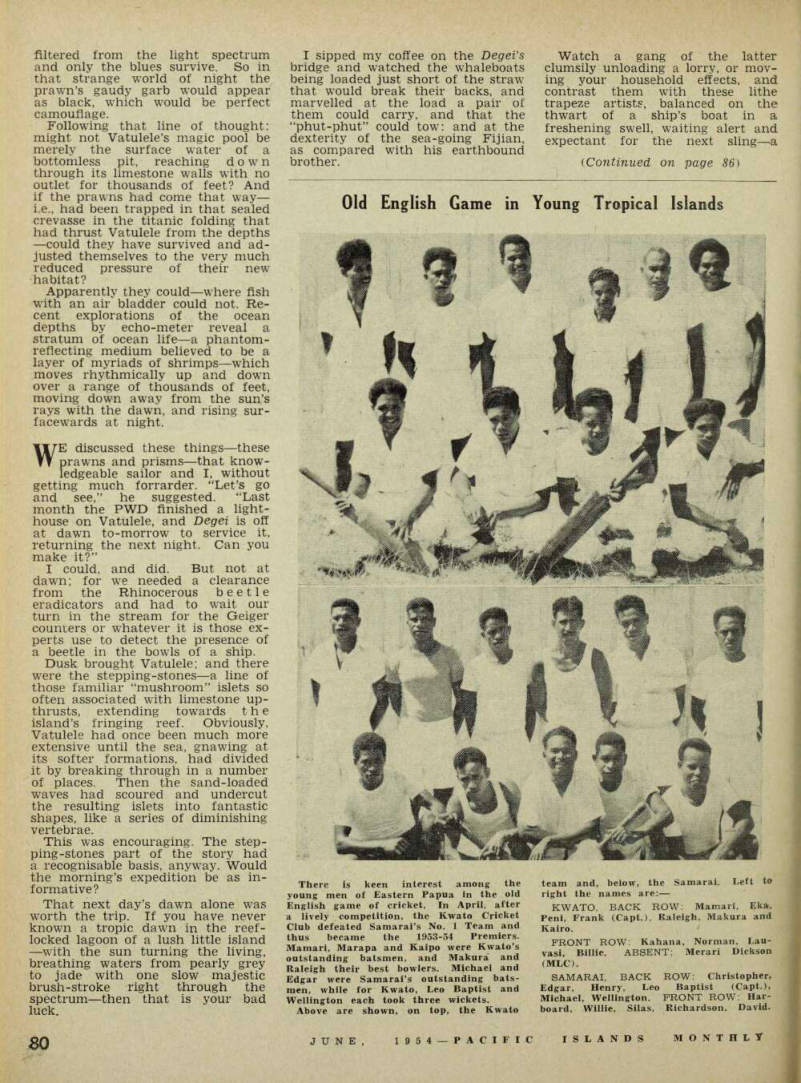
The Pool of the Sacred Red Prawns, on the island of Vatulele, Fiji. The cliff in the background is deeply eroded. INSET: The row of eroded, mushroom-shaped coral islets, between the mainland and Vatulele, called “The Stepping-Stones’’.
filtered from the light spectrum and only the blues survive. So in that strange world of night the prawn’s gaudy garb would appear as black, which would be perfect camouflage.
Following that line of thought: might not Vatulele’s magic pool be merely the surface water of a bottomless pit, reaching down through its limestone walls with no outlet for thousands of feet? And if the prawns had come that way— i.e., had been trapped in that sealed crevasse in the titanic folding that had thrust Vatulele from the depths —could they have survived and ad justed themselves to the very much reduced pressure of their new habitat?
Apparently they could —where fish with an air bladder could not. Re cent explorations of the ocean depths by echo-meter reveal a stratum of ocean life—a phantom reflecting medium believed to be a layer of myriads of shrimps—which moves rhythmically up and down over a range of thousands of feet, moving down away from the sun’s rays with the dawn, and rising sur facewards at night.
WE discussed these things—these prawns and prisms—that know ledgeable sailor and I, without getting much forrarder. “Let’s go and see,” he suggested. “Last month the PWD finished a light house on Vatulele, and Degei is off at dawn to-morrow to service it, returning the next night. Can you make it?”
I could, and did. But not at dawn; for we needed a clearance from the Rhinocerous beetle eradicators and had to wait our turn in the stream for the Geiger counters or whatever it is those ex perts use to detect the presence of a beetle in the bowls of a ship.
Dusk brought Vatulele; and there were the stepping-stones—a line of those familiar “mushroom” islets so often associated with limestone up thrusts, extending towards the island’s fringing reef. Obviously, Vatulele had once been much more extensive until the sea, gnawing at its softer formations, had divided it by breaking through in a number of places. Then the sand-loaded waves had scoured and undercut the resulting islets into fantastic shapes, like a series of diminishing vertebrae.
This was encouraging. The step ping-stones part of the story had a recognisable basis, anyway. Would the morning’s expedition be as in formative?
That next day’s dawn alone was worth the trip. If you have never known a tropic dawn in the reef locked lagoon of a lush little island —with the sun turning the living, breathing waters from pearly grey to jade with one slow majestic brush-stroke right through the spectrum—then that is your bad luck.
I sipped my coffee on the Degei’s bridge and watched the whaleboats being loaded just short of the straw that would break their backs, and marvelled at the load a pair of them could carry, and that the “phut-phut” could tow: and at the dexterity of the sea-going Fijian, as compared with his earthbound brother.
Watch a gang of the latter clumsily unloading a lorry, or mov ing your household effects, and contrast them with these lithe trapeze artists, balanced on the thwart of a ship’s boat in a freshening swell, waiting alert and expectant for the next sling—a
('Continued on page 86)
massive clumsy samson post that had somehow to be stowed fore and aft across the very thwarts on which they swayed precariously.
With split second timing on every one’s part, the monster was mast ered and lashed and a second lowered beside it—with wheel barrows, drums of cement and workmen filling in the interstices.
Then off the whole flotilla started into what had become a fresh sou’easterly, on the long tow round the point to their beach—singing, of course. Where else in the world do workmen sing their hearts out at sunrise?
Later the launch returned for us and we left the working party some how to manhandle their derricks and drums and supplies to the top of a hundred-foot cliff, over up ended eroded and razor-sharp limestone pinnacles, while we set out to find our prawns.
The happy Fijians were still sing ing, despite the limestone and their bare feet, with never a thought of danger money, dirt money or any other of those modern inventions.
They w r ould work thus throughout the day, and at dusk would fish and eat and brew their yangona and yarn for half the night before settling down on their mats. And that would be their routine until the job was finished and the Degei returned for them, perhaps a fort night hence.
THE Sailor and I made good time along the cool, shady gallery that the waves had etched into that forbidding cliff —a sizeable groove that ran for miles. A car could have driven along that covered w r ay, could it have reached it, six to ten feet above high tide level.
Above it was a series of similar galleries that had once been just as spectacular but had now weathered to shallow scrub-clad furrows.
It was clear that after the island’s original emergence the lifting process had continued in at least four stages, with aeons sep arating each. For perhaps a million years the waves had worried and fretted away the first gallery, only to have it raised beyond their hungry reach. Patiently they again proceeded with their ordained task of reducing this upstart island to sea level; and again and yet again unbelievable pressure a mile below, had pushed it upward.
How did this evidence of an in exorable but spasmodic emergence fit in with our prawn theory? It didn’t; but still we plodded on across indented bays and coral beaches, varied by more cliffs, with galleries now twenty feet above us.
From them, cool limestone caves beckoned and promised thrills and
beauties that must only be guessed for the present.
We pressed on through open forest, with lofty dakua trees stand ing on tip-toes in their urge to see over the top of those mighty cliffs; over fretted and pierced and honey combed pinnacles as sharp as dragon’s teeth; and through arches supported by columns and etched with delicate tracery.
And still no prawns nor any sign.
Somehow we had missed the track, with our allotted time more than half gone.
WE retraced our steps and met a maiden stepping warily among the trees. In his best Fijian, at a range of fifty feet —we could get no closer—the Sailor asked to be piloted to the sacred prawns. She shrieked some Fijian incantation and made for the tall timber. I like to think it was only the purity of the Sailor’s Fijian she doubted, this “maiden with the fair wind up.”
Then we saw several maramas, of which party our fleet-footed one was probably the advance guard.
They led us back along the track we had just trodden, and a scant ten feet beyond.
There were the ruddy prawns— paddling around in a pool formed In a cleft or fissure, at the base of the cliff, quite fifty yards from
the sea and open to the sky. The water was salt and tidal. Strange trees shaded it and, scored in the cliff behind and above, were those unmistakeable undercut grooves of wave erosion.
Yet between the sea and that cliff was a mature forest, and limestone fangs and buttresses twenty feet high. It didn’t make sense. No theory fitted anywhere; and with Degei hooting, there wasn’t time to investigate further.
So, until we go back and explore
those caves, and sound that pool, and analyse those waters, and trace that fissure to its junction with the sea, the Fijian legend stands un challenged.
We left reluctantly and prawnless, for there might just be something in that shipwreck story. The maramas were twiddling their fingers below the surface and chant ing huskily; and the prawns were being difficult and blase. Maybe they knew something, and we should have tried them with the maiden that got away.