Tropicalities
pp. 79-80 · Read in the full issue
Magazine Section
Coconut Pearls And
Coconut Crabs
RONALD POWELL, seaman, author, and long-time resident of the Cook Islands, stirs up the coconut pearl fact-or-myth correspondence again.
It all began when we came across a paragraph in Pearls and Men (an autobiography by Louis Kornitzer, a man with a lifetime of experi ence in pearl trading) a couple of years ago.
Kornitzer declares flatly that there are coconut pearls but that, emphatically, they do not come from coconuts —they come £rom conch shells. Since then others have as flatly declared that coconuts do yield pearls at times —but we are still searching for a man who has personally extracted one from a coconut. However, the controversy seemed definitely to be settled against Kornitzer when a lady in
Samoa refered us to Fairchild’s Garden Islands of the Great East, written by an acknowledged botanical expert.
Ronald Powell now draws atten tion to another statement by Fair child in the same book which people in the South Pacific will be quick to contest—a denial that there are such things as crabs which climb
coconut palms or eat coconuts. Do crabs climb coconut palms?
Powell admits that he has yet to locate a person who can person ally swear that he has seen a crab up a palm or has caught one in the act of eating a nut —though they certainly use the husk for lin ing their burrows.
But, in support of the almost universally held opinion, he notes Charles Darwin’s description given in 1836 of the Coconut or Robber crab, in the Cocos-Keeling Islands.
Darwin noted that the crab tears the husk clear of the eye end, hammers a hole there large enough to insert a claw, and scoops out the meat. Large crabs, he says, have a mass of fat under the tail which, when rendered down, yields up to a quart of oil, almost identical with pure coconut oil.
It could be that Fairchild is more of a botanist than a crab-and-pearl expert. Meanwhile, we await flash light photos (the creatures allegedly work by night) showing coconut crabs at work —or on the way to or from work —JPS.
Simpson Leaves Tahiti
THAT good American and excel lent photographer, Mr. Frederick H. Simpson, has departed from Tahiti, after long residence in Polynesia’s delectable isle. He had suffered considerably from bronchial asthma in recent years, and he thinks that residence in Hollywood may improve his chest condition.
At any rate, his blood circulation should improve if the photographs of Hollywood personalities which bespatter the pages of our popular daily newspapers nowadays are any indication of Hollywood conditions.
Mr. Simpson, in the course of years of practice in Tahiti, de veloped a type of photograph which was so good that it actually flattered Tahiti—and as a consequence it is probable that the Government of Tahiti is now indebted to Mr. Simp son for thousands of dollars’ worth of free overseas publicity!
This Way For Tarawa!
A YOUNG English actress named Lesley Darell —very pretty, according to newspaper photo graphs—stepped from the liner Oronsay in Melbourne early in May, and told reporters that her correct name is Georgie Bishop, and that she was on her way to the Gilbert Islands to marry Mr. Peter Holland
Rose. Mr. Rose is an engineer who went out to the G and E Colony last December, to do a job for the Colonial Office.
Miss Bishop said that she was carrying ro Tarawa various marri age paraphernalia, including a wedding ring, which Mr. Rose could not purchase in the Gilberts. “I haven’t the foggiest idea, yet, of how I am to get to Tarawa, but the travel agents assure me that I’ll make it,” said Miss Bishop.
When Wassail Was Wassail
THERE is some congregation of old Territorians in West Aus tralia. There came into PIM office the other day, seeking the address of Gordon Thomas (former Rabaul Times editor), Mr. J. K.
Twycross, who was Amalgamated Wireless Manager in Rabaul over 20 years ago; and who now is Over sea Tele-Communication’s Super visor of Western Regional (which embraces the newly developed Cocos Island base). He says that among his neighbours are Mr. D. S. Davies and Mr. Walford King—the former of whom was a pharmacist and the
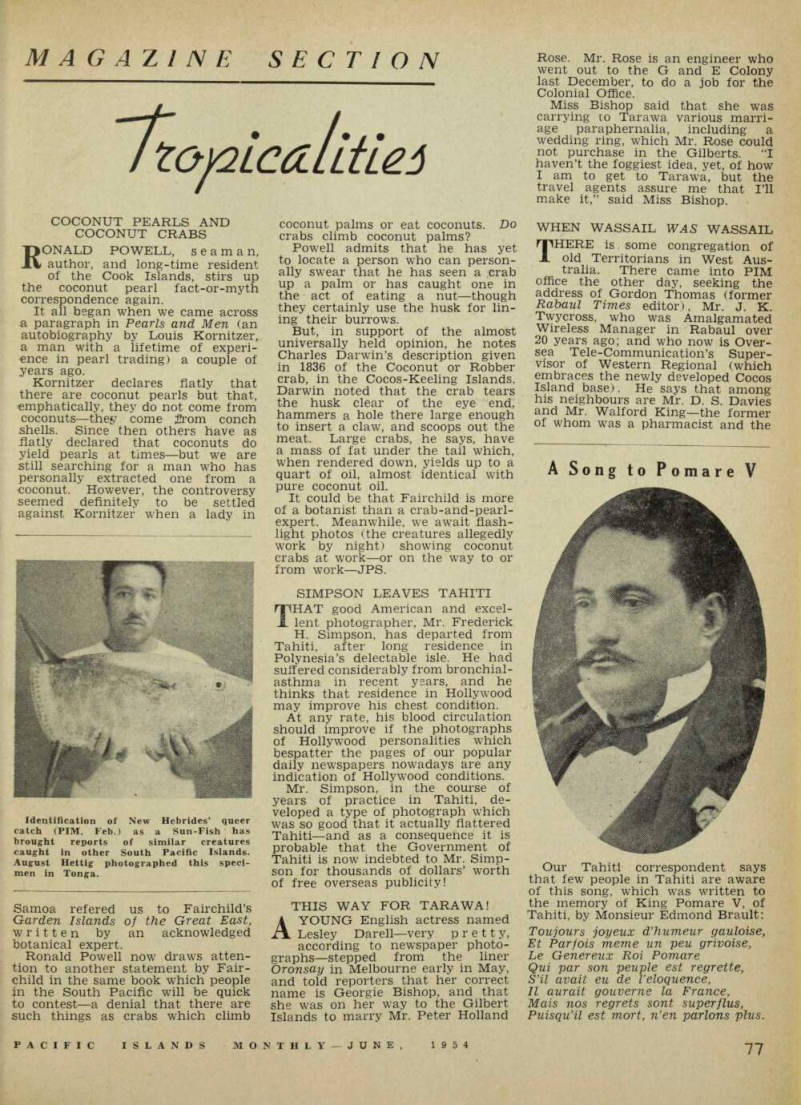
Identification of New Hebrides’ queer catch (PIM, Feb.) as a Sun-Fish has brought reports of similar creatures caught in other South Pacific Islands.
August Hettig photographed this speci men in Tonga.
latter an audit official in Rabaul in the early 30’s. Mr. Twycross re minded the now venerable editor of the PIM of an occasion when all five of us (including GT) made un restricted wassail in a certain Rabaul hostlery—then well known, but subsequently wiped out of ex istence by the Japs and by the bombs which were aimed at the Japs.
Point Of View
THE Thompson’s live in a U shaped house; The Peters live in a T-shaped house; The Perkins house is quiet as a mouse— But I hate to think of our sort of house.
The Joneses live in a Z-type home.
The Burtons live in an R-type home— You can always find every brush and comb, But I’d hate to think of our type of home.
The Carters live in an L-shaped place Where nary a thing is out of place.
Though the Carters L we would disgrace, I think we live in one L of a place.
—Noelle Mason.
Bougainville.
A Feverish Nightmare
A BRITISH Medical Journal states that Dr. Otto Karl (Berlin), who says “unpeffer,” and Dr. Mulin ski, who refers to “feverski,” and Dr. Henri Laperouse, of Paris Uni versity, dealing with “La fievere,” are all agreed that these complaints are the same as the Islands’ dis ability known as “fever.”
However, the noted gynaecologist, Dr. Piccolino, disagrees with this finding. He states that if the disease referred to as “feverino” —and not “feverio” as he had originally supposed—there might be some proof in the above-mentioned as sumptions. He said: “Either ‘feverino’ or ‘feverio’ are very preva lent in childbirth, but at the moment I am not sure.”
Dr. Piccolino, addressing a Con gress, stated: “There are some fevers in Italy. Many fevers come from the north, and a lot from the south. ... I myself discovered a fever in my laboratory with plenty test tube and I put this fever in one test tube. To keep it fresh and look at him when I want to look at him I put him long bokis ice. But my daughter, Marie, who is lik lik you savvy think it is a new kind of limonata —she drink
him. But I say, So! I speak to Sister Teresa at the Convent, say ing, ‘Sister, you must thrash Marie for has she not eaten my fever?’
Dr. Waddington Cholmondley, of Harley Street, interposed; “Did the
girl suffer any ill-effects from the fever?”
Dr. Piccolino, with some show of anger, replied; ‘‘Plenty more daughter I got, but I losa my beautiful fever.”