Brother Gautier
pp. 69-72 · Read in the full issue

Of The Gilberts
By Jack Thornton
TO the Gilbertese, Brother Joseph Gautier, by reason of his travels and the time he has been among them, is probably the most widely known European in the G & EIC.
His cheery disposition, sincerity, frankness, and capacity for work have endeared him to all sections, including officialdom. In the 21 years since he arrived in the atolls the Brother has seen many Colonial officers come and go.
He was born in Brittany in 1897, and he arrived at Abiang atoll as a carpenter and cement-worker, in the Sacred Heart Mission, in January, 1933. In 1938, he was appointed engineer on the auxiliary schooner Santa Teretia /, built at Abemama by William Reiher. Mr.
Reiher commanded the new mission ship for about a year while he taught Father Klipfel and Brother Gautier to navigate.
When the Japanese invaded Tarawa, the Santa Teretia I was 30 miles south of the atoll, and Father Klipfel received orders to proceed to Funafuti and transport the Dis trict Officer, Ellice Is., to Suva. The WPHC then chartered the vessel for patrol work in the New Hebrides.
Brother Gautier was suffering a form of beri-beri caused by lack of green vegetables, so he was sent to Sydney for hospital treatment.
After being cured, he volunteered for mission work in New Guinea and Papua, where he remained until the Allied forces landed at Tarawa.
Then he sought a transfer back to the Colony. He had to wait 15 months for a ship, but eventually arrived at Tarawa, where he was occupied in rebuilding mission buildings until the Santa Teretia I returned in 1947.
In 1949, the Sacred Heart Mission bought the Halgard in Australia, re named her Santa Teretia II and took delivery in Fiji. About that time Father Klipfel became ill and re turned to Alsace, and Brother Gautier has been captain and en gineer on the ship ever since.
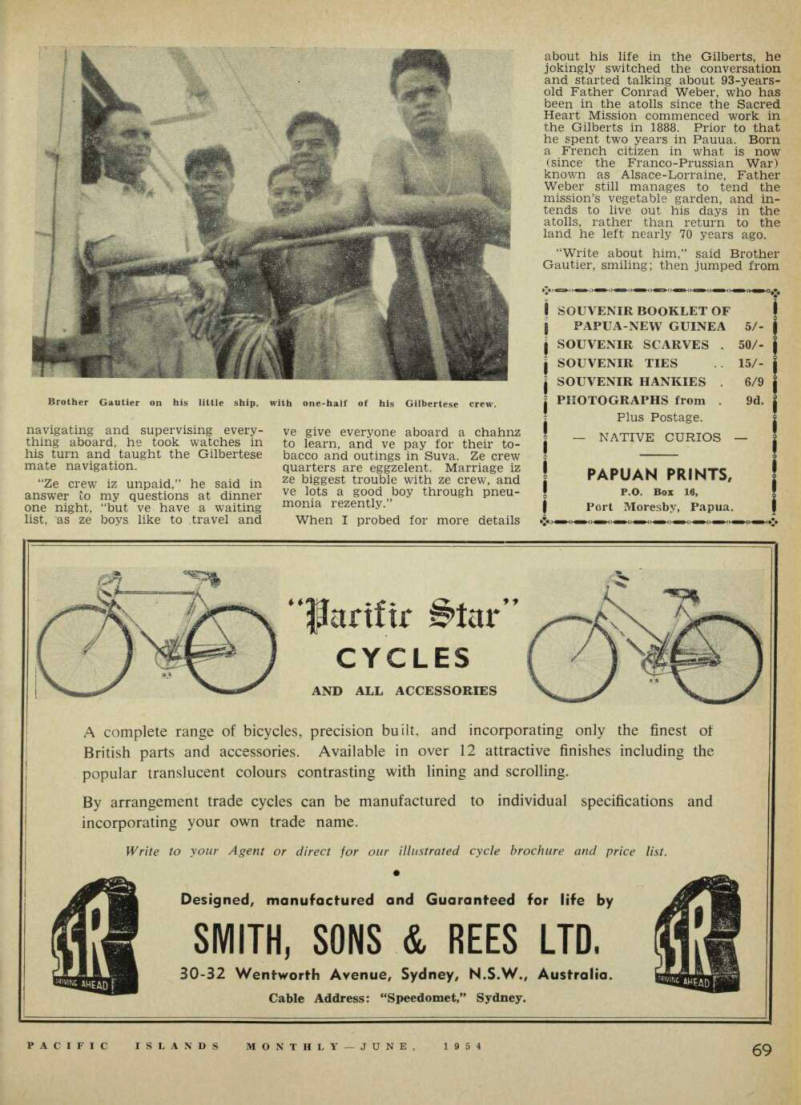
With a crew of eight Gilbertese, the Santa Teretia II -sails regularly from Tarawa to all the Gilbert atolls, the Phoenix Is., Ocean Is. and Nauru, and occasionally visits the Ellice Is. I sailed aboard her recently from Funafuti to Suva, where she underwent refit.
A little above average height, stockily built, with a slightly convex nose and hazel eyes that twinkle easily, Brother Gautier’s straight, light brown hail' is now getting sparse, but his gnarled hands are still those of a hard-working skipper-engineer.
HE is proud of his ship and her 160 hp diesel that drives her an
average of 20.000 miles annually at a steady 7 knots. Seventy-five feet long. 90 tons gross, she is listed as an auxiliary ketch. But before the mainsail can be hoisted the wireless aerial has to be taken down; and as there is no mainbrace the sail has to be lashed to a bulwark. So she usually proceeds under power.
When I was aboard her, one fuel tank was unserviceable, the bilge had to be pumped by hand from a pump rigged on deck, and we carried water in 40-gallon drums.
But although she was en route for annual refit she was well found in essentials and obviously sturdy and seaworthy.
Brother Gautier had faith in his
ship. He did not even bother to listen to the weather report from Fiji, though there had been a hurri cane warning the previous week, “Vot does it matter?” he remarked in his fascinating, clipped French accent, as we cleared the reef pass age. “It’s all vind!”
We carried fuel for five days. In fair weather the Santa Teretia 11 does the voyage in about four days, “Iv ve run into bad veather and run out of vuel, ve’ll hoist ze zail,” the captain explained. I knew there was nothing to worry about— I think I know a resourceful skipper when I see one.
Our opportunities for conversation were limited, because in addition to
(Continued on Page 69)
navigating and supervising everything aboard, he took watches in his turn and taught the Gilbertese mate navigation.
“Ze crew iz unpaid,” he said in answer to my questions at dinner one night, “but ve have a waiting list, as ze boys like to travel and
ve give everyone aboard a chahnz to learn, and ve pay for their to bacco and outings in Suva. Ze crew quarters are eggzelent. Marriage iz ze biggest trouble with ze crew, and ve a S°od boy through pneu monla rezently.
When I probed for more details
about his life in the Gilberts, he jokingly switched the conversation and started talking about 93-years old Father Conrad Weber, who has been in the atolls since the Sacred Heart Mission commenced work in the Gilberts in 1888. Prior to that he spent two years in Pauua. Born a French citizen in what is now (since the Franco-Prussian War) known as Alsace-Lorraine, Father Weber still manages to tend the mission’s vegetable garden, and in tends to live out his days in the atolls, rather than return to the land he left nearly 70 years ago.
“Write about him,” said Brother Gautier, smiling; then jumped from
Brother Gautier on his little ship, with one-half of his Gilbertese crew.
his chair and hurried below. The captain-engineer s attuned ears had of 6t the eC ln a gines an |nd in when fixed things he turned in for five hours’ sleerf d f 6 sieep.
That is about his average night’s rest aboard the Santa Teretia II at sea, yet he is never too tired for a smile and a joke