British Colonialism’
p. 40 · Read in the full issue
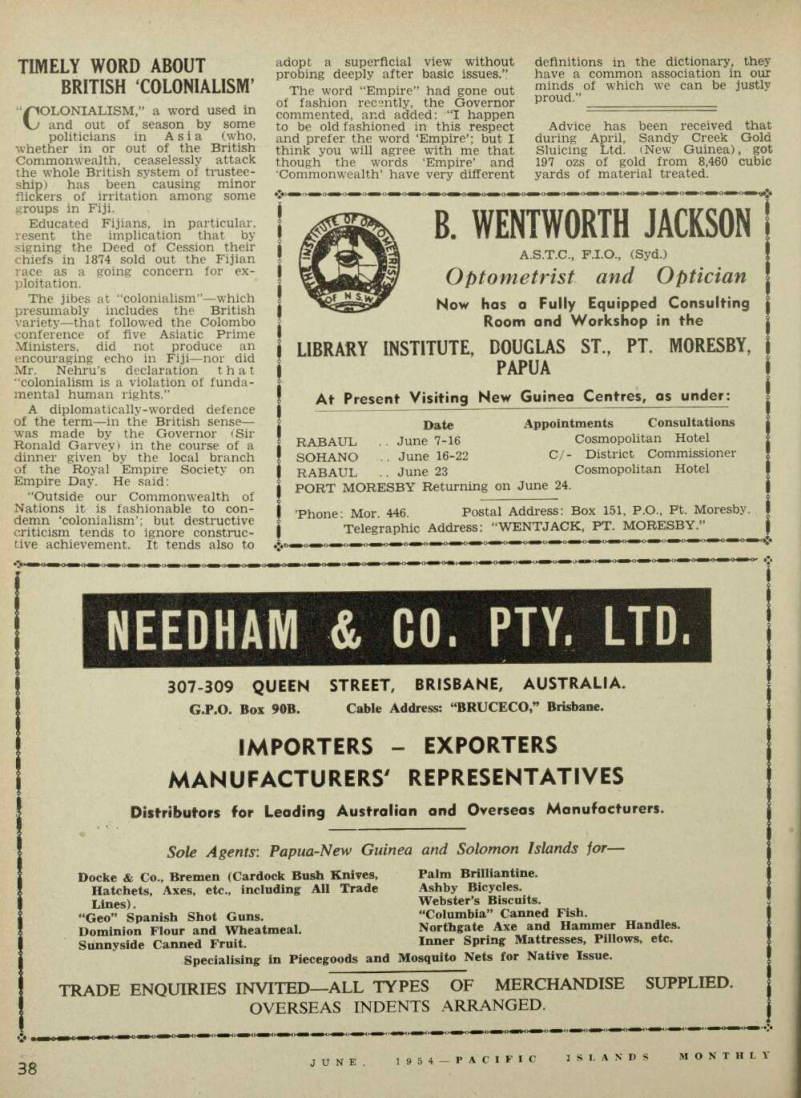
Timely Word About
• /COLONIALISM,” a word used in Vy and out of season by some politicians in Asia (who, whether in or out of the British Commonwealth, ceaselessly attack the whole British system of trustee ship) has been causing minor flickers of irritation among some groups in Fiji.
Educated Fijians, in particular, resent the implication that by signing the Deed of Cession their chiefs in 1874 sold out the Fijian race as a going concern for ex ploitation.
The jibes at “colonialism”—which presumably includes the British variety—that followed the Colombo conference of five Asiatic Prime Ministers, did not produce an encouraging echo in Fiji—nor did Mr. Nehru’s declaration that “colonialism is a violation of funda mental human rights.”
A diplomatically-worded defence of the term—in the British sense— was made by the Governor (Sir Ronald Garvey) in the course of a dinner given by the local branch of the Royal Empire Society on Empire Day. He said; “Outside our Commonwealth of Nations it is fashionable to con demn ‘colonialism’; but destructive criticism tends to ignore construc tive achievement. It tends also to
adopt a superficial view without probing deeply after basic issues.”
The word “Empire” had gone out of fashion recently, the Governor commented, and added: “I happen to be old fashioned in this respect and prefer the word ‘Empire’; but I think you will agree with me that though the words ‘Empire’ and ‘Commonwealth’ have very different
definitions in the dictionary, they have a common association in our minds of which we can be justly proud.”
Advice has been received that during April, Sandy Creek Gold Sluicing Ltd. (New Guinea), got 197 ozs of gold from 8,460 cubic yards of material treated.