Distinguished Visitors
p. 19 · Read in the full issue
IN
American Samoa
Arrangements which covered the official call at Pago Pago of the French High Commissioner in the Pacific and Governor of New Caledonia, Mons. Raoul Angemarre, were shaped, to an extent, by the troublesome Rhinoceros Beetle situ ation in the South Pacific.
His Excellency, travelling in the French corvette La Perouse (781 tons, 8 officers and 100 crew), arrived early on April 27, and was warmly welcomed by Acting-Governor A. M.
MacQuarrie and Mrs. R. B. Lowe (whose husband, Governor Richard Barrett Lowe, was absent in Wash ington). After a day of ceremonies, entertainments and inspections, most of the officers had to depart, to take the ship outside the har bour, so that any night-flying beetles which she might have picked up m Futuna and Wallis Islands,
or in Fiji (all now contaminated) might not get ashore in American Samoa.
The French Governor and other officials were entertained at a formal dinner at Government House, and left by launch at 9 pm, to join the corvette at sea, en route to French Oceania.
La Perouse is named after the famous French navigator who dis covered many Pacific Islands towards the end of the eighteenth century.
On one of his voyages, La Perouse called at Massacre Bay and Aasu, on the northern side of Tutuila.
There was a clash here with the natives, and several Frenchmen were massacred —hence the name.
A party of men from La Perouse hiked over the central range from Pago Pago to visit these historical spots.
There has been interesting activity on Palmyra—an equatorial atoll be tween Hawaii and Tahiti, and de serted since the war. Details will be given in a PIM article in July.
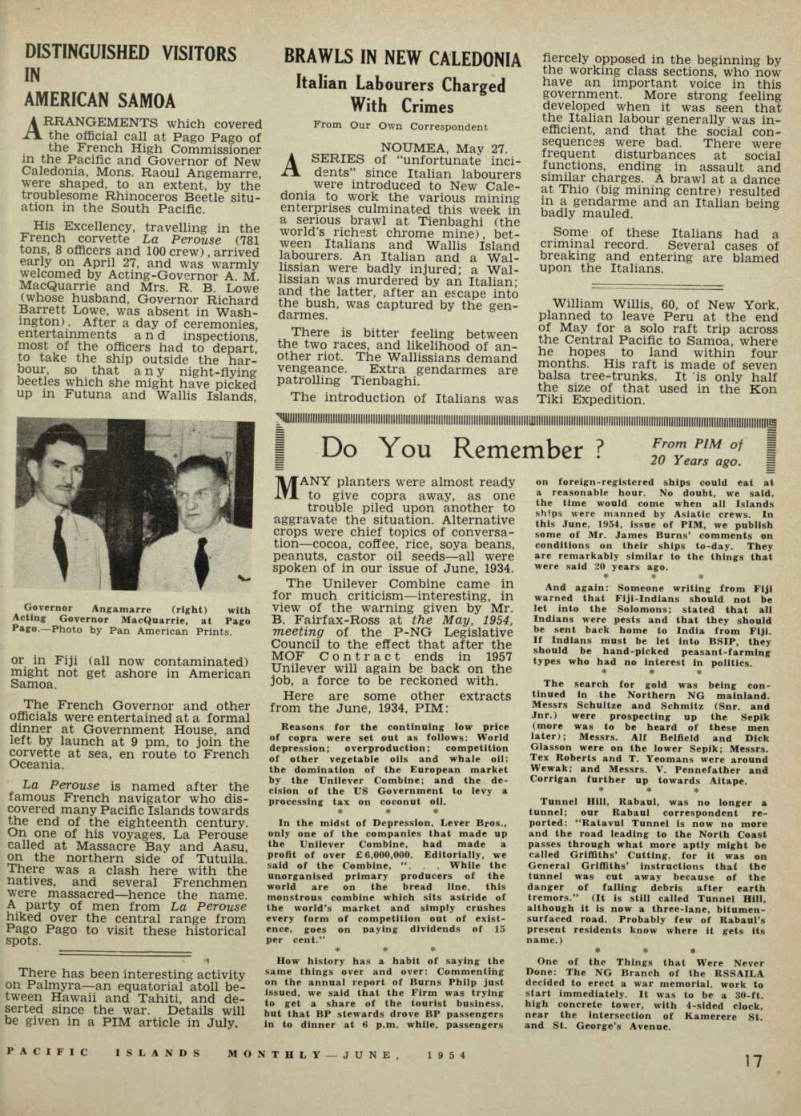
Governor Angamarre (right) with Acting Governor MacQuarrie, at Pago Pago.—Photo by Pan American Prints.