Menace Of Our Near North
pp. 159-160 · Read in the full issue
Bad Political and Economic Conditions In Philippines and Indonesia
ONDITIONS in Philippines and Indonesia, which are two
thickly-populated, independent
tposts of Asia, are of much in •est to the South Pacific countries, [f they maintain strong and ierly governments they can serve a protective barrier for the uth Seas. But if—as now appears be the case in Indonesia —they e their capacity for self-govern ;nt, and begin to slide towards mmunism, they can become a mace to our future. rhe United States gave the llippines full independence after Drld War II; but, although the mtry still is under American in ence, observers are not happy out what they see going on there, ministrative inefficiency and cor jtion in high places are encourag \ the growth of Communism, rhe Hukbalahaps (Philippines mmunist organisation) are sup sed to have been broken up and ven into the remoter mountains, tually (say observers recently in 3 Philippines) vicious landlordism and almost incredible poverty tong the masses, are driving Dusands into the Huk ranks; and and influence, and Huk terrorism, j encountered as soon as one ,ves the larger centres. 7 was thought that, when Mag saysay was elected President a few weeks ago, there would be \ changes. Magsaysay may be nest and sincere; but he will have *at difficulty in putting through i necessary fundamental reforms, ainst the opposition of the com ircial barons and powerful land ds. \ great part of the arable land of 3 Philippines is owned outright a limited number of landlords, to mostly live in the big cities and ploit the peasants. They do not nt Communism—but neither do ;y want the land reforms which ; imperative if the peasantry are be kept quiet and contented and ay from Communism. \Jr. H. E. Maude, OBE, Member Social Development, South cific Commission, attended a con ence in Manila recently, and took 3 opportunity of going out, far ;o the country, to examine some :ial project in which he is in ested. He found the country so turbed —the result of poverty and iccntent —that he could not get ck to Manila, within the time 'anged, until he was assisted back police armed with machine ns.
A friend on the West Pacific Line motorship Citos, recently loading timber in the Philippines, writes: “To my inexperienced eye, Manila is a mess. Beauty and the beast of poverty, cheek by jowl. The pesa (approx. 5/- Australian) is unac ceptable outside of the Philippines.
The Manila Hotel (losing at the rate of 50,000 pesas a month) is always full of regally-dressed men and women, who pay a small for tune for a very ordinary meal. Yet at every street corner, with a double puard near the churches, you hear: ‘Please give me five pesas— I am hungry—l want five pesas to buy some bread.’ 25/- seems a lot of money for a hunk of bread!
“We loaded 430,000 super feet of logs at Kennedy Bay—a new con cession being opened up by an American firm, the guiding spirit of which is 37-years-old Don Ayre ton, who has come into prominence within the last few years. We took 55 hours for the job. Captain Killi man later remarKed that they had taken 11 hours at Powell Harbour to load 372,000 super feet, using the ship’s crew as stevedores, and with natives on the logs. Ayreton, who does the opening-up part of his Company’s timber concessions, had brought over a team of Filipinos, handpicked.”
MEANWHILE, conditions con tinue to deteriorate in Indo nesia, where a ragtag-and bob-tail Government is functioning weakly. The nation is divided into three sections — the Javanese Nationalists, who provide the Re publican government: the Moslems (who are themselves divided into
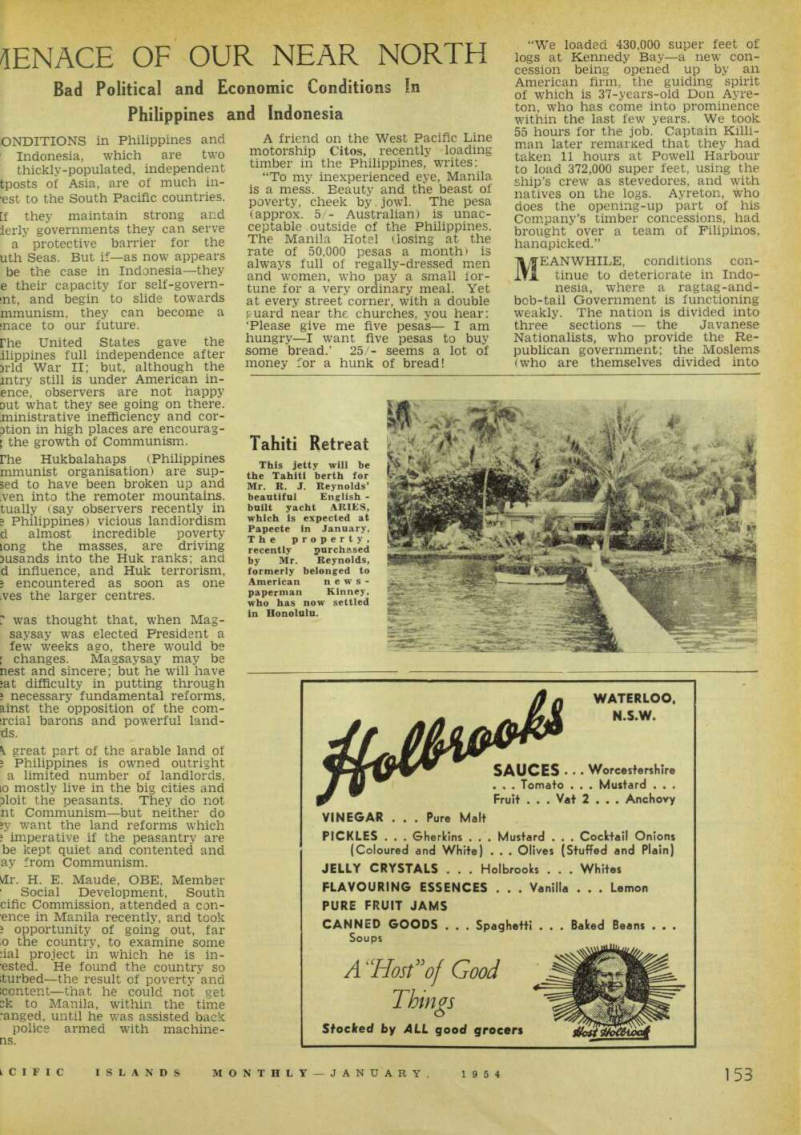
Tahiti Retreat
This jetty will be the Tahiti berth for Mr. R. J. Reynolds’ beautiful English built yacht ARIES, which is expected at Papeete in January.
The property, recently purchased by Mr. Reynolds, formerly belonged to American news paperman Kinney, who has now settled in Honolulu.
two sections, moderate and ex tremist—the latter being the Dar ul-Islam) and the Communists.
The latter are the best organised and they are ruthless and always on the job—their influence seems to be growing steadily.
Early in January, the news agencies reported a growing ten dency for the Indonesians to attack the Dutch, who still retain valuable interests there, especially in trans port and shipping, it is believed
that the Indonesians plan to pus the Dutch out of the country en tirely, and seize their property.
The Djakarta politicians are tn mg to divert the people’s attentie from the country’s tragic politic* economic condition by (a) threaten mg to seize Western New Guine from the Dutch and (b) encouragiri attacks upon the persons and pr« perty of the Dutch remaining in In donesia. A move to put an end t the Netherlands-Indonesian Unic (still officially in existence) is im mment. rOM what I could see, tM Dutch are themselves i blame for the way the Ind« nesians hate them,” said a his Australian official, recently in Dis karta. “The Dutch, in their rels ticns with the Indonesians, behax with the same high-handed am gance as in the days before Wor; War ll—they cannot understar that the whole Asiatic world hs changed—l refer especially to Indii Pakistan, Burma, Ceylon, China and that the Indonesian objec; furiously to being treated as a per son of inferior status. The Indo nesian attitude to Australians an Americans is quite friendly—vei different to the face they show t the Dutch.”
This traveller said that the stead penetration of Indonesia by Com munist influence can be seen i some directions. While he ws there, there was a meeting of filiJ people, to prepare for a Moticc Picture and Film Festival in Hon Kong. It was proposed that it W a rule that no Communist film U shown at that Festival. The In donesians immediately objected they said that they would not co operate if the proposal was accepter The discussion is still going on.
Moves are afoot in Djakarta t very considerably extend trade re lations between Indonesia air Communist China and Russia.