Royal Visit
pp. 139-141 · Read in the full issue

Fiji Indians And
Overseas Misrepresentation
By Frank Ryan
h Fiji, as also in other Islands groups of the South Pacific, there is a growing feeling of ritation and resentment at the isrepresentation to which Islands jople are frequently subjected by urnalists who, in their urgent ssire for a “bright story”, will sregard the ethics of their pro ssion and, in their exaggeration id misrepresentation, make a mentable return for the tradi jnal Islands hospitality shown ,em.
A typical example was seen in the reless disregard of facts shown r some visiting journalists, when ey sent overseas a totally roneous impression of Indian m-co-operation in the welcome tended to Her Majesty the Queen.
In the past the Indian community Fiji has been accused—and, ssibly, with good reason—of Ihering too closely to Mother dia and of not entering more lly into the general life of the mmunity. But both during the ironation celebrations, and during e Royal visit, no accusation of is sort could be sustained.
Actually, the decision of the dian people, as represented by the dian members of Legislative •uncil, not to organise any special dian welcome but to join with e rest of the community in a neral welcome, was actuated by peal and very sensible motives. [t was understood that the cere mies of welcome were to be per •med by the native race; and, >m the time of the ceremonial station to land, given on board ; Gothic, until the farewell song, lian ceremonies predominated, number of Gilbertese people who ne specially to Suva to see the ieen brought with them some mtiful costumes for their dances; fc this plan had to be forbidden wever regretfully, in order to e proper precedence to the lan people—a decision which s generally approved by all other nmunities in Fiji.
Consequently, instead of over ding the programme with their n communal welcome, the nan people crowded the streets, ng with others, and thus helped isiderably to swell the thous ds of onlookers at the Fijian emonies. hdian representatives attended ; State Dinner at Government use and also the State Ball, ring the Coronation celebrations, i also during the Royal Visit, iian shops were lavishly :orated.
In fairness to the Indian people it should be made clear that their decision to co-operate with the rest of the community, instead of de manding separate ceremonies, is a tendency which should be en couraged, and which is generally welcomed in Fiji. Apparently this was not realised by visiting journa lists who had not taken the trouble to verify information mischievously given them.
The address of welcome to the Queen came from all sections of the community and was read at a special session of the Fiji Legis lative Council by Ratu Sir Lala Sukuna, Secretary for Fijian
Affairs; and, supporting him, were a European and an Indian member.
This spirit of unity was indeed a very desirable feature of the Royal visit. The desire of the Indian people to join in a general welcome seemed particularly appropriate when in her reply Her Majesty re ferred to the peaceful way the various races in Fiji worked to gether for their general advance ment. 1953 was one of the driest years recorded in Samoa. The average annual rainfall is 112.89, but 1953 had only 76.23 inches. Only 1912 showed a lower rainfall—namely 69.50 inches.
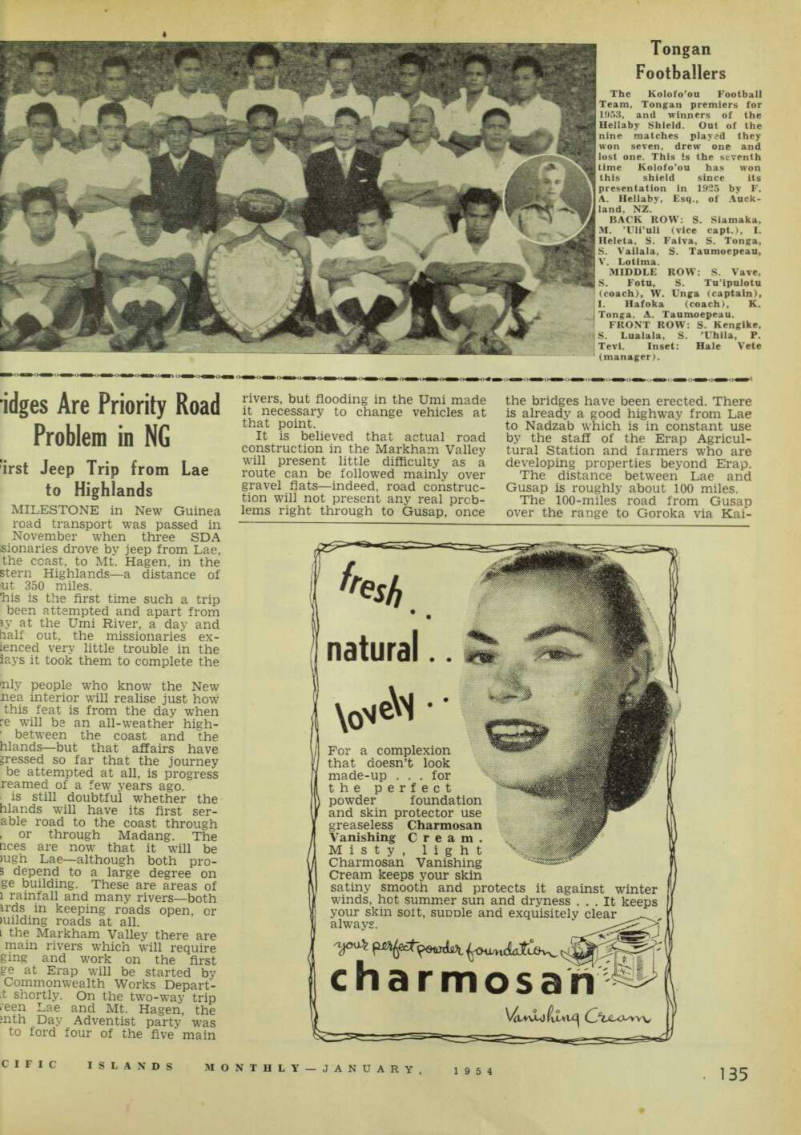
Tongan Footballers