Pearling Industry
pp. 99-101 · Read in the full issue
Origin Of Torres Strait
By W.H.M.
Quick Thinking By Kanaka In 1869
It is about 84 years since Captain William Banner, trading to Torres Strait for beche-de-mer in the schooner Bluebell, from Syd ney, helped to make the momentous discovery which transformed the area between North Queensland and New Guinea into rich pearling grounds.
Banner had set up an establish nent on Warrior Island, known to ;he natives, as “Tu-Tu” or “Toot”, )ut receiving its English designation Tom the attack made by its canoe oads of fighting men on William 31igh, when he sailed through the Strait in Providence and Assistant n 1792. Captain Banner took pos lession of the nor’west side; and, >efore long, a mixed community of Forres Strait people and South Sea islanders were working together, lore or less amicably, collecting repang for the white man’s enter >rise.
While the Captain was taking a argo of cured fish to Sydney, early n 1869, he left the station in charge if a Kanaka a man who had erved in various ships, including IMS Leopold at the seige of Sebas opol. During the skipper’s absence, ome of the Tutu men showed the
Kanaka-deputy where they obtained the pearlshell to make the hand some neck and breast ornaments they wore.
That was the beginning of the activities on the famous Wappa Reefs.
When Banner returned, he was surprised to find that his trusty henchman had six tons of shell waiting for him. Straightway he took it to Sydney, as a sample.
“Plenty more where that came from!” he told the firm of Merri man. “The natives declare it’s lying there thick, just like putting vour hands one on top of the other.”
And so the beche-de-mer fishery was abandoned for the more cleanly and lucrative pearl-shell trade.
The brig Pakeha was sent to help the Bluebell. In the next six months, another 50 tons of shell had been collected and despatched to Sydney.
Seven boats built by the Sydney firms of Macbeth, Russell, and Stephens were employed to assist in gathering shell, fetching wood and water from neighbouring islands, and so on. They were sturdy craft, about 30 feet long, with an eight foot beam, bow and stern alike, fur nished with two standing lugs, and they stood up to the weather well,
carrying four tons of shell. With masts, sails, oars, anchor and chain, etc., these little-maids-of-all work cost only from £6O to £7O each, all ready for sea. It is interesting to compare boat-building prices to day!
Lieutenant h. m. Chester, then at Somerset’s recently formed settlement at the top ©f Cape York, paid a visit to the
Warrior Island pearling statipn
shortly after it started off on its new industry. He furnished some reports which provide a picture of the set-up.
About 70 Kanakas, in Captain Banner’s employ, were housed in grass buildings; the captain himself occupied a corrugated-iron struc ture. Each of the smaller boats re ferred to had its captain, and con siderable rivalry existed concern ing both the sailing qualities of the craft and the amount of shell picked up.
The boats started for the reefs on Monday morning at daylight, remained out all the week, and re turned on Saturday night, guided to the island by large fires kindled as heacons. The largest take in one week was 2,500 pairs of pearlshell.
The oysters were found in from six inches to three fathoms. Opened as soon as landed, the shell was left to dry in the sun for 24 hours, after loose pearls had been removed, and was then stacked. Some of the shell weighed up to thirteen pounds; but the average weight was four pounds a pair.
Chester records that Captain Ban ner was treating his men well: “The maize-meal flour and molasses issued to them was of good quality,” and there appeared to be no dis content.
On a later occasion Lieutenant Chester himself did some shell bartering with natives of Jervis
Island, and mentions that the rate of exchange was 10 pairs for a small knife or tomahawk, and 5 pairs for a piece of iron to make a fish s P ear - Shell was at that time £l6O to £245 a ton in the London market. It was no doubt, possibilities of good profits such as this, led him to try and form a, “Queensland Fearl shell and Fishery Com-
pany” in Brisbane in 1872. An old prospectus, announcing 5,000 shares at £1 each, suggests that investors would get 100 per cent, on their out lay; but the project was still-born.
Wading and swimming on the reef at low tide was the earlier method of collecting shell in the Strait. Native women worked with the men; but skin-diving methods
were partly replaced by the intro duction of diving equipment used by professional white divers. The “Pearl Fishery Company” had ideas about gathering the shell with dredges. The “apparatus boats,” as they were called, employing dress drivers, enabled deeper waters to be prospected. Some wonderful catches were reported. In 1871 the value of shell taken was given as £25,000.
NATURALLY, news of the poten tial wealth of the Strait could not long remain secret, and vessels were soon streaming in to the scene of Banner’s discovery. At this time, it may be remembered, the waters were outside Australian territorial boundaries; there was little official control, and pearlers were free to conduct their business unhampered by any laws. Some of Banner’s less scrupulous competi tors caused trouble in neighbouring islands through their crews going on the loose.
Mr. M. E. Wells completed his erm in Suva as representative for ICPA and returned to Sydney in December. His place has been taken y Mr. J. R. Webster, Mr. A. H. Davies completed a hree-year term as manager of the lank of New South Wales at Suva i December. He will shortly ransfer to Australia to become issistant Inspector for Victoria. Mr.
C. Thomas, at present manager f the Post Office Branch of the lank at Brisbane, has been ppointed manager at Suva.
Butter Now Luxury in Apia
WITH the recent removal of the Government subsidy on butter in W. Samoa, the price rose from 2/6 per pound to 4/3 at the beginning of November.
Butter is thus now a luxury in W. Samoa, though probably no more so than in many other Island areas —notably the S-W Pacific where it is about twice that price. tl Mr. J. H. Luxford, recently elected Mayor of Auckland, NZ, was form erly Chief Judge in Western Samoa.
U Judge A. McCarthy, who recently reired as Judge of the High Court and Chief Judge of the Land Court in the Cook Islands, has accepted a relieving appointment as Acting Chief Judge, Western Samoa, in the absence of Chief Judge Marsack, who is on furlough in New Zealand.
Judge McCarthy arrived in Apia late in November.
H Fernando Malevitch has been elected King of Ulithi Atoll, in Micronesia, in succession to King Ueg, who recently died.
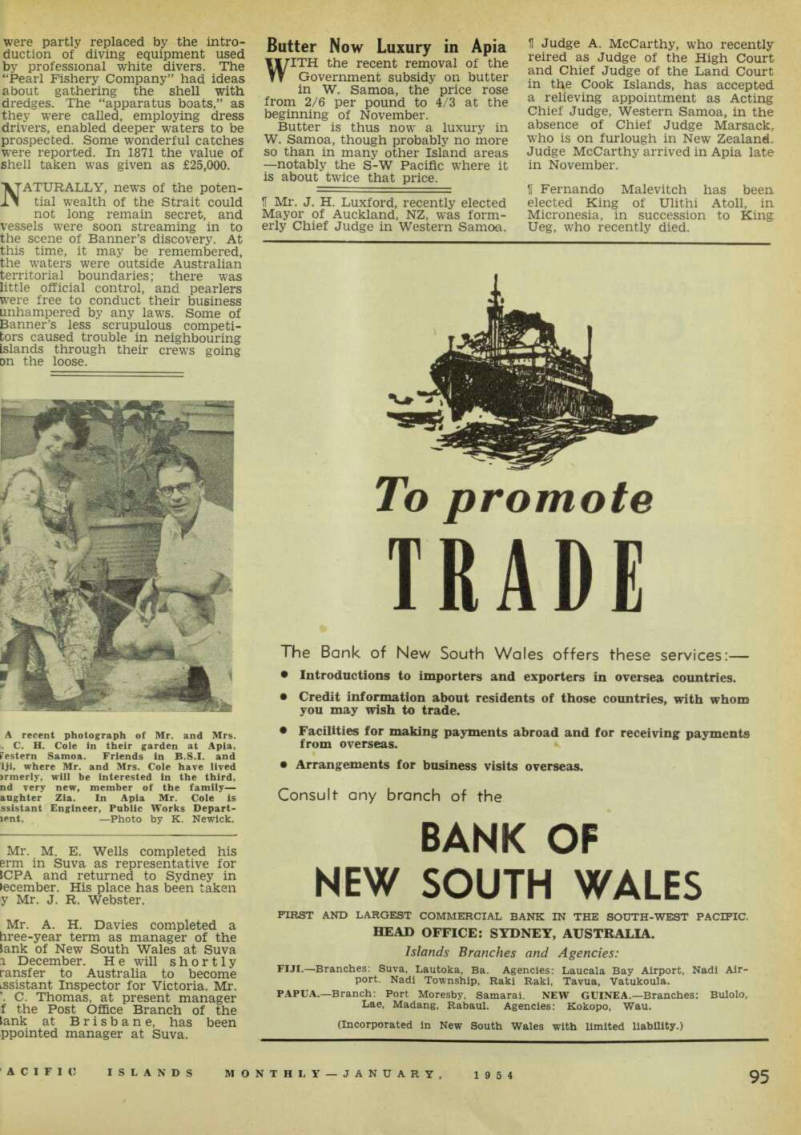
A recent photograph of Mr. and Mrs.
C. H. Cole in their garden at Apia, Western Samoa. Friends in B.S.I. and Fiji, where Mr. and Mrs. Cole have lived prmerly, will be interested in the third, [?]nd very new, member of the family— [?]aughter Zia. In Apia Mr. Cole is [?]ssistant Engineer, Public Works Depart [?]ent. —Photo by K. Newick.