By Launch Th ough the Rewa Delta
pp. 82-83 · Read in the full issue
By Jps
ONE of Fiji’s most interesting attractions—and one of the most accessible from Suva — is a launch trip through the tortuous waterways of the Rewa Delta.
The reason that it is not in cluded in the regular scheduled trips arranged by the enterpris ing Fiji Visitors’ Bureau is be cause the journey is governed by state of tide and the availability of a suitable launch. A day trip could be made only about once per fortnight, and the trip, to be fully enjoyed, should occupy two days—and launches are not readily available to meet this latter requirement.
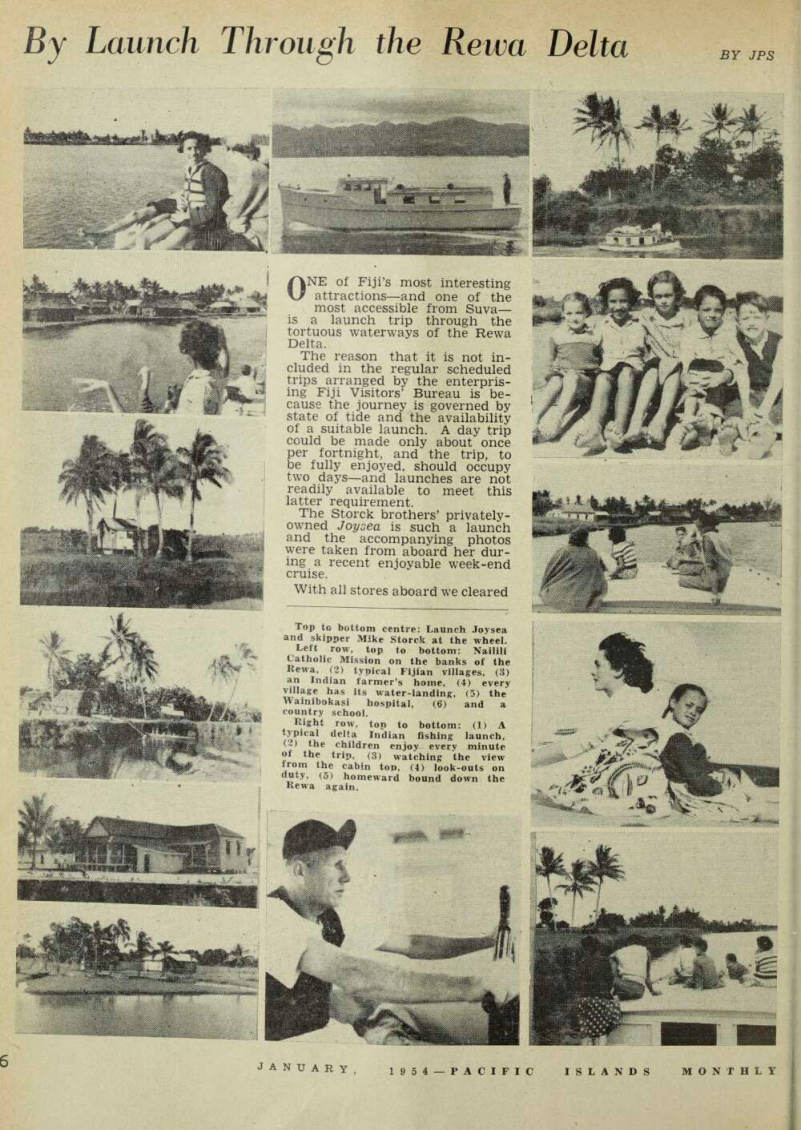
The Storck brothers’ privately owned Joysea is such a launch and the accompanying photos were taken from aboard her dur ing a recent enjoyable week-end cruise.
With all stores aboard we cleared
Top to bottom centre: Launch Joysea and skipper Mike Storck at the wheel.
Left row. top to bottom: Nailili Catholic Mission on the banks of the Rewa, (2) typical Fijian villages, (3) an Indian farmer’s home, (4) every village has its water-landing, (5) the Wamibokasi hospital, (6) and a country school.
Right row. ton to bottom: (1) A typical delta Indian fishing launch, (2) the children enjoy every minute of the trip, (3) watching the view from the cabin top, (4) look-outs on duty, (5) homeward bound down the Rewa again.
Suva wharf at the crack of dawn on a clear fine tropical morning, put out the trolling lines, and sailed south round Suva Point and the just-awakening suburbs, with the odour of a tasty breakfast floating up from the galley. We ate it with Lauthala Bay and its flying-boats abeam to port and the largest of the Rewa’s five mouths opening out ahead, the tide hurrying us along.
Visitors from overseas are always surprised to discover such large rivers in an island of the compari tively small size of Viti Levu, and the Rewa is, in fact, the largest river system anywhere in the Pacific Islands with the exception of New Guinea. Roughly a hundred miles long, its lowfer reaches are extremely tortuous, a fact which can only be fully appreciated from the air. The lower delta consists of huge areas of tidal mud-flats densely over grown with mangroves, and inter sected by numerous narrow water channels. It is an unpleasant place of steamy heat and objectionable odours. But a little further up, these shoals become dry land, the main banks of the river fall sheer, standing ten feet above the normal river level, with miles of waving green sugar cane approaching to the very edges and separated from the river only by the narrow foot tracks that connect the Fijian vil lages and Indian homes along the banks. We pass the Nailili Catho lic mission station away on our ■ight and the hulk of the old Tui \auvaro stranded against the bank m our left, then take a sudden 'ight turn into the narrow Wainibo casi creek—which is nothing but me of the outlets of the Rewa.
Then for an hour or two the rip is full of interest—and skipper Hike very fully occupied—as the ide sweeps us round sharp curves vhich form three-parts of a circle it times. At some of these bends ye gently nose the bank, go astern, inship a long bamboo pole and ease •ur bows round while swarms of ittle Fijian boys, with tummy ength shirts but no trousers, yell nth delight and heave lengths of ugar-cane aboard, then dash across he isthmus to meet us again for a epeat performance as we almost omplete a circle. Down in the fater, Indian women, busy at their sundry, pause for a moment as our '.ash sweeps by but, as is their wav ive neither a wave nor a smile We pass the old Wainibokasi ospital, where most of the atients rush from bed to the ver ndahs to cheer us on our way. At itervals the dense cane opens out d make room for a Fijian village f the unattractive home of some adian squatter with its few coco ut palms or breadfruit overhanging , and the inevitable, long, flat ottomed boat tied nearby to the
ank. Occasionally an Indian
lunch, loaded to the gunwales with
men and gear, chugs back against the current from a fishing expedi tion.
Then the cane is left behind again, the channel is back in the mangrove swamps and presently we are out on open water with a line of beacons pointing away to the north on the sheltered behind-the reefs path to Ovalau Island. Out here there are anchorages in ideal fishing spots amongst the reefs that encircle the pretty little Robinson Crusoe island of Leleuvia, its neigh bours Caqalai and Nasautabu, or any of the others towards Ovalau A launch can lie snugly at anchor here all night, with all hands busily hauling aboard a variety of fish to provide dinner and breakfast—then home next day on a fair tide, back through the delta—by another route if desired.