Tropicalities
pp. 79-80 · Read in the full issue
Magazine Section
From Brede Place To
Melanesia
CAPTAIN Hugh Frewen, who is well known in Fiji waters, where he does some smallships trad ing in the Melanesia, returned to Australia at the end of November after nine months in the United Kingdom.
At one stage of his career, about 30 years ago, he worked as a journalist on the Adelaide Ad vertiser, and when he passed through Adelaide in November, the Advertiser printed a long article about the Captain—all very Debrett.
Captain Frewen’s daughter-in law, who is Lord Selby’s daughter and Anthony Eden’s cousin, was mentioned—plus Sir Eugene Mill ington-Drake, a retired ambassador, the Swedish Ambassador, the King of Libya, cousin Sir Winston Churchill and Lady Churchill, a youthful Spanish Don, another cousin, Sir Shane Leslie, and his sculpturing sister, Clare Sheridan, who lives in an oasis in the Sahara desert.
During his stay in England he revisited Eton and the ancient Frewen family manor, Brede Place, in Surrey, which is now owned by his eldest son. At present Captain Frewen is at his home in Dorrigo, NSW. but he expects to return to Fiji in the New Year.
More About Coconut
Pearls
DO Pacific Island residents ever come across coconut pearls?
They’re rare enough to be priceless: in fact too rare to be of any commercial value. The first one was discovered in 1741, and more than a hundred years passed before another one was found. A few have been found in Fiji; one or two in the Torres Straits, and about 30 years ago ona was found in Tonga. It was a tiny pearl and clear amber in colour.
In Java and the East Indies the vegetable pearls, sometimes as large as cherries, are found in the joints of the bamboos and occasionally in the wood of the teak and pome granate trees. They are probably formed by an excess of calcareous and siliceous matter in the plant.
They do rank as real pearls, since they consist of almost pure car bonate of lime, which goes to make up the oyster pearl.
In the coconut the pearl is caused by the seedling being unable to escape through the three soft dents for that purpose in the end of the nut. When these dents become as
hard as the rest of the nut, the imprisoned seedlings cause a growth of carbonate of lime which forms the pearl in much the same way as the oyster pearl is formed.
In the East Indies they are valued very highly as charms, and the owner of one cannot be induced to part with it as he believes himself immune from all evils while he re tains possession of the pearl. Any way, he will not in a lifetime be likely to find another one to match
It.—Glenn Macgregor.
(PIM published numerous articles on coconut pearls about two years ago—at first and until corrected, taking the view that the whole thing was a fairy story).
Lightning Strikes Differ
Ently In The Bsip
SEVERAL readers have sent us, with suitable comment, an article which appeared some weeks ago in the Melbourne Herald and came from the Herald Special Service in London.
The'article says, in part: Nowhere else in the South Pacific does lightning strike with the same fearful force as in the Solomons.
Until the eve of the war, planters in
the Solomons crossed their fingers when the clouds banked and blackened and tropical lightning seared the wet sky.
By the end of 1936, the books of Levers Pacific Plantations Pty., Ltd., listed 110 acres of coconut palms lost by lightning since Levers started planting in 1905.
But on the eve of the war, tropical agriculture researchers supplied the answer. Now new planting is confined to country where the soil contains iron stone—which seems to disperse lightning strikes.
There are three columns more of the article —dealing with everything from the American invasion to the founding of the Protectorate—and most of its sounds like a good leg pull of some innocent, visiting journalist by some wicked resident of the BSIP.
In regard to the beneficial effect of ironstone —we have paused to shed a tear for the owners of the thousands —maybe millions—of acres of coconuts planted in the South Seas in just plain coral.
When I was in the Highlands of NG last April, one of the local re sidents pointed out a spot some thousands of feet above, which, he said, was famous for the ferocity of its electrical storms. The reason: the whole darned place was com posed of ironstone, which attracted the lightning!
Some of these Territorians will
tell you anything.
JT.
Case Of The Neuter Cats
WRITING to the Sydney Morning Herald recently, with consider able feeling and a certain re finement, a Sydneysider had this to Say: (Over)
Five months ago I went to Suva with the intention of settling there and I took two treasured pals—a Siamese cat, aged nine years (neuter male), and a younger black cat (neuter female).
I have found it necessary to return to Australia, but I am not allowed to bring back my pets. Not even for quarantine.
I am told that if I take them to England for six months’ quarantine I may then bring them to Australia for quarantine. 1 cannot afford to do this.
I have it from the Government veterinary officer in Suva that there are no cat diseases in Fiji that are not already in Australia.
Does it not seem unreasonable not to allow healthy neuter cats to return and be placed in quarantine for observation?
Although, traditionally, people who make a fuss about cats are looked upon with tolerant amusement (while a similar fuss about dogs is supposed to indicate a fine char acter), it is a fact that the regula tions governing the re-entry of cats and dogs into Australia from the Islands are patently absurd.
People who take these animals, de-sexed or otherwise, from Aus tralia to Fiji or Papua-New Guinea (and we presume elsewhere in the Pacific) are warned that they can not bring them back, although there are no cat or dog diseases, in P.NG or Fiji that are not already present in Australia. To our knowledge, there has never been a case of rabies amongst dogs in these Pacific territories; yet animals from Europe, where this disease is present, are admitted to Australia after the usual period of quarantine.
And, as the SMH reader points out, if the Fiji or NG owner likes to send his pet to England for the necessary period of quarantine he can then bring it into Australia.
There is a branch of the RSPCA in Fiji. Perhaps they could bring some pressure to bear in the right places,
She Spurned The “Samoan
Throne”
ONE of the two movies made in the South Pacific last year is cur rently being released in Aus tralia. It is called Return To Paradise— from a story by James A. Michener, and was shot in Western Samoa. Hollywood stars, Gary Cooper and Roberta Haynes, take the leading roles and this is what Melbourne Argus reported about Roberta’s sojourn in Samoa, in some preliminary blurb about the film: The Upolu Islanders accepted her as one of their own, and taught her how to make the native drink of kava, how to dance the papio and to wear the lava-lava, which is more, maybe, than Dotty Lamour knows about the South Seas.
She even had a chance to marry Samoan royalty and to become a queen of the South Sea island she was on.
“Prince Mata’afa, the only un married chief on the island, dated me three times,” she says. “I think
his intentions were serious Any way, he introduced me to his folks.”
Spurning the throne, she returned to Hollywood, where she is right now, doing very well indeed.
Wonder what the Mata’afa family thinks about that!
THROUGH the initiative of New X Zealand writer Ronald Syme, • has spent some months 9? ok Islands, singers at the
T?fS5? nglla • Community Centre,
Karotonga, will entertain New York
radio listeners in the well-known Hands Across the Sea” programme from station WMYC.
Mr. Syme recorded, on tape, a programme “Songs of Rarotonga"
S S T? n if to an a S ent in America. fSfo- 4 lf " 1 ?? ur P ro § ram me was en thusiastically received, in the re cording each item is introduced by f a £ nl P’ a leading chieftainess of the Cooks. Requests for similar pro grammes have been received from America and from the BBC.
A Band Visits Pitcairn
Island
Returning home on the Mataroa, the New Zealand band that had been to the Corona tion arrived at Pitcairn Island on October 16. You should have seen the islanders as they watched and listened in wonder when the band played!
Usually, when the islanders leave the ships on which they have been trading, maybe some miles out at se a they sing hymns as a farewell to those on board. And very touch ing it is to see the tiny boats standing off there, sometimes in the darkness, and hear the beautiful songs coming over the water.
But the band brought to the people of Pitcairn music such as they have never before compre hended because the gramophone is a poor substitute for the reality.
How they listened spellbound and longed for the beautiful recital to continue! Long will they remember the visit of the New Zealand band.
—Myrtle L. Ward.
What Makes Hermits Tick?
MR. TOM NEALE, from his lonely outpost on Suwarrow atoll, Cook Islands, has indicated that he is not particularly pleased with the publicity that he and his tom-cat have had since they took up abode there a year ago. Firstly, the facts were all wrong—there were other cats besides the famous Tom; nor have the cats been out of place in that bird sanctuary. They have left the birds strictly alone and have cleaned out the rats which were feeding on the birds’ eggs.
With hqrmits in very short supply Mr.'-'Neale must expect him self to be news while in his present location. That he is news is re vealed in letters to friends reporting on the extraordinary mail that arrives by the occasional boat from Rarotonga. Recent mail included a lengthly questionnaire from a learned psycho-analyst or ’ologist of some note, bent on discovering what makes Tom tick.
Yachtsmen are welcome,- we un derstand, so long as they first obtain permission from Rarotonga to make the call, and are prepared to bring in a fresh supply of interesting mail —and get out again within 24 hours so that Mr. Neale can get on with his gardening.
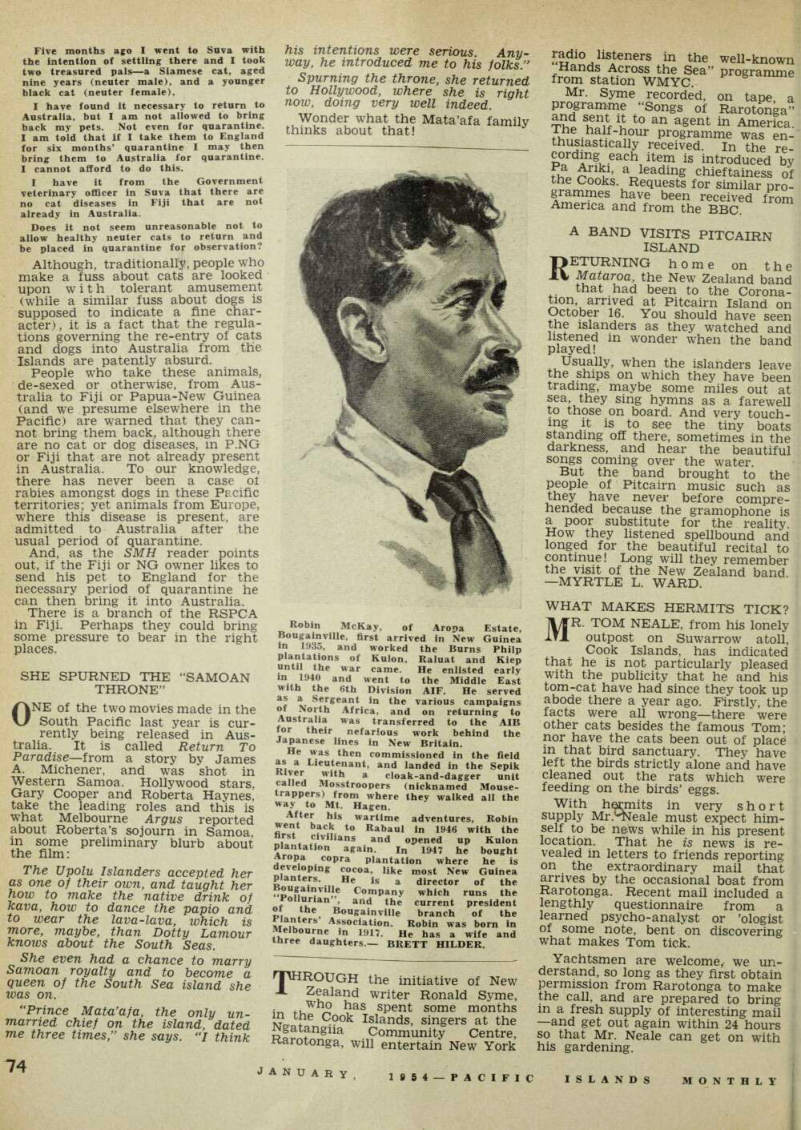
Robin McKay, of Aropa Estate, Bougainville, first arrived in New Guinea in 1935, and worked the Burns Philp plantations of Kulon, Raluat and Kiep until the war came. He enlisted early in 1940 and went to the Middle East with the 6th Division AIF. He served a s a Ser geant in the various campaigns of North Africa, and on returning to Australia was transferred to the AIB for their nefarious work behind the Japanese lines in New Britain.
He was then commissioned in the field as a Lieutenant, and landed in the Sepik a cloak-and-dagger unit called Mosstroopers (nicknamed Mouse trappers) from where they walked all the way to Ml. Hagen.
After his wartime adventures, Robin went back to Rabaul in 1946 with the first civilians and opened up Kulon plantation again. i n 1947 he bought Aropa copra plantation where he is developing cocoa, like most New Guinea Planters. He is a director of the Bougainville Company which runs the "Pollurian" and the current president of the Bougainville branch of the Planters Association. Robin was born in Melbourne in 1917. He has a wife and three daughters. — BRETT HILDER.