New Caledonia
p. 59 · Read in the full issue
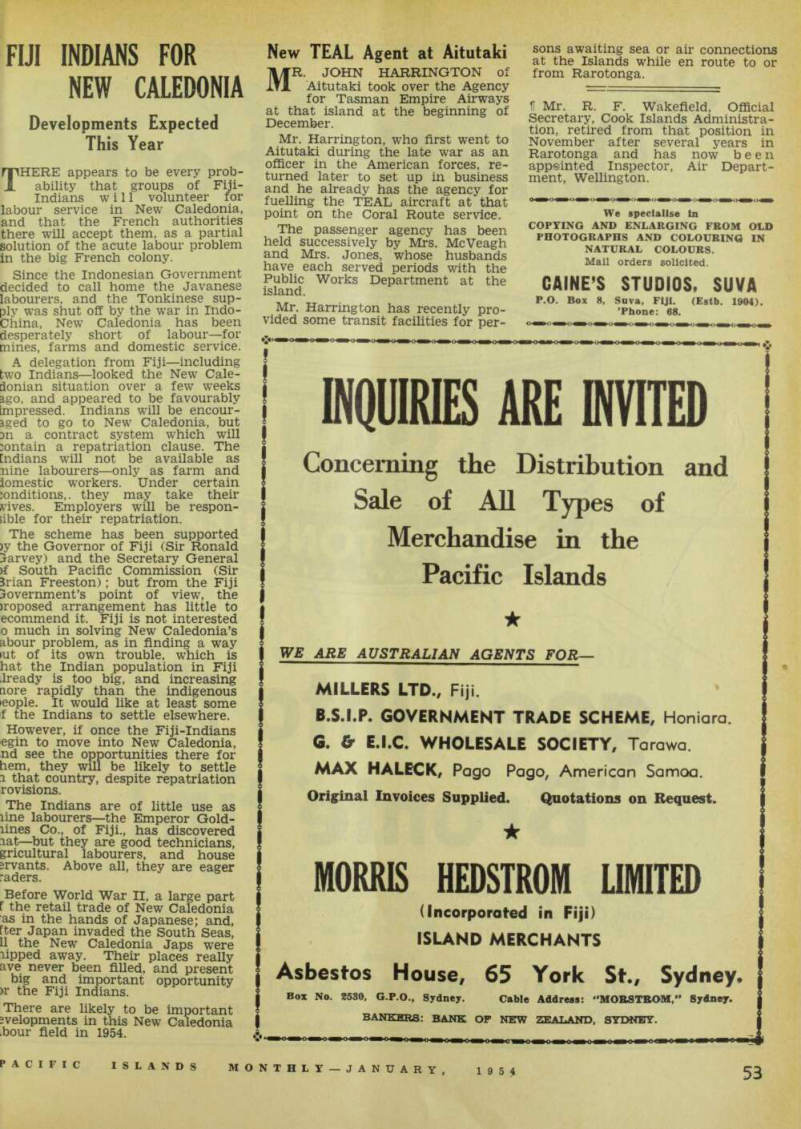
Fiji Indians For
Developments Expected This Year
THERE appears to be every prob ability that groups of Fiji- Indians will volunteer for labour service in New Caledonia, and that the French authorities there will accept them, as a partial solution of the acute labour problem in the big French colony.
Since the Indonesian Government decided to call home the Javanese labourers, and the Tonkinese sup ply was shut off by the war in Indo china, New Caledonia has been desperately short of labour —for mines, farms and domestic service.
A delegation from Fiji—including two Indians—looked the New Cale donian situation over a few weeks ago, and appeared to be favourably impressed. Indians will be encour aged to go to New Caledonia, but an a contract system which will contain a repatriation clause. The Indians will not be available as nine labourers —only as farm and iomestic workers. Under certain jonditions,. they may take their vives. Employers will be respon sible for their repatriation.
The scheme has been supported >y the Governor of Fiji (Sir Ronald jarvey) and the Secretary General )f South Pacific Commission (Sir Brian Freeston); but from the Fiji government’s point of view, the >roposed arrangement has little to ecommend it. Fiji is not interested o much in solving New Caledonia’s abour problem, as in finding a way >ut of its own trouble, which is hat the Indian population in Fiji Jready is too big, and increasing tiore rapidly than the indigenous ►eople. It would like at least some f the Indians to settle elsewhere.
However, if once the Fiji-Indians egin to move into New Caledonia, nd see the opportunities there for hem, they will be likely to settle i that country, despite repatriation revisions.
The Indians are of little use as line labourers—the Emperor Gold lines Co., of Fiji., has discovered iat>—but they are good technicians, gricultural labourers, and house srvants. Above all, they are eager :aders.
Before World War 11, a large part f the retail trade of New Caledonia as in the hands of Japanese; and, fter Japan invaded the South Seas, U the New Caledonia Japs were lipped away. Their places really ave never been filled, and present big and important opportunity >r the Fiji Indians.
There are likely to be important svelopments in this New Caledonia .bour field in 1954.
New TEAL Agent at Aitutaki
Mr. John Harrington Of
Aitutaki took over the Agency for Tasman Empire Airways at that island at the beginning of December.
Mr. Harrington, who first went to Aitutaki during the late war as an officer in the American forces, re turned later to set up in business and he already has the agency for fuelling the TEAL aircraft at that point on the Coral Route service.
The passenger agency has been held successively by Mrs. McVeagh iand Mrs. Jones, whose husbands have each served periods with the Public Works Department at the island.
Mr. Harrington has recently pro vided some transit facilities for per
sons awaiting sea or air connections at the Islands while en route to or from Rarotonga.
IT Mr. R. F. Wakefield, Official Secretary, Cook Islands Administra tion, retired from that position in November after several years in Rarotonga and has now been app®inted Inspector, Air Depart ment, Wellington.