By Tolala
pp. 27-31 · Read in the full issue
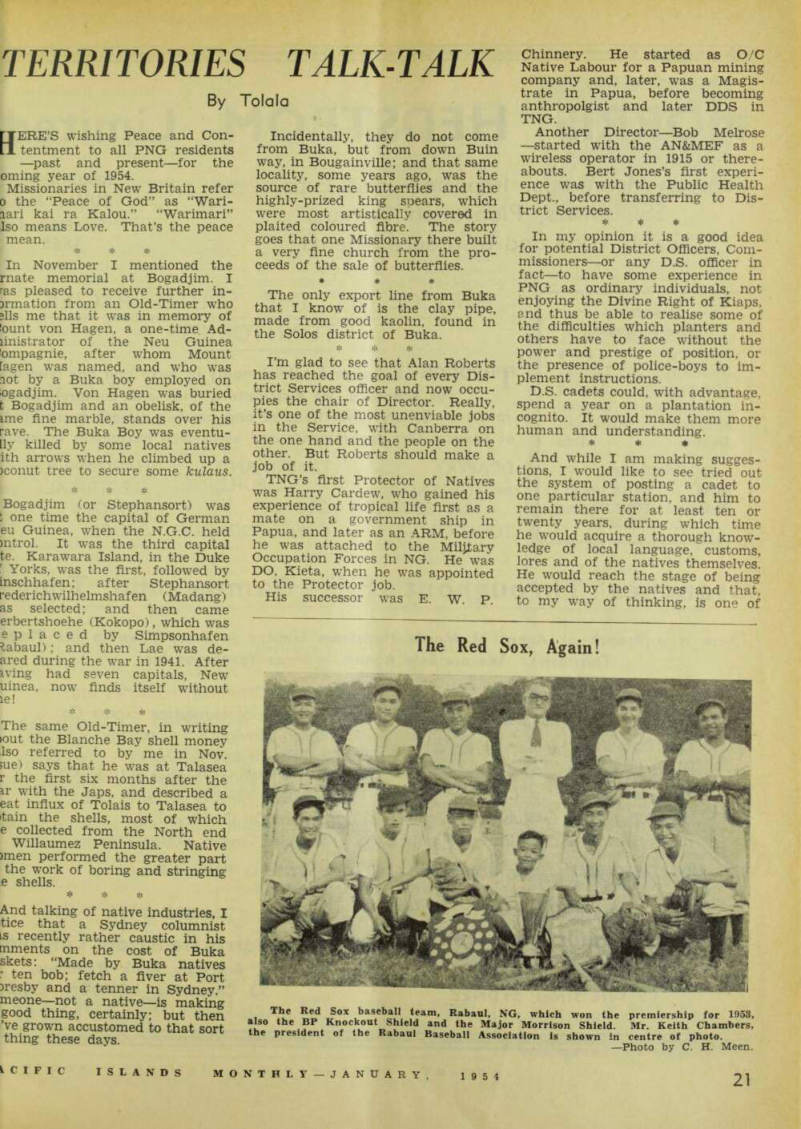
Territories Talk-Talk
SERE’S wishing Peace and Con tentment to all PNG residents —past and present—for the oming year of 1954.
Missionaries in New Britain refer o the “Peace of God” as “Wari lari kai ra Kalou.” “Warimari”
Iso means Love. That’s the peace mean. 5-S sic !(C In November I mentioned the mate memorial at Bogadjim. I ras pleased to receive further in- Drmation from an Old-Timer who fils me that it was in memory of fount von Hagen, a one-time Ad linistrator of the Neu Guinea bmpagnie, after whom Mount [agen was named, and who was lot by a Buka boy employed on Ogadjim. Von Hagen was buried t Bogadjim and an obelisk, of the ime fine marble, stands over his rave. The Buka Boy was eventu lly killed by some local natives ith arrows when he climbed up a >conut tree to secure some kulaus. * * * Bogadjim (or Stephansort) was k one time the capital of German eu Guinea, when the N.G.C. held mtrol. It was the third capital te. Karawara Island, in the Duke [ Yorks, was the first, followed by inschhafen; after Stephansort rederich wilhelmshafen (Madang) as selected; and then came erbertshoehe (Kokopo), which was epla c e d by Simpsonhafen labaul); and then Lae was be ared during the war in 1941. After iving had seven capitals, New uinea, now finds itself without le! sfs $ Jic The same Old-Timer, in writing »out the Blanche Bay shell money Iso referred to by me in Nov. sue) says that he was at Talasea r the first six months after the ir with the Japs, and described a eat influx of Tolais to Talasea to itain the shells, most of which e collected from the North end Willaumez Peninsula. Native )men performed the greater part the work of boring and stringing e shells. * * * And talking of native industries, I tice that a Sydney columnist is recently rather caustic in his tnments on the cost of Buka skets: “Made by Buka natives ten bob; fetch a fiver at Port jresby and a tenner in Sydney.” meone —not a native—is making good thing, certainly; but then ’ve grown accustomed to that sort thing these days.
Incidentally, they do not come from Buka, but from down Buin way, in Bougainville; and that same locality, some years ago, was the source of rare butterflies and the highly-prized king spears, which were most artistically covered in plaited coloured fibre. The story goes that one Missionary there built a very fine church from the pro ceeds of the sale of butterflies. * * * The only export line from Buka that I know of is the clay pipe, made from good kaolin, found in the Solos district of Buka. * * * I’m glad to see that Alan Roberts has reached the goal of every Dis trict Services officer and now occu pies the chair of Director. Really, it’s one of the most unenviable jobs in the Service, with Canberra on the one hand and the people on the other. But Roberts should make a job of it.
TNG’s first Protector of Natives was Harry Cardew, who gained his experience of tropical life first as a mate on a government ship in Papua, and later as an ARM, before he was attached to the Military Occupation Forces in NG. He was DO, Kieta, when he was appointed to the Protector job.
His successor was E. W. P.
Chinnery. He started as O/C Native Labour for a Papuan mining company and, later, was a Magis trate in Papua, before becoming anthropolgist and later DDS in
Tng.
Another Director—Bob Melrose —started with the AN&MEF as a wireless operator in 1915 or there abouts. Bert Jones’s first experi ence was with the Public Health Dept., before transferring to Dis trict Services. * ♦ * In my opinion it is a good idea for potential District Officers, Com missioners—or any D.S. officer in fact—to have some experience in PNG as ordinary individuals, not enjoying the Divine Right of Kiaps, 2nd thus be able to realise some of the difficulties which planters and others have to face without the power and prestige of position, or the presence of police-boys to im plement instructions.
D.S. cadets could, with advantage, spend a year on a plantation in cognito. It would make them more human and understanding. * ♦ ♦ And while I am making sugges tions, I would like to see tried out the system of posting a cadet to one particular station, and him to remain there for at least ten or twenty years, during which time he would acquire a thorough know ledge of local language, customs, lores and of the natives themselves.
He would reach the stage of being accepted by the natives and that, to my way of thinking, is one of
the most important factors in dealing with natives anywhere.
The present drill is for an officer to be posted to a district for one term and then to another on his return from leave; and so on down the years, giving him little oppor tunity of closely studying the very people of whom he is in charge, “ither native or non-native. And this does not make for complete understanding, which is so neces sary in a Black Country. rHE Long Residence Stakes: Several letters have come to hand touching on this topic, md at the moment the selection ;eems to go to two of 1915 vintage, vho are still resident in TNG, >oth of whom I met recently in Sydney town looking the picture of lealth. They are Vic Pennefather md Tex Roberts.
Vic was D.O. with the AN&MEF md stationed at Namatanai. He uccessfully tendered for the Expro »oard property Tokua, where he ,has esided for the past 27 years.
Tex was in AWA, attached to LN&MEF. and about 1920 he started , taxi business and garage in labaul. Later, he acquired planta ion interests in the Bainings and [own the South Coast of New Britain.
As runners-up I should say Mrs. lawnt and daughter Marjorie (now Irs. Blake). Mrs. Dick Moore, [alien Evans and Tom Ellis were rell to the fore. They all arrived i 1920. Another arrival about this ime was Gilbert (How’re yer late?) Renton, who from a plum er in the Public Works at Rabaul as become one of the most ffluent of TNG residents, when he
is not flying off to the Old Dart or some other part of the world. ❖ * It is certainly time that the First Gentleman in PNG should receive a more senior designation than Ad ministrator, a title which always reminds me of intestate estates. In this regard both Papua and New Guinea have retrogressed. Sir Hubert Murray was Lieut.-Gover nor; and, in the German time, Dr.
Hahl was Governor of German New Guinea. If my memory serves me aright, the Military Administrators during 1914-21 received the courtesy title of His Excellency; and Briga dier Wisdom, the first Civil Admin istrator, also received that address until Australia brought him down to His Honour. ♦ * * Australians seem to have a tend ency to play down any ceremonial, or “dog” as they term it, and this is by no means appreciated by natives, who dearly love it and are strict observers of caste.
German police-masters, when on patrol, used to halt near native villages after a long march, to enable the police-boys to clean up and for the PM himself to change from soiled khaki to spick and span white drill, for a ceremonial entry into the village. Mere window dressing, but it paid a dividend and earned respect. Difference now is we window-dress for UNO, and pay little attention to personal appear ance.
And while on the matter of titles: Why has “Honourable” been dropped from the P-NG M’sLC? ♦ ♦ ♦ The sudden death of Bill McGowan, of the PWD in Moresby, means the loss to P-NG of a good man. Many landmarks in both
Territories stand to perpetuate his memory. An outstanding one is the First War Memorial at Bitapaka. which he designed at the request of Administrator Tom Griffiths; it was unveiled in 1934, and still stands. One of his most artistic de signs w r as the Automobile Club of NG badge, of which I expect very few remain now. * * * Missionaries somehow invariably (and I repeat invariably) manage to get the best publicity plugs out of press interviews and keep the loud pedal down on such themes as cannibalism, head-h unters, jungle and the hardships to be faced in working in God’s New Guinea Vineyard. * ❖ * The palm this month goes to the “Sydney Woman” who helped to establish the first school at Vunairima, out on the North Coast, from Rabaul It was the year 1925 and “she lived amongst the Kunua tribe”; some of her pupils had been cannibals and head-hunters.”
Cannibalism was still practised on New Britain. There was no dictionary from which she could learn the language and she had been presented with a “Chieftain's Medal given only to people especi ally honoured by the native chiefs.”
Shades of Dr. George Brown and the Reverends Rickard and Ben jamin Danks, who had worked amongst those natives about fifty years before! They certainly would not appreciate the remarks about there being no dictionary of the Blanche Bay dialect.
Then there was an arrival in Brisbane from Papua “who had lived 32 years in the jungle”. . .
Another who had a mission teacher who stopped canibalism with Bible pictures; and another who received typewritten reports and detailed financial statements from native mission secretaries. . . Words fail me.
I do not belittle the work done by missionaries in NG. Many have done—and are still doing—a good job; but I do think they overdo the cannibalism-headhunter angle to an exaggerated degree, possibly with an eye on the Foreign Mission money-box perched up on the Australian mantel-piece.
The death on New Year’s Day, in Sydney, of Charlie Bates, takes away from PNG a fine officer and a good friend of many. He had been suffering indifferent health for some time. Transferring from the T-NG Police to District Ser vices in the early Thirties, he did
excellent work on patrols and for several years was ADO in Rabaul.
During the war he was outstanding as a Coastwatcher and finished up as a Major, with the MC. He was in charge of ANGAU when Rabaul was taken over from the Japs in 1945. Latterly, he was District
Commissioner at Madang. He is survived by his widow, a daughter and two sons. * * * Logic on Liquor: Rabaul Ad /isory Council rightly objects t<p the ntroduction of the changed Liquor Drdinance, which permits native irinking. During the debate, an Education Officer is reported to aave let fall these words of wis- Jom: It was a well-known fact that latives were drinking, and the only vay to stoo it was through the lelp of other natives. If a few, veil-behaved natives were allowed ;o drink they would assist by re sorting any other natives who irank without a permit.”
Well, that’s one way to police :he Law!
A n oth e r Administration official laid, during the same debate: “We nust realise that conditions are ;onti n u a 11 y changing in the :ountry.”
No one will dispute that state nent. The question is: Are they ihanging for the improvement or otherwise of the country? * * * Another liberty being permitted n T-NG which is of doubtful lenefit is the use of shot-guns by latives (as mentioned in Dec. PIM, > 39). It may have dangerous re >ercussions. In 50 years in Papua, t is stated, only one attempt at nurder was made by a native with i permit. It is different in T-NG, /here there have been several nurders by natives with shot-guns /ithin that period, not the least if them the St. Paul massacre.
Shoot-boys in T-NG were always upposed to bring back the dis iharged shot-gun cartridges after hooting, and it was a wise pre aution. . . Yes, conditions are hanging, allright.