Highlights Of Royal Visit
pp. 19-23 · Read in the full issue
To Fiji And Tonga
For five successive days, Fiji and Tonga held the front pages of Australian newspapers, with tens of thousands of words from special :orrespondents, press associations, feature writers and sob-sisters.
The following are some of the highlights culled from this very mixed mass of reports.
Her Majesty’S Smile
“In the first day of her Suva visit he Queen won the hearts of all. rhose who saw or met Her Majesty or the first time to-day found all heir expectations more than re alised. ‘She is a lovely woman,’ one aid. ‘And she has more than ieauty—she has grace and charm.’
Jut she will be best remembered in >uva for her smile —a smile that ights up her whole face, adds a winkle to her eye and sets every ne smiling in return.” — Sydney lorning Herald.
The Bamboo Curtain
“Organisers in Suva have gone ut of their way to please the Jueen. They have used 30,000 amboo poles up to 30 ft long in alisades to hide the city’s eyesores, r hich were caused by the dis strous September earthquake. They bought the Queen might be sick nd tired of red, white and blue unting flags everywhere, and so ave tried to keep the decorations epical of Fiji life and customs.” — unday Sun.
Fiji’S Distinguished Chief
“In a Legislative Council cere tony, leading Fijian chief, Ratu ir Lala Sukuna, who was educated i England, formally welcomed the •ueen to Fiji. The Queen paid ose attention as Sir Lala—of strik ig appearance, with grey hair and ishy eyebrows—read his address i a cultured English accent.”— ydney Daily Mirror.
In the; recorded version of the oyal visit, broadcast in Australia few days later, the most im •essive feature, next to Her [ajesty’s speech, was Sir Lala ikuna’s delivery of this address, is voice was strong and resonant, s emphases just right, and his :cent perfect.
Hula Girls In Tears
“Hula Girls Unhappy At Royal Dur Upset—Their dance, to be a ghlight of the State Ball, was can ned. The dancers were in tears... aurice Scott, DFC, goodlooking irrister, who trained the girls, ught ‘stiff shirts’ to have the hula mce put on the programme. . . r. D. A. Butler, one of the com ittee, agreed that when the Gothic rived and the programme was bmitted, someone blue-pencilled e hula girls’ dance, which was e only entertainment of the even g. . . The hula girls’ appearance
had been hotly debated for two months. . . Lady Garvey, who per sonally met the girls, said: T think the idea is very imaginative, and the dance is very nice.’ ” — Sydney Daily Telegraph.
The girls were Polynesians mostly Samoans. The hula is in teresting and even exciting for casual tourists, but probably is not sufficiently decorous for a State ball, with Royalty present. However, most of the visitors—including some of very high rank—did see the dance, though not in the GPH ballroom.
Bearers Of Flowers
“First to greet Her Majesty (at Lautoka wharf) was 9-years-old Subadhara, a pupil of Drasa Indian School, who was chosen by a system of intelligence tests and know ledge of English to present a bouquet to the Queen .’’—Sydney Daily Tele graph.’ ’ . . . When the Queen stepped onto Suva wharf, 4-years-old Mei Kainona Ganilau, daughter of Major
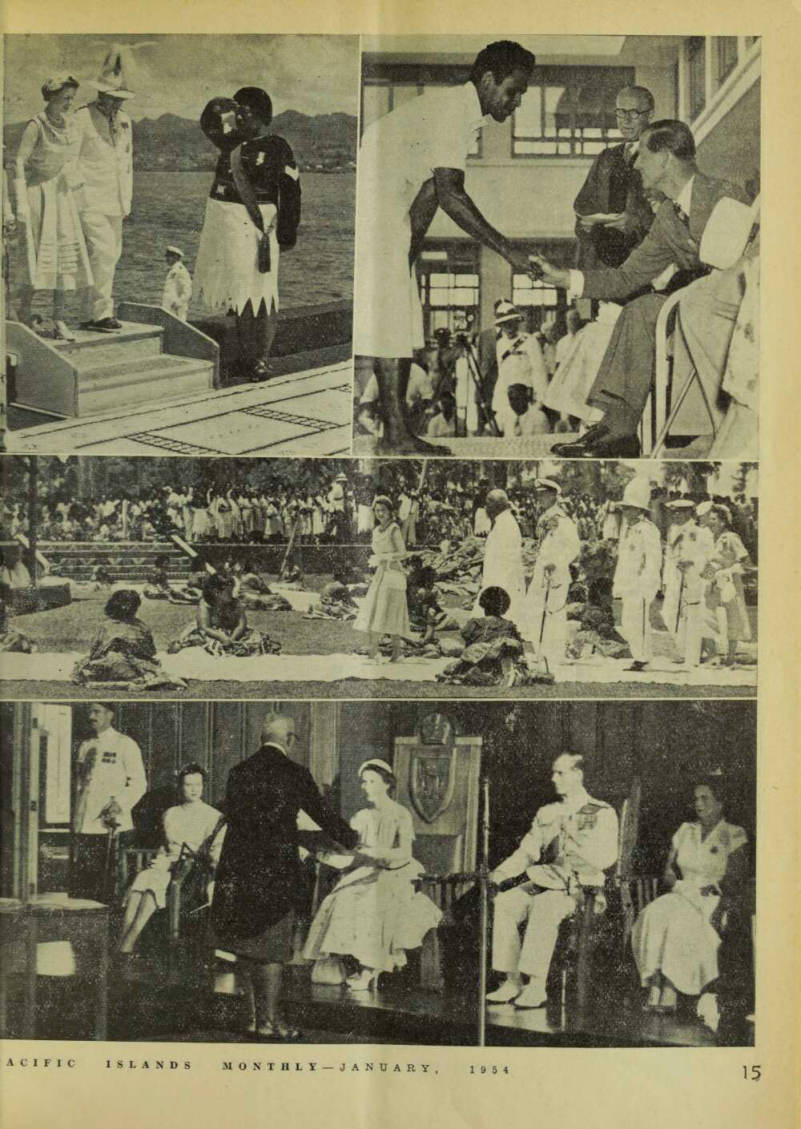
Ratu Penala Ganilau, second-in command of the Fiji Battalion in Malaya, was waiting. Slowly the little girl, her eyes fixed unblink ingly on the Queen, came forward carrying a bouquet almost as big as herself. She presented the flowers . . . and stepped back three slow deliberate paces, sank to the ground and clapped her small, cupped hands three times, to show the traditional form of respect. The Queen turned to the Governor and said, ‘How lovely!’”— Sydney Daily Telegraph.
“While the band played the British National Anthem, Queen Salote’s tiny grand-daughtsr came forward to greet Queen Elizabeth.
Curtseying, she presented the Queen with a shell basket, brimming with tropical flowers.”— Sydney Sunday Sun-Herald.
Her Majesty’S First Kava
“The Queen and the Duke watched the preparation (of kava) intently, and the Queen frequently turned to Sir Ronald Garvey . , . obviously asking for information about the ceremony: and some of the Governor’s replies made her laugh. . . When all was ready, they poured some into a coconut bowl, and this was taken with great ceremony to the Queen. Her Majesty held out a smaller bowl and, when it was filled, she drained it—upon which another great sigh came from all over the ground. . . The Duke
(Continued on Page 16)
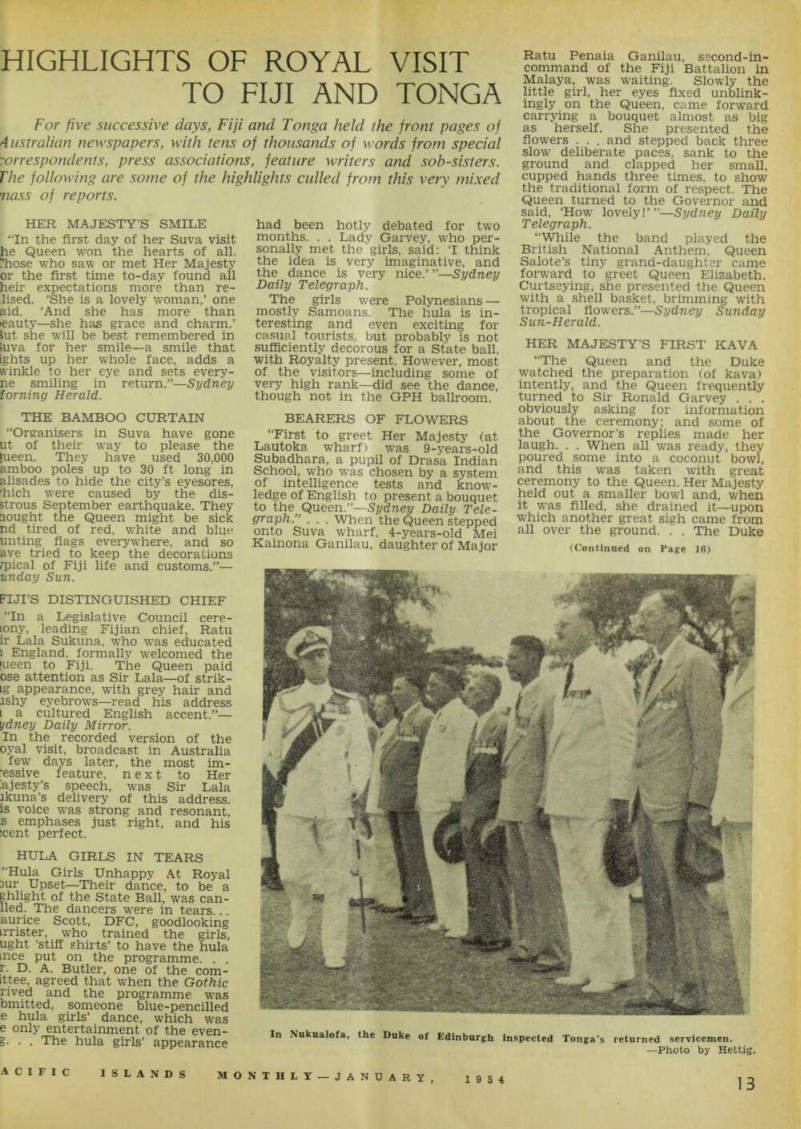
In Nukualofa, the Duke of Edinburgh inspected Tonga’s returned servicemen. —Photo by Hettig.
(Continued from Page 13) drained the shell, amid further cries of approval.”— Sydney Morning Herald.
The Royal visitors had been warned that, while Europeans can in time become quite fond of this famous Polynesian beverage, the first taste is somewhat shocking; but that the kava bowl, like the tabua, is interwoven deeply with Fijian tradition and ceremony, and must on no account be treated lightly.
Whence Came This Ancient
Gent?
“Greatest attraction for the Royal visitors to Tonga probably is the tortoise presented to the King of Tonga in the 1770’s by Captain Cook. It ranks with Tongan nobles, and is by far the oldest inhabitant of the kingdom, as well as the only one of its kind in the Pacific.” — Melbourne News Pictorial. Interest ing query not answered: Where did Captain Cook get the famous tortoise?
They Said It With Flowers
“Tens of thousands of Fijian and Indian people, from the canelands of northern Viti Levu and the rich goldmines of the Tavua field, pour ing into Lautoka to welcome the Royal visitors, brought with them flowers by the truckload and greenery by the ton. The whole of the Royal path was decorated, so that the Queen and the Duke passed under flower-laden arches, alongside suspended baskets of crimson flamboyant blooms, placed every few yards along the roads. . .
Orchids of all types were used in decorations. One group of 50 choice blooms was sent by air to Lautoka as a gift from the people of Hawaii.”— Reuter.
Over-Coloured Report
• “Royal Ball Was a Dismal Failure —Tired Queen Left Early—The Costly State Ball at the Grand Pacific Hotel was a dismal flop. The tired Queen didn’t enjoy herself, nor did anybody else. Her first day in Fiji had been too long and too hard a typical example of an over full programme. . . She didn’t have one dance and took a quick look at the sumptuous supper, but didn’t ea £ - * LIS P- m -> well before schedule, she left the ball by slip ping through a side entrance. This is always a sure sign that the Queen is not enjoying herself.”— Sydney s u?}- .The Sun also published an editorial headed, “Strain on the Queen.”
None of the reports in other news papers, however, suggested that the ball was a “dismal flop” or that the Queen was unhappy or resentful Their reports indicated that Her Majesty was tired, at the end of a long and strenuous day. She did not dance; but she chatted, with obvious interest, with the manv nro mment people of the four com mumties—European, Fijian, Indian and Chinese—who were presented to her at the GPH ballroom.
Quick Broom-Work
“The Queen and the Duke then visited the new Anglican Cathedral in Suva. They were met by the Bishop in Polynesia, the Right Rev.
L. S. Kempthorne, whom a few minutes previously the Queen had invested with the CBE.
“There was some consternation when, within a minute of the Queen’s approach, it was noticed that a watertable near the path way, where the Queen and the Duke would alight from their car, was full of leaves.
“Hurriedly, an immaculately white-clad missionary dashed into the cathedral, found a broom, and did some fast sweeping up. He re turned the broom and then took his
place in the line of clergy assembled: to meet the Queen. It was touch and go as a few seconds later the Queen’s car stopped and she alighted.”—Sydney Morning Herald\
Thrill For The Hennings
“This evening (Dec. 16), while the ships lay in the lee of Naitambs Island, the Queen and the Duke ot Edinburgh, from the Gothic, visited the escorting NZ cruiser, BlacK Prince. Maori members of the BlacK Prince’s crew gave a haka.”—Mel bourne Age. This appears to have been a bright incident in the his tory of Naitamba, which is the family home of veteran planter Mr Gus Hennings.
Queen's “Lovely Day" at Lautoka
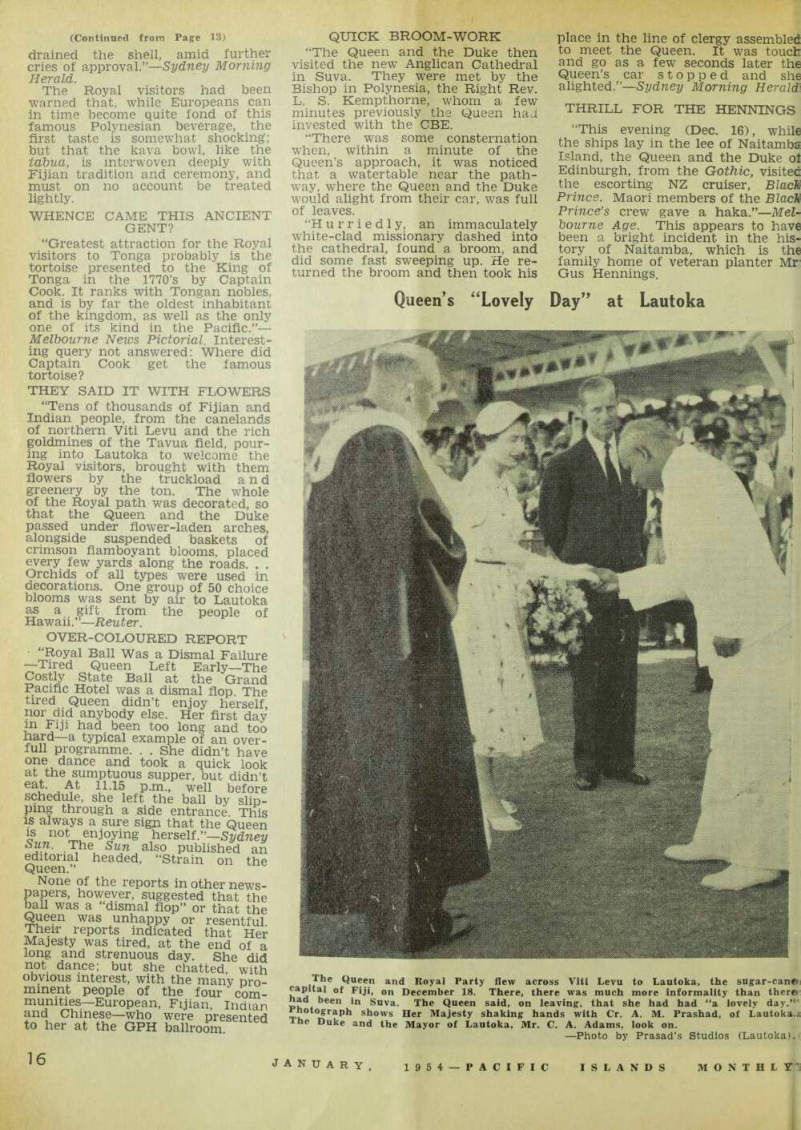
The Queen and Royal Party flew across Viti Levu to Lautoka, the sugar-canoi capital of Fiji, on December 18. There, there was much more informality than there had been in Suva. The Queen said, on leaving, that she had had “a lovely day."
Photograph shows Her Majesty shaking hands with Mr. C. A. Prashad, of Lautoka.s The Duke and the Mayor of Lautoka, Mr. C. A. Adams, look on. —Photo by Prasad’s Studios (Lautoka).
Reds In Fiji?
“Fiji—an Isle of Beauty with a Problem” —Melbourne Age. A fair review of the very familiar racial problem. This paragraph is in teresting: “That there is violent inti-British, pro-Communist agita tion in Fiji no one can or would ieny; but there is little agreement )n whether the Communists con stitute any potentially serious nenace to the Colony.” We should lave thought that there was gen eral agreement that they do not.
On Nukualofa Wharf
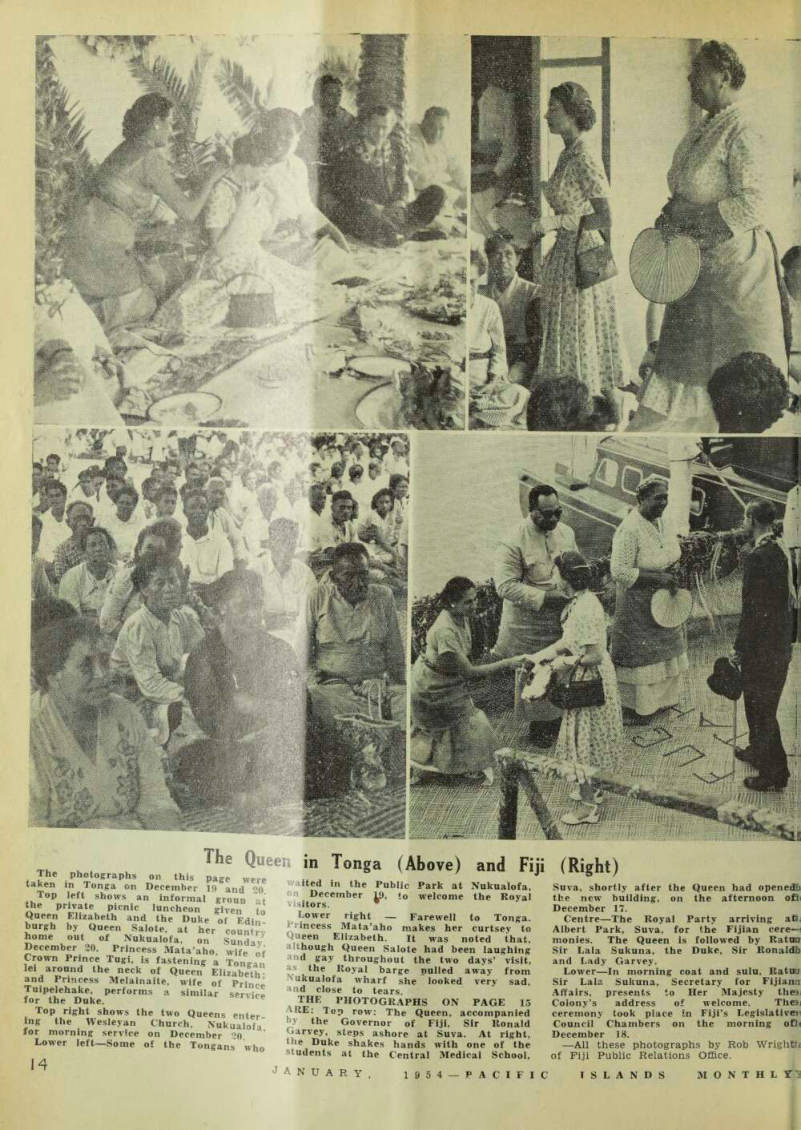
“An historic meeting between wo Queens —petite Elizabeth II of England, and tall Salote of Tonga -took place in steamy heat at Nukualofa wharf at noon to-day December 19). Queen Salote, 6ft : in. and weighing 18 stone, ruler if the world’s smallest monarchy, owered over the delicate figure of Jueen Elizabeth, 5 ft 4 in., ruler if the world’s largest monarchy. . . rhe wharf, 400 yards along, was overed on both sides with tapa, leads, skirting and woven bags— recious possessions of the Tongans, eadily loaned for this important ccasion.” — Sydney Daily Mirror. (The newspapers subsequently re orted that a large portion of the recious Tongan decorations, along tie wharf, were “souvenired” by tie crews of the Gothic and Black ’rince . The latter, presumably, did lot realise the value, actual and mtimental, of the artifacts).
From Pitcairn
A large basket, made specially for ’rincess Anne by the women of Pit airn Island, was presented to the Jueen in Suva by Mr. and Mrs. ohn Christian, who were special uests of the Fiji Government dur ig the Royal visit. The Queen was iterested to meet a direct descend nt of Fletcher Christian, leader of le Bounty mutineers, 150 years ago.
Salote As Royal Hostess
“The Queen of the Friendly slands has taken charge personally f the whole programme of Queen lizabeth’s two-days’ visit. Well nown to her people as a poet and mg writer, she has composed a mg of welcome called a lakalaka, )r the men and women of Tonga ) sing to Queen Elizabeth on Sat rday. She has designed the tapa loth decorations for the wharf, had le whole palace repainted (she has erself moved into a nearby angalow), she has lined the garden eds with huge clam shells vividly ainted with the British Royal rms, and local fish and flower de gns, and has supervised rehearsals f the dancing. . . She has taken irticular care over the Queen’s Brsonal likes and dislikes—no wired owers, no magenta colouring, and ouquets to be presented by chil ren, and not by adults.”— Sydney lorning Herald.
At Nukualofa Party
“The Royal party stayed at the ance (in Nukualofa) until about 1.30 p.m. The Queen received all
the guests, but she did not dance.
She sat out as a gesture of courtesy to Queen Salote, who does not dance. The Duke danced with his hostess (Mrs. Windrum) and the Princesses Mataaho and Malenaite, who are the wives of Queen Salote’s two sons.” —Sydney Daily Telegraph.
J. Arthur Rank Colour Film
Newsreels covering the Royal Visit to Fiji and Tonga were show ing in New Zealand and Australia —and doubtless all over the world —by Christmas. The camera work could not be faulted—but there were some glaring errors. Most obvious was a splendid series of shots of singers entertaining the Queen and Duke at Nukualofa—but the music, apparently dubbed in, in the studio, was Fiji’s national song, Isa Lei.
Tongans and Fijians might well feel disgusted with the musical error in this film.
The J. Arthur Rank colour film (made in Association with NZ National Film Unit), shown in Australia in the New Year, was excellent. It gave intimate close ups of the Royal Party’s progress through Fiji and Tonga—and made it quite obvious that the general public will see much more of the Queen and Duke through the medium of the film, than by standing in packed crowds in the street.
Those Cancelled Dances
NO word of official explanation has ever been given about the removal of Polynesian dancing from the programme of the State ball at Suva on December 17, after it had been approved.
It was originally announced that dances would be given by girls from Islands groups not included in the Royal tour. Criticism of that plan was based on the fact that during the limited time the Queen and the Duke would be at the ball they would be on the Grand Pacific Hotel balcony for 15 minutes, during which massed Fijian choirs would sing outside; and that hula-dancing in any form would not fit into the Fijian pattern, or, for that matter, into the formal pattern of a State ball.
It was also argued that, if any thing of the kind were attempted, the first non-Fijian claimants should be from the Western Pacific territories, leaving out Western Samoa and the Cook Group, which are New Zealand’s concern anyway.
There was a strong European feel ing that the Fijians had more than earned the right to first place dur ing the Royal visit to Fiji, and when it was rumoured that the pro posed floor-show was strongly tinged with Hawaiian-American ideas, with possibly a flavour of Tahiti, opposition hardened.
A Sydney paper has alleged that official Suva rejected at least some of the proposed dances as “too erotic”—and, for once, Sydney al legations about Fiji may be right.