Nature Notes
p. 151 · Read in the full issue
By Raimanu
lALOLO FOR LUNCH: At Lakeba, Iji, the balolo rose on November 1. in 1951. I had heard in the illage the previous day and had een warned to be ready for an arly start. So just after daybreak was down on the beach, to find aat two or three canoes and punts r ere ready near the passage, away ) the west of the village. The last unt to go out had just left the md, and I was lucky to get a lift.
We poled and paddled quickly out cross the lagoon. Clouds covered le sky, and a cool wind was blow ig, but the water felt warm.
Just at this point there is a small reak in the reef, and on the inner de a small, but deep pool. Here, ist out of reach of the big rollers hich were breaking outside, we mght the balolo.
They came wriggling up out of
the depths, thousands of them. Just thin, threadlike worms, varying in colour from dark green to brown.
They were not unpleasant to handle ; just a bit slimy to the touch.
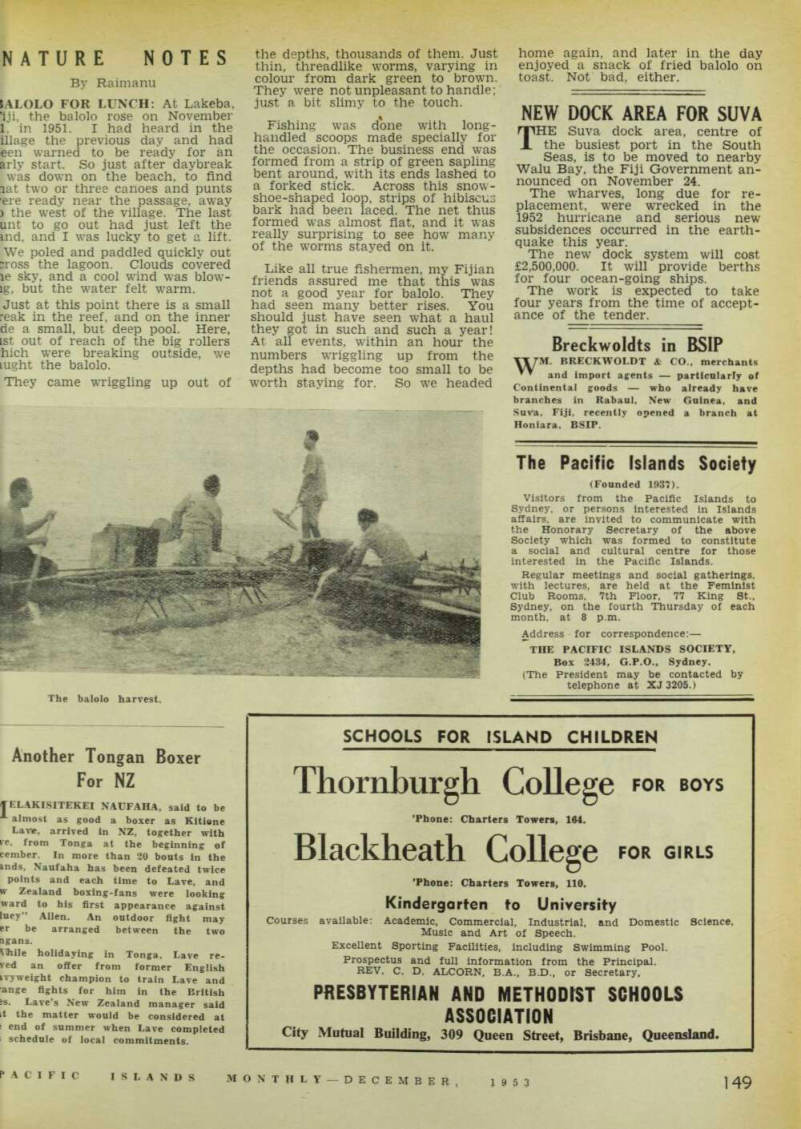
Fishing was done with long handled scoops made specially for the occasion. The business end was formed from a strip of green sapling bent around, with its ends lashed to a forked stick. Across this snow shoe-shaped loop, strips of hibiscus bark had been laced. The net thus formed was almost flat, and it was really surprising to see how many of the worms stayed on it.
Like all true fishermen, my Fijian friends assured me that this was not a good year for balolo. They had seen many better rises. You should just have seen what a haul they got in such and such a year!
At all events, within an hour the numbers wriggling up from the depths had become too small to be worth staying for. So we headed
home again, and later in the day enjoyed a snack of fried balolo on toast. Not bad, either.
The balolo harvest.