Telefomin Has a Long
pp. 79-80 · Read in the full issue
Old Story Re-Read:
Telefomin Has a Long History—for N. Guinea
SOME of the most interesting books about Papua and New Guinea are those now out of print and, therefore, not generally available to the present generation which tends to believe that the dis covery of these Territories occurred somewhere around 1942.
The publication recently of Colin Simpson’s Adam With Arrows was scarcely complete when natives of the country about which he wrote killed two young P-NG District Ser vices patrol-officers. The murders seemed to give point to the whole tenor of Simpsoh’s narrative —that life for these men of the remotest outposts is about as comfortable as living inside a minefield; that nerves should have been —even if they were not—stretched to near breaking point. Although it might be a country fit only for heroes to live in, few District Services men will admit to their heroic role and it is as well to get the whole thing back into its correct perspective. For this I recommend a course of Ivan F. Champion.
Over 20 years ago he wrote a book called Across New Guinea From the Fly To the Sepik. In it, he tells how he accompanied the late Charles H. Karius on two attempts to do just what the title indicates —the first attempt lasting from December, 1926, to July, 1927, and being unsuccessful; the second last ing from September, 1927, to Jan uary, 1928, and being successful.
I read this book years ago, and, after Adam With Arrows and the recent Telefomin trouble, dipped into it again; I remembered that the second patrol had spent some time around Telefomin (which they called Kelefomin) . Having dipped, I began to read. And, having be gun, I sat up all night and finished the job. Here are no journalistic tricks or angles; no attempt to “catch the interest of the reader.”
It is a plain story of a year of un remitting effort, and if it has one fault it is probably that it makes the task look too easy. Simpson made it look too hard.
It was Karius and Champion who were the first Europeans to stand on the 9,000-ft. divide in the Victor Emanuel Range and see that the Fly River (which flowed south westward hundreds of miles through Papua) and the Sepik (which flowed north-westward into Dutch New Guinea before it turned eastward to empty itself into the sea be tween Madang and Wewak) rose within a few miles of each other.
The local, native name for the
upper Sepik was Takin; for the Fly, at its source, Feneng. This is how Champion describes their first sight, from an elevation of 7,000 ft., of the
Sepik basin:
We were standing on a small grass plateau looking at what I thought was the most beautiful sight that one could ever wish to see. Several thousands of feet below us was a great basin, sur rounded by mountains and through this basin, bordered by casuarina trees, meandered a slow-flowing stream.
It was the Promised Land. We saw where the Takin started its flow in a narrow ravine to the east, formed by two spurs of the Victor Emanuel For a distance of perhaps 15 miles it was flanked by a grass plain about eight miles broad and stretching north to the base of the mountains. Spaced at regular intervals along it, narrow lings of dark forest ran down to the river Numerous fires denoted the presence of many villages . . . What a contrast this was to the rugged gorge-like valleys of the upper Fly and Palmer, with their small and scattered population.
They dropped down to the banks of the Takin and camped. Less than a day’s walk brought them to
Telefomin territory. Champion de
scribes it: The Takin was no longer a placidly flowing stream. Dropping quickly, it was running strongly towards the west-south west at an altitude
of 4,200 feet. We left it and clambered up the steep bank on a native track which took us over some grassy hills to the edge of an immense grass plain. Mile upon mile it stretch ed to the base of the mountain to the north, seemingly as flat as a billiard table. On the native track that led in a north-westerly direc tion, our progress was fast and within half an hour we heard voices from the near -by scrub.
We went on to reach a large village which we were able to walk right into before our presence was dis covered.
There followed the usual shrieks; of surprise and fear as the natives saw Europeans for the first time, the usual flight for cover; the over tures of peace from the patrol party; the slow exchange of gifts and the establishment of good relations.
Then: There being no food available we moved off across the plain, men and boys follow ing. Suddenly we heard the peculiar croaking of frogs, a variety of low and high notes from behind and then from our left and front. It was the assembly call of the Kelefomin .
Village after village was passed, prettily situated on the sides of the forest ravine and all of them surrounded with crotons and other gaily coloured shrubs. The smallest contained 10 houses, the others from 16 to 20 . . . Throughout the whole of our journey this Kelefomin plateau, at an altitude of 4,877 ft., was the only place we saw where an aeroplane could, land, and it is ideal although after heavy rains it would no doubt be a morass.
Those were the days before field radio and before planes had been called in to ease the burden of ex ploration in Papua or New Guinea.
Planes had already solved the trans port problem between the new gold fields at Wau, and the coast at Lae and Salamaua but once they got away from navigable rivers patrol ling was still a matter of foot-slog ging. From the time that Karius and Champion, their police-boys and their carriers, left the Elevala on the Fly below Palmer junction, until they met up with her again, 500 miles up the Sepik River, they were entirely on their own, as far frcm contact with their own people as if the earth had opened and swallowed them. They had only their own resource, courage and en-
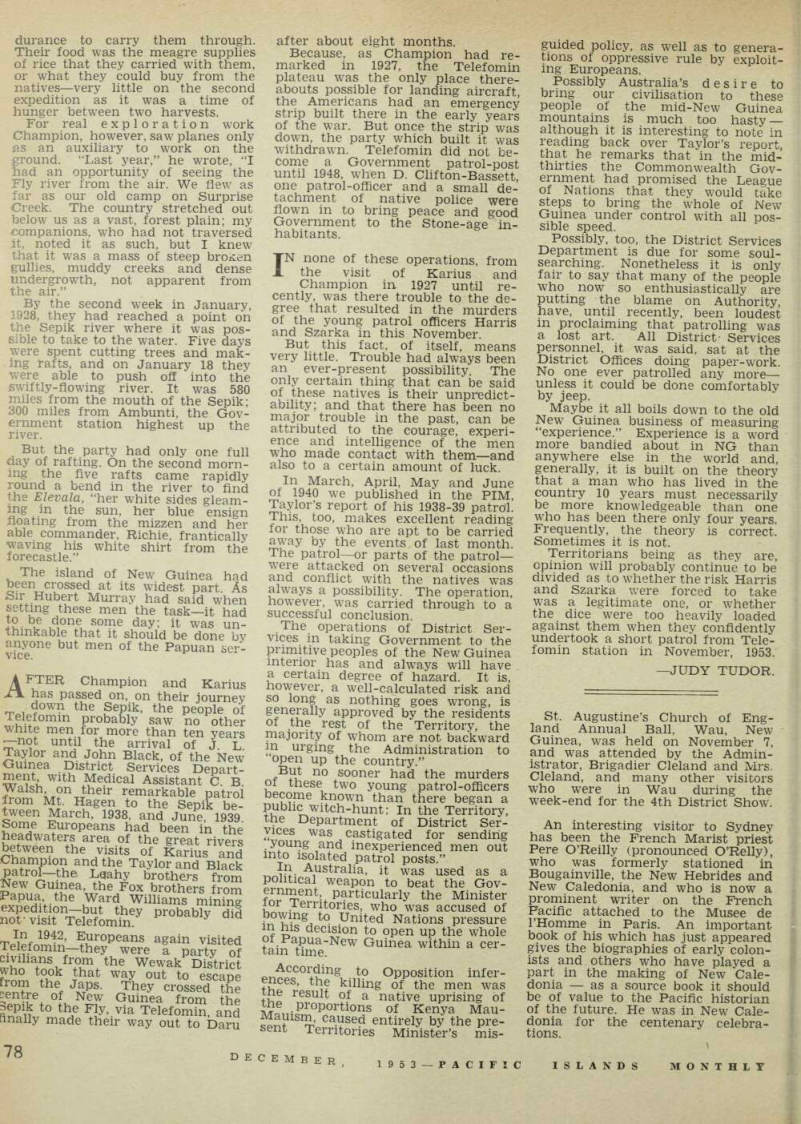
An old photograph of Black, Taylor and Walsh on the 1938-39 patrol.
durance to carry them through.
Their food was the meagre supplies of rice that they carried with them, or what they could buy from the natives —very little on the second expedition as it was a time of hunger between two harvests.
For real exploration work Champion, however, saw planes only as an auxiliary to work on the ground. “Last year,” he wrote, “I had an opportunity of seeing the Fly river from the air. We flew as far as our old camp on Surprise Creek. The country stretched out below us as a vast, forest plain; my companions, who had not traversed it, noted it as such, but I knew that it was a mass of steep broken gullies, muddy creeks and dense undergrowth, not apparent from the air.”
By the second week in January, 1928, they had reached a point on the Sepik river where it was pos sible to take to the water. Five days were spent cutting trees and mak ing rafts, and on January 18 they were able to push off into the swiftly-flowing river. It was 580 miles from the mouth of the Sepik: 300 miles from Ambunti, the Gov ernment station highest up the river.
But the party had only one full day of rafting. On the second morn ing the five rafts came rapidly round a bend in the river to find the Elevala, “her white sides gleam mg in the sun, her blue ensign floating from the mizzen and her able commander, Richie, frantically waving his white shirt from the forecastle.”
The island of New Guinea had been crossed at its widest part. As Sir Hubert Murray had said when setting these men the task—it had to be done some day; it was un thinkable that it should be done bv anyone but men of the Papuan ser vice.
AFTER Champion and Karius
has passed on, on their journey down the Sepik, the people of Telefomin probably saw no other white men for more than ten years -—not until the arrival of J. L Taylor and John Black, of the New Guinea District Services Depart ment, with Medical Assistant C B Walsh, on their remarkable patrol from Mt. Hagen to the Sepik be tween March, 1938, and June, 1939.
Some Europeans had been in the headwaters area of the great rivers between the visits of Karius and nafr^i Plo fßo n ? th u Ta u ylor and Black patrol—the Lqahy brothers from New Guinea, the Fox brothers from Papua the Ward Williams mining expedition—but they probably did
not-visit Telefomin.
In !942’ Europeans again visited Telefomin— they were a party of Sn la tnnt fr lff the Wewak District J hat way out t 0 esca Pe from the Japs. They crossed the of New Guinea from the t 0 the Fly, via Telefomin, and finally made their way out to Daru
after about eight months.
Because, as Champion had re marked in 1927, the Telefomin plateau was the only place there abouts possible for landing aircraft, the Americans had an emergency strip built there in the early years of the war. But once the strip was down, the party which built it was withdrawn. Telefomin did not be come a Government patrol-post until 1948, when D. Clifton-Bassett, one patrol-officer and a small de tachment of native police were flown in to bring peace and good Government to the Stone-age in habitants.
IN none of these operations, from the visit of Karius and Champion in 1927 until re cently, was there trouble to the de gree that resulted in the murders of the young patrol officers Harris and Szarka in this November.
But this fact, of itself, means very little. Trouble had always been an ever-present possibility. The only certain thing that can be said of these natives is their unpredict ability; and that there has been no major trouble in the past, can be attributed to the courage, experi ence and intelligence of the men who made contact with them—and also to a certain amount of luck.
In March, April, May and June of 1940 we published in the PIM, Taylor’s report of his 1938-39 patro'l.
This, too, makes excellent reading for those who are apt to be carried away by the events of last month.
The patrol—or parts of the patrol— were attacked on several occasions and conflict with the natives was always a possibility. The operation, however, was carried through to a successful conclusion.
The operations of District Ser vices in taking Government to the primitive peoples of the New Guinea interior has and always will have a certain degree of hazard. It is, however, a well-calculated risk and so long as nothing goes wrong, is generally approved by the residents of the rest of the Territory, the majority of whom are not backward m urging the Administration to open up the country.” no soon er had the murders of these two young patrol-officers become known than there began a bhc witch-hunt: In the Territory, the Department of District Ser vices was castigated for sending young and inexperienced men out into isolated patrol posts.”
Australia, it was used as a political weapon to beat the Gov ernment particularly the Minister Territories, who was accused of bowing to United Nations pressure in his decision to open up the whole otPapua-New Guinea within a cer tain time.
Col l^ ing , . Opposition infer ences, the killing of the men was Nrf result °f a native uprising of MQniJ^° portions of K enya Mau- C£ Wsed entirely by the pre sent Territories Minister’s mis
guided policy, as well as to genera tions of oppressive rule by exploit ing Europeans.
Possibly Australia’s desire to bring our civilisation to these people of the mid-New Guinea mountains is much too hasty although it is interesting to note in reading back over Taylor’s report, that he remarks that in the mid thirties the Commonwealth Gov ernment had promised the League of Nations that they would take steps to bring the whole of New Guinea under control with all pos sible speed.
Possibly, too, the District Services Department is due for some soul searching. Nonetheless it is only fair to say that many of the people who now so enthusiastically are putting the blame on Authority, have, until recently, been loudest in proclaiming that patrolling was a lost art. All District- Services personnel, it was said, sat at the District Offices doing paper-work.
No one ever patrolled any more unless it could be done comfortably by jeep.
Maybe it all boils down to the old New Guinea business of measuring “experience.” Experience is a word more bandied about in NG than anywhere else in the world and, generally, it is built on the theory that a man who has lived in the country 10 years must necessarily be more knowledgeable than one who has been there only four years.
Frequently, the theory is correct.
Sometimes it is not.
Territorians being as they are, opinion will probably continue to be divided as to whether the risk Harris and Szarka were forced to take was a legitimate one, or whether the dice were too heavily loaded against them when they confidently undertook a short patrol from Tele fomin station in November, 1953.
Judy Tudor.
St. Augustine’s Church of Eng land Annual Ball, Wau, New Guinea, was held on November 7, and was attended by the Admin istrator, Brigadier Cleland and Mrs.
Cleland, and many other visitors who were in Wau during the week-end for the 4th District Show.
An interesting visitor to Sydney has been the French Marist priest Pere O’Reilly (pronounced O’Relly), who was formerly stationed in Bougainville, the New Hebrides and New Caledonia, and who is now a prominent writer on the French Pacific attached to the Musee de I’Homme in Paris. An important book of his which has just appeared gives the biographies of early colon ists and others who have played a part in the making of New Cale donia as a source book it should be of value to the Pacific historian of the future. He was in New Cale donia for the centenary celebra tions.