Tropicalities
pp. 77-78 · Read in the full issue
The Ng Women With The
Answer
IF you just keep reading the Sunnanprs it is amazine what von P S learn Quite
fammar Zees
familiar places.
Some weeks back, the Sydney Sunday Sun-Herald reported (from South Africa, no less) the existence of a “primitive and uncivilised” tribe somewhere in New Guinea that was ruled by a Queen. If the rest of the women did not exactly wear the pants 5 (they are alleged not to have had as much as a grass skirt amongst theUot of them) they certainly had the'men where they wanted them: They kept them in cayes and brought them out as re-
quired.
Well, what’s so primitive and uncivilised about that?—J.T.
All Spit And Pollige
Ti/|R. Athol Mellars, Of
Turner’s Supply Company, back m Auckland from one of his Periodic Island circuits reported this incident while a guest at the Labasa Hotel, Fiji, recently. in bed very early one morning, half-awake and dreaming of a tasty breakfast, he was surprised when the head of an Indian appeared around the door and inquired “Youse want pollige?”
Puzzled that he should be asked whether he wanted porridge at this ea rly hour, and before arriving at the table, the guest’s surprise evid ently appeared on his face, “Pollige, pollige,” the boy re peated—pointing to the guest’s shoes beside his bed.
Then it dawned. Yes, yes, his shoes did want polishing!
Sulus And Top
Hats At
Flemington
Lieut.-Col. Ra T U
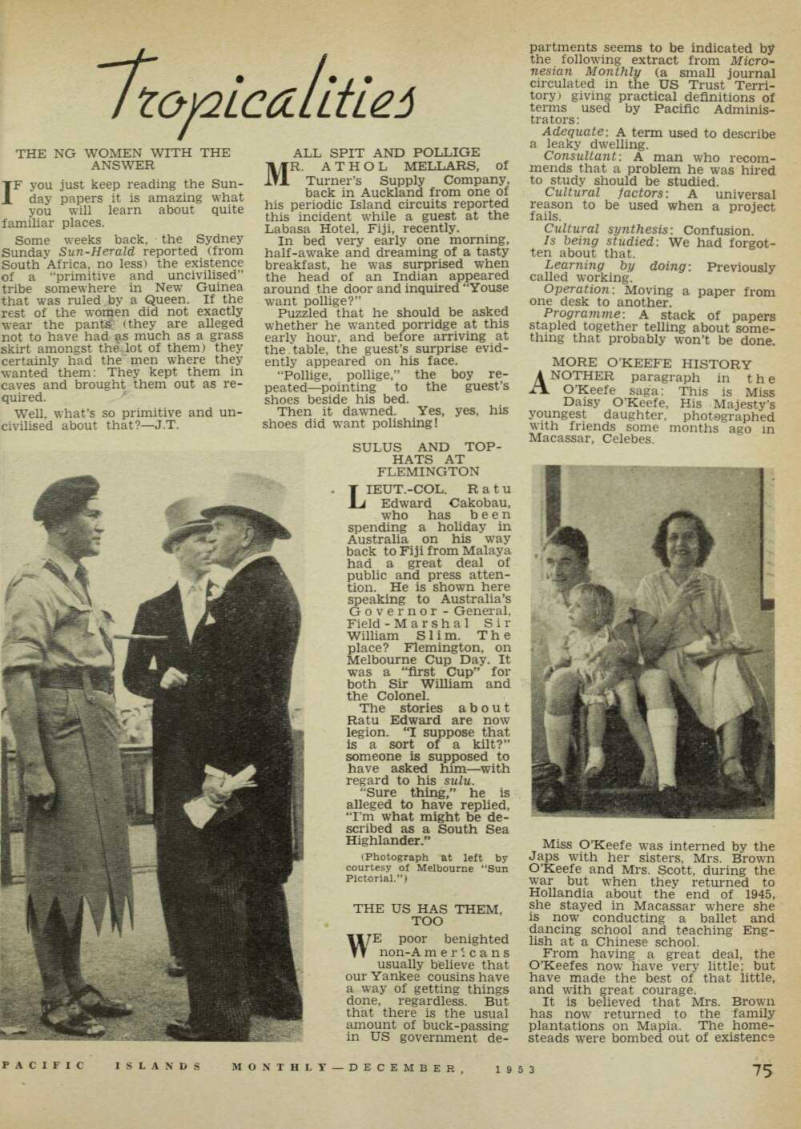
Edward Oakobau, who has been spending a holiday in Australia on his way back to Fiji from Malaya had a great deal of public and press atten tion. He is shown here speaking to Australia’s Governor - General, Field - Marshal Sir William Slim. The place? Flemington, on Melbourne Cup Day, It was a “first Cup” for both Sir William and the Colonel.
The stories about Ratu Edward are now legion. “I suppose that is a sort of a kilt?” someone is supposed to have asked him—with regard to his sulu.
“Sure thing,” he is alleged to have replied, “I’m what might be de scribed as a South Sea Highlander.” (Photograph at left by courtesy of Melbourne “Sun Pictorial.”)
The Us Has Them,
Too
11IE poor benighted ▼ ▼ non-A mer'icans usually believe that our Yankee cousins have a way of getting things done, regardless. But that there is the usual amount of buck-passing in US government de
partments seems to be indicated by the following extract from Micro nesian Monthly (a small journal circulated in the US Trust Terri tory) giving practical definitions of terms used by Pacific Adminis trators: Adequate : A term used to describe a leaky dwelling.
Consultant ; A man who recom mends that a problem he was hired to study should be studied.
Cultural factors : A universal reason to be used when a project fails.
Cultural synthesis : Confusion.
Is being studied : We had forgot ten about that.
Learning by doing'. Previously called working.
Operation'. Moving a paper from one desk to another.
Programme : A stack of papers stapled together telling about some thing that probably won’t be done.
More O’Keefe History
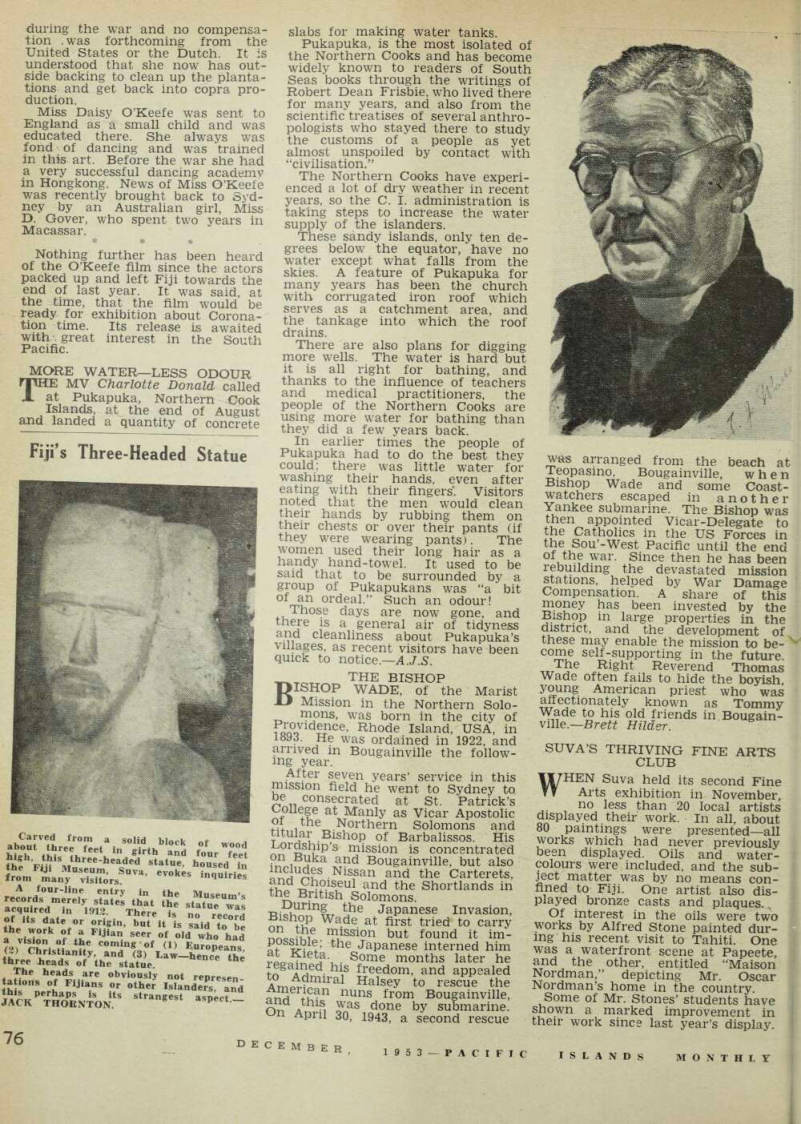
ANOTHER paragraph in the O’Keefe saga: This is Miss Daisy O’Keefe, His Majesty’s youngest daughter, photographed with friends some months ago in Macassar, Celebes.
Miss O’Keefe was interned by the Japs with her sisters, Mrs. Brown O’Keefe and Mrs. Scott, during the war but when they returned to Hollandia about the end of 1945, she stayed in Macassar where she is now conducting a ballet and dancing school and teaching Eng lish at a Chinese school.
From having a great deal, the O’Keefes now have very little; but have made the best of that little, and with great courage.
It is believed that Mrs. Brown has now returned to the family plantations on Mapia. The home steads were bombed out of existence
during the war and no compensa tion .was forthcoming from the United States or the Dutch. It is understood that she now has out side backing to clean up the planta tions and get back into copra pro duction.
Miss Daisy O’Keefe was sent to England as a small child and was educated there. She always was fond of dancing and was trained in this art. Before the war she had a very successful dancing academv in Hongkong. News of Miss O’Keefe was recently brought back to Syd ney by an Australian girl, Miss D. Gover, who spent two years in Macassar. * * * Nothing further has been heard of the O’Keefe film since the actors packed up and left Fiji towards the end of last year. It was said, at the time, that the film would be ready for exhibition about Corona tion time. Its release is awaited with great interest in the South Pacific.
More Water—Less Odour
rTSHE MV Charlotte Donald called X at Pukapuka, Northern Cook Islands, at the end of August and landed a quantity of concrete
slabs for making water tanks.
Pukapuka, is the most isolated of the Northern Cooks and has become widely known to readers of South Seas books through the writings of Robert Dean Frisbie, who lived there for many years, and also from the scientific treatises of several anthro pologists who stayed there to study the customs of a people as yet almost unspoiled by contact with “civilisation.”
The Northern Cooks have experi enced a lot of dry weather in recent years, so the C. I. administration is taking steps to increase the water supply of the islanders.
These sandy islands, only ten de grees below the equator, have no water except what falls from the skies. A feature of Pukapuka for many years has been the church with corrugated iron roof which serves as a catchment area, and the tankage into which the roof drains.
There are also plans for digging more wells. The water is hard but it is all right for bathing, and thanks to the influence of teachers and medical practitioners, the people of the Northern Cooks are using more water for bathing than they did a few years back.
In earlier times the people of Pukapuka had to do the best they could: there was little water for washing their hands, even after eating with their fingers*. Visitors noted that the men would clean their hands by rubbing them on their chests or over their pants (if they were wearing pants). The women used their long hair as a handy hand-towel. It used to be said that to be surrounded by a group of Pukapukans was “a bit of an ordeal.” Such an odour!
Thos .e days are now gone, and there is a general air of tidyness and cleanliness about Pukapuka’s villages, as recent visitors have been quick to notice.— A.J.S.
B The Bishop
ISHOP WADE, of the Marist Mission in the Northern Solo mons, was born in the city of Providence, Rhode Island, USA, in 1 . ■ • i 1? was ordained in 1922, and ai rived in Bougainville the follow ing year.
After seven years’ service in this mission field he went to Sydney to be consecrated at St. Patrick’s College at Manly as Vicar Apostolic PA /he Northern Solomons and titular Bishop of Barbalissos. His JLordship’ 5 mission is concentrated ?AAiP ka and Bougainville, but also Nl ssan and the Carterets, a nd the Shortlands in the British Solomons. the Japanese Invasion, fA SI APP Wade at first tried to carry Piston but found it im possmie, the Japanese interned him Some months later he t^ ga A^ ec *- freedom, and appealed A°mit? miral HaJ sey to rescue the +£ an nuns f rom Bougainville, On aV? 1 ®! ™ as done by submarine, i April 30, 1943, a second rescue
was arranged from the beach at Teopasmo, Bougainville, when Bishop Wade and some Coast watchers escaped in another Yankee submarine. The Bishop was then appointed Vicar-Delegate to the Catholics in the US Forces in the Sou’-West Pacific until the end of the war. Since then he has been rebuilding the devastated mission stations, helped by War Damage Compensation. A share of this money has been invested by the Bistmp in large properties in the district, and the development of these may enable the mission to be come self-supporting in the future.
The Right Reverend Thomas Wade often fails to hide the boyish, young American priest who was affectionately known as Tommy Wade to his old friends in Bougain ville.—Brett Hilder.
Suva’S Thriving Fine Arts
Club
WHEN Suva held its second Fine Arts exhibition in November, no less than 20 local artists displayed their work. In all, about 80 paintings were presented—all works which had never previously been displayed. Oils and water colours were included, and the sub ject matter was by no means con fined to Fiji. One artist also dis played bronze casts and plaques.
Of interest in the oils were two works by Alfred Stone painted dur ing his recent visit to Tahiti. One was a waterfront scene at Papeete, and the other, entitled “Maison Nordman,” depicting Mr. Oscar Nordman’s home in the country.
Some of Mr. Stones’ students have shown a marked improvement in their work since last year’s display.