The Pacific Now Has Another
pp. 75-76 · Read in the full issue
Magazine Section
The Pacific Now Has Another Nature-Man
By Jack Thornton
AFTER planning and working for seven years with the object of setting himself completely apart from civilised society—surely one of the most sustained efforts ever made by a believer in the simple life —a 30-years-old civil engineer from Denmark recently made final contact with society at Nukualofa, and Is now living alone on a hitherto uninhabited islet in Tonga.
He intends to remain there for the rest of his life.
The appearance of this blue-eyed, bearded Dane aroused considerable interest during his voyagings in search of a home in the Islands.
He says he has arrived to stay, and looks like becoming another legend in the Pacific.
He has already replaced his Nordic Christian name, which he regards as an unnecessary reminder ef Western civilisation, with the Polynesian “Tavi,” conferred upon him when he was looking for an island where he could live without paying land tax. In Polynesian mythology, Tavi is the brother of Maui, who fished up several islands from the depths of the sea.
Kauffmann made up his mind in 1945 to renounce civilisation and revert to the Stone Age. He began to put a plan of operations into effect immediately he had gradu ated, in science, from Copenhagen University; the following year he
, . , , , . moved to Sweden and worked for two years to save enough money to enter the USA; there he lived and worked in San Francisco for 2 h years.
“Frisco offered the apex of what most people strive to achieve,’’ Tavi, who speaks excellent English, told me recently in Fiji. “I studied navigation and was lucky enough to buy cheaply from a Marine Corps officer a 26-foot sloop in which I quesas and 63 Tahiti 18 'Mv°friend *Sho
had*alreSdvhad ten eiZrt
ence of living close to Nature ?n North America had found ft npppi sarv tosTarch for a warmerrlimate where°he%ould°hve^fthout Cl wearin| party Cl to h the a^ and killing of sheen He he came 1 discouraged° during P our Search
fo“ a Pacificisland andleft' the
shin at Tahiti He a£d hf* wife are P now living the nnhirni S Costa RidVherethe cltoate doesn’t interfere with their prm- . ... T . . .
From Tahiti I sailed alone to the Cook Islands Tonga and Fiji— where I arrived last year—looking for somewhere to settle During these voyages I fished only once to pass the time; and saw only one shark. I lived on coconuts—we had taken a stock aboard at Frisco —fruit and vegetables.
‘ln Suva I received word that the Government of Tonga required the services of a consulting engineer, so I sailed back to Tonga and worked in that capacity for ten months. I gave away my sloop (it now belongs to the Royal Family of Tonga) and now I have been given this islet rent free, with an assurance that
There seldom are nature-women (unless there is a nature-man somewhere in the picture) hut nature-men, going solo, are not new. In recent issues of PIM we have learned a lot about Tahiti’s nature-man who migrated to Fiji and died there in 1918. Now, here is news of another, right up to date in 1953, who believes that the world can be saved only if every one returns to the Stone Age. The story is told by Jack Thornton. 11 is interestin 9 to reflect that, at the same time > Politicians, theorists and the gentlemen who belong to the UN Trusteeship Council, heat their collective chest
gjf be* r^edJrorL
St Z ne Age f° rthwith and hurled the Atom A ° e ‘ We wonder, therefore, if Mr. Kauffmann might Z ot servm 9 his convictions better by staying around to convert the politicians, theorists, etc., instead aW “ V °” “
I can stay on it undisturbed for the rest of my life “My new home is called Hunga, is about a mile long, a third of a mile wide at its widest, and rises to four hundred feet. It is 40 miles from Nukualofa, and there is no proper landing place. I have
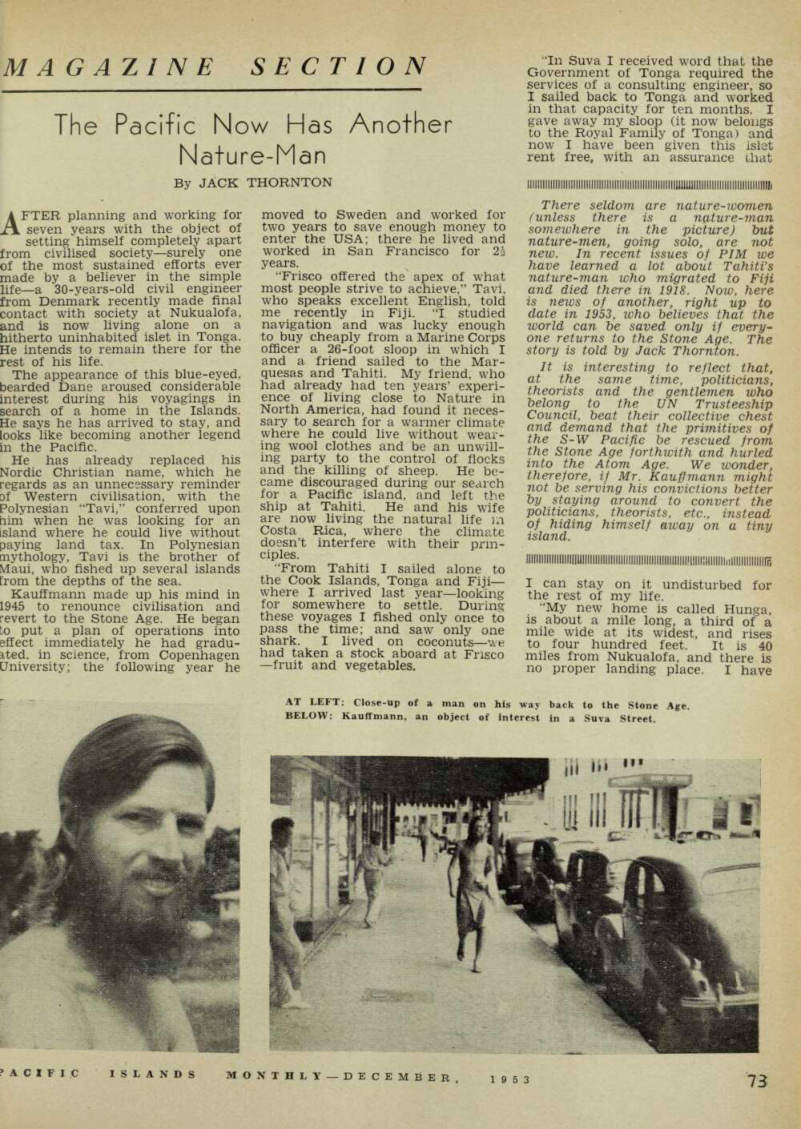
AT LEFT: Close-up of a man on his way back to the Stone Aee.
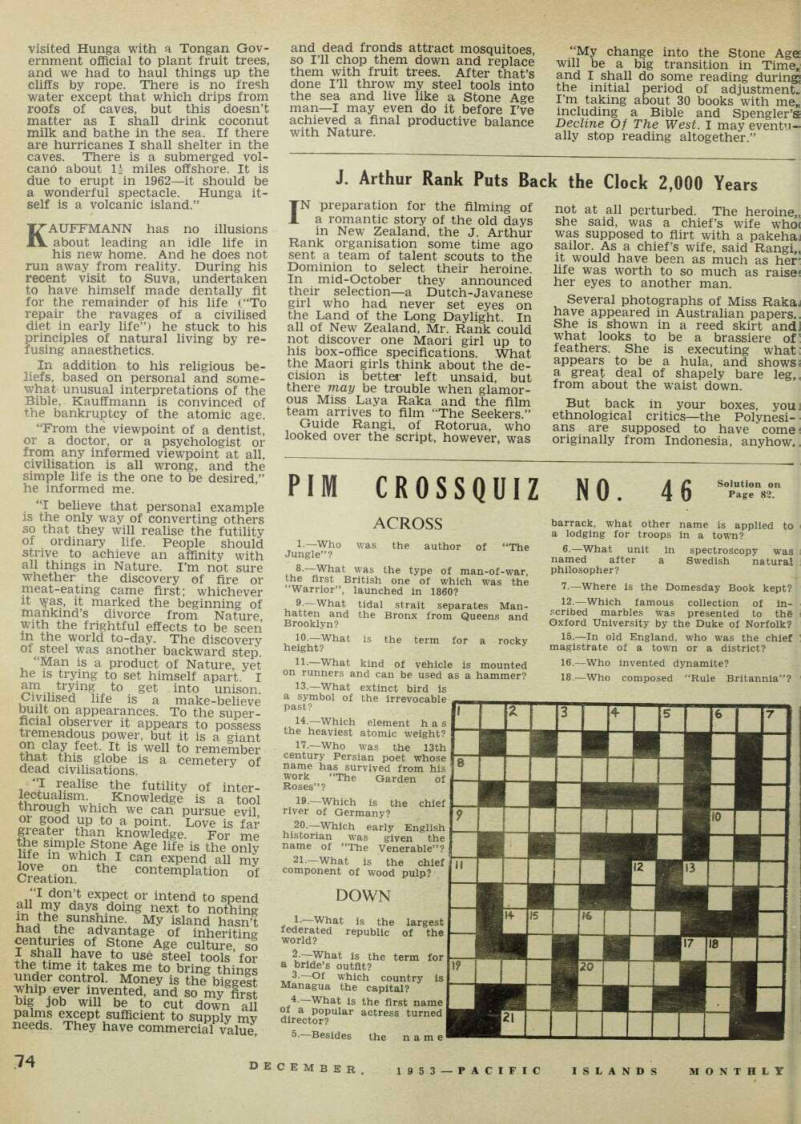
BELOW: KaufTmann, an object of Interest in a Suva Street,
visited Hunga with a Tongan Gov ernment official to plant fruit trees, and we had to haul things up the cliffs by rope. There is no fresh water except that which drips from roofs of caves, but this doesn’t matter as I shall drink coconut milk and bathe in the sea. If there are hurricanes I shall shelter in the caves. There is a submerged vol cano about li miles offshore. It is due to erupt in 1962—it should be a wonderful spectacle. Hunga it self is a volcanic island.”
KAUFFMANN has no illusions about leading an idle life in his new home. And he does not run away from reality. During his recent visit to Suva, undertaken to have himself made dentally fit for the remainder of his life (“To repair the ravages of a civilised diet in early life”) he stuck to his principles of natural living by re fusing anaesthetics.
In addition to his religious be liefs. based on personal and some what unusual interpretations of the Bible, Kauffmann is convinced of the bankruptcy of the atomic age.
“From the viewpoint of a dentist, or a doctor, or a psychologist or from any informed viewpoint at all, civilisation is all wrong, and the simple life is the one to be desired,” he informed me.
“I believe that personal example is the only way of converting others so that they will realise the futility of ordinary life. People should strive to achieve an affinity with all things in Nature. I’m not sure whether the discovery of fire or meat-eating came first; whichever it mis, it marked the beginning of mankind’s divorce from Nature, with the frightful effects to be seen in the world to-day. The discovery of steel was another backward step.
“Man is a product of Nature, yet he is trying to set himself apart. I ,to get into unison.
Civilised life is a make-believe built on appearances. To the super ficial observer it appears to possess tremendous power, but it is a giant ?u ? a Z*eet. * s well to remember that this globe is a cemetery of dead civilisations. * “I realise the futility of inter }£™fii SIn V knowledge is a tool through which we can pursue evil or good up to a point. Love is far greater than knowledge. For me the simple Stone Age life is the only life in which I can expend all mv Creation 1 the contem P la tion of “I don’t expect or intend to spend f* 1 da ys doing next to nothing £i h L SUns 5 lne V My island hasn’t had the advantage of inheriting "ies of Stone Age culture, so I shah have to use steel tools for the time it takes me to bring things under control. Money is the biggeit whip ever invented, and so my first hig job will be to cut down all palms except sufficient to supply mv needs. They have commercial value,
and dead fronds attract mosquitoes, so I’ll chop them down and replace them with fruit trees. After that’s done I’ll throw my steel tools into the sea and live like a Stone Age man—l may even do it before I’ve achieved a final productive balance with Nature.
“My change into the Stone Age will be a big transition in Time, and I shall do some reading during the initial period of adjustment.
I’m taking about 30 books with me, including a Bible and Spengler’s Decline Of The West. I may eventu ally stop reading altogether.”