You Wreck Them —Property-Owners Mend Them
p. 53 · Read in the full issue
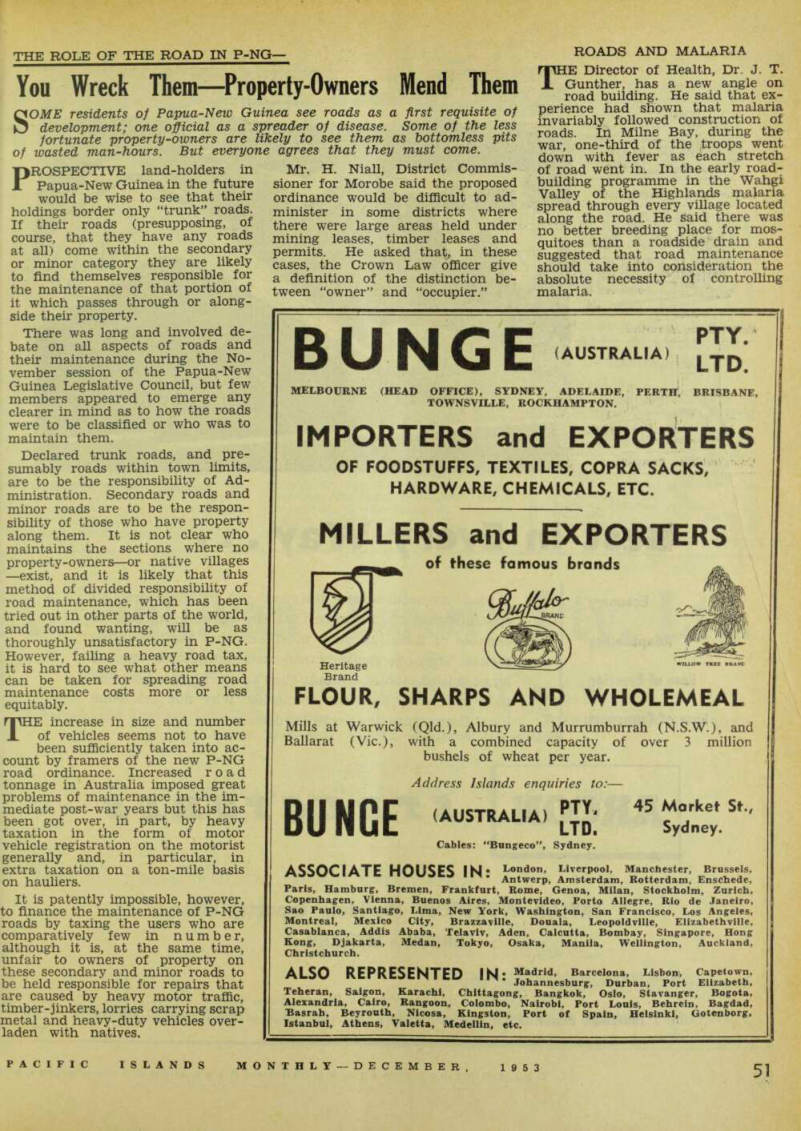
THE ROLE OF THE ROAD IN P-NG- You Wreck Them —Property-Owners Mend Them
SOME residents of Papua-New Guinea see roads as a first requisite of development; one official as a spreader of disease. Some of the less fortunate property-owners are likely to see them as bottomless pits of wasted man-hours. But everyone agrees that they must come.
Prospective land-holders in Papua-New Guinea in the future would be wise to see that their holdings border only “trunk” roads.
If their roads (presupposing, of course, that they have any roads at all) come within the secondary or minor category they are likely to find themselves responsible for the maintenance of that portion of it which passes through or along side their property.
There was long and involved de bate on all aspects of roads and their maintenance during the No vember session of the Papua-New Guinea Legislative Council, but few members appeared to emerge any clearer in mind as to how the roads were to be classified or who was to maintain them.
Declared trunk roads, and pre sumably roads within town limits, are to be the responsibility of Ad ministration. Secondary roads and minor roads are to be the respon sibility of those who have property along them. It is not clear who maintains the sections where no property-owners—or native villages —exist, and it is likely that this method of divided responsibility of road maintenance, which has been tried out in other parts of the world, and found wanting, will be as thoroughly unsatisfactory in P-NG.
However, failing a heavy road tax, it is hard to see what other means can be taken for spreading road maintenance costs more or less equitably. rE increase in size and number of vehicles seems not to have been sufficiently taken into ac count by framers of the new P-NG road ordinance. Increased road tonnage in Australia imposed great problems of maintenance in the im mediate post-war years but this has been got over, in part, by heavy taxation in the form of motor vehicle registration on the motorist generally and, in particular, in extra taxation on a ton-mile basis on hauliers.
It is patently impossible, however, to finance the maintenance of P-NG roads by taxing the users who are comparatively few in number, although it is, at the same time, unfair to owners of property on these secondary and minor roads to be held responsible for repairs that are caused by heavy motor traffic, timber-jinkers, lorries carrying scrap metal and heavy-duty vehicles over laden with natives.
Mr. H. Niall, District Commis sioner for Morobe said the proposed ordinance would be difficult to ad minister in some districts where there were large areas held under mining leases, timber leases and permits. He asked that, in these cases, the Crown Law officer give a definition of the distinction be tween “owner” and “occupier.”
Roads And Malaria
r:E Director of Health, Dr. J. T.
Gunther, has a new angle on road building. He said that ex perience had shown that malaria invariably followed construction of roads. In Milne Bay, during the war, one-third of the troops went down with fever as each stretch of road went in. In the early road building programme in the Valley of the Highlands malaria spread through every village located along the road. He said there was no better breeding place for mos quitoes than a roadside drain and suggested that road maintenance should take into consideration the absolute necessity of controlling malaria.