Copra Market
pp. 22-141 · Read in the full issue
Threat of Detergents to DISPOSAL OF P-NG COPRA STABILISATION FUND
Australian Government Submits A Plan
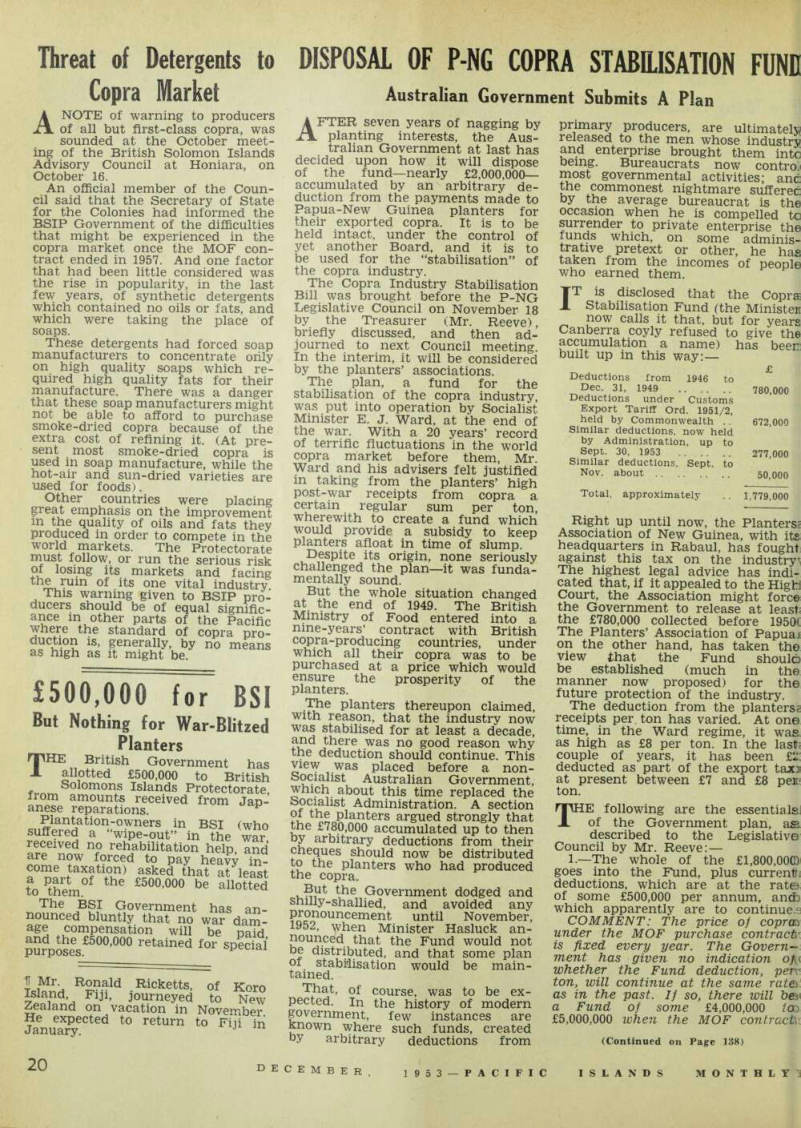
A NOTE of warning to producers of all but first-class copra, was sounded at the October meet ing of the British Solomon Islands Advisory Council at Honiara, on October 16.
An official member of the Coun cil said that the Secretary of State for the Colonies had informed the BSIP Government of the difficulties that might be experienced in the copra market once the MOF con tract ended in 1957. And one factor that had been little considered was the rise in popularity, in the last few years, of synthetic detergents which contained no oils or fats, and which were taking the place of soaps.
These detergents had forced soap manufacturers to concentrate only on high quality soaps which re quired high quality fats for their manufacture. There was a danger that these soap manufacturers might not be able to afford to purchase smoke-dried copra because of the extra cost of refining it. (At pre sent most smoke-dried copra is used in soap manufacture, while the hot-air and sun-dried varieties are used for foods).
Other countries were placing great emphasis on the improvement in the quality of oils and fats they produced in order to compete in the wor id markets. The Protectorate must follow, or run the serious risk of losing its markets and facing rum its one vital industry This warning given to BSIP pro ducers should be of equal signific ance 111 other parts of the Pacific where the standard of copra pro duction is, generally, by no means as high as it might be.
AFTER seven years of nagging by planting interests, the Aus tralian Government at last has decided upon how it will dispose of the fund—nearly £2,000,000 accumulated by an arbitrary de duction from the payments made to Papua-New Guinea planters for their exported copra. It is to be held intact, under the control of yet another Board, and it is to be used for the “stabilisation” of the copra industry.
The Copra Industry Stabilisation Bill was brought before the P-NG Legislative Council on November 18 by the Treasurer (Mr. Reeve), briefly discussed, and then ad journed to next Council meeting.
In the interim, it will be considered by the planters’ associations.
The plan, a fund for the stabilisation of the copra industry, was put into operation by Socialist Minister E. J. Ward, at the end of the war. With a 20 years’ record of terrific fluctuations in the world copra market before them, Mr.
Ward and his advisers felt justified in taking from the planters’ high post-war receipts from copra a certain regular sum per ton, wherewith to create a fund which would provide a subsidy to keep planters afloat in time of slump.
Despite its origin, none seriously challenged the plan—it was funda mentally sound.
But the whole situation changed at the end of 1949. The British Ministry of Food entered into a nine-years’ contract with British copra -producing countries, under which all their copra was to be purchased at a price which would ensure the prosperity of the planters.
The planters thereupon claimed, with reason, that the industry now was stabilised for at least a decade, apd there was no good reason why the deduction should continue. This view was placed before a non- Socialist Australian Government, which about this time replaced the S ®ciahst Administration. A section of the planters argued strongly that the £780,000 accumulated up to then by arbitrary deductions from their cheques should now be distributed to the planters who had produced the copra.
But the Government dodged and shilly-shallied, and avoided any P™D° unceme nt until November, 1952, when Minister Hasluck an nounced that the Fund would not be distributed, and that some plan of stabilisation would be main tained.
That, of course, was to be ex pected. In the history of modern government, few instances are known where such funds, created by arbitrary deductions from
primary producers, are ultimately released to the men whose industry and enterprise brought them intc being. Bureaucrats now contro most governmental activities; and the commonest nightmare suffered by the average bureaucrat is the occasion when he is compelled tc surrender to private enterprise the funds which, on some adminis trative pretext or other, he has taken from the incomes of people who earned them.
IT is disclosed that the Copra Stabilisation Fund (the Minister now calls it that, but for years Canberra coyly refused to give the accumulation a name) has been built up in this way:—
Right up until now, the Planters?
Association of New Guinea, with its headquarters in Rabaul, has fought against this tax on the The highest legal advice has indi cated that, if it appealed to the High!
Court, the Association might force the Government to release at least; the £780,000 collected before 1950 C The Planters’ Association of Papua* on the other hand, has taken the view that the Fund should) be established (much in the manner now proposed) for the future protection of the industry.
The deduction from the planters? receipts per, ton has varied. At one time, in the Ward regime, it was, as high as £8 per ton. In the last; couple of years, it has been £2; deducted as part of the export tax? at present between £7 and £8 pen ton. rE following are the essentials; of the Government plan, as described to the Legislative Council by Mr. Reeve: — I.—The whole of the £1,800,000 goes into the Fund, plus currents deductions, which are at the rats of some £500,000 per annum, and) which apparently are to continues COMMENT: The price of copras under the MOF purchase contract is fixed every year. The Govern ment has given no indication oA< whether the Fund deduction, pen' ton, will continue at the same rate, ; as in the past. If so, there will be* a Fund of some £4,000,000 tos £5,000,000 when the MOF contractu
(Continued on Page 138)
Deductions from 1946 to £ Dec. 31, 1949 780,000 Deductions under Customs Export Tariff Ord. 1951/2, held by Commonwealth .. 672.000 Similar deductions, now held by Administration, up to Sept. 30, 1953 277,000 Similar deductions, Sept, to Nov. about 50,000 Total, approximately 1,779,000
expires. The Fund is invested an is bearing interest. 2 - —The Treasurer said tl “scheme would be administered I a Board” of five members, thrr of whom shall be representative of copra producers. But the Fun itself will be under the immediai control of the Administratio Treasurer.
COMMENT: Mr. Fairfax Ro& who is chairman of the Papu Planters’ Association, immediatei challenged this proposal. Why creat another Board, he asked, wit secretarial staff and all the otht trimmings, when the. Copn Marketing Board, in constitution and purpose, and with specialise local knowledge, is quite capabi of directing the administration o the Fund. Why, indeed! This typical of the haste and eagernes of bureaucracy in creating new am expensive governmental instrument talities ... So far, the plan plain enough. But the next sta o bristles with difficulties: 3.—To ensure stabilisation, tM Board will decide when the tirm has come to declare a bounty, anr a bounty shall be declared accord] mgly, and the Treasurer shall pas it out. Then come provisions “tt ensure that the bounty paymem reaches the producer.”
COMMENT: This is where tht Government’s plan begins t\ assume the earmarks of urw workableness. The plan apparentl\ envisages the payment of bounty at the point of shipment, or theres abouts; and the planners are most, anxious that the full amount of tht bounty shall go back to the actual producer, even to the native village cutter who may have handed oves to the small trader, cruising alows his coast, a couple of baskets do copra.
Anyone who knows anything about the conditions of copra proc duction and collection in P-NO will realise the difficulties of adl ministering a bounty plan in this manner proposed. No wonder this Government proposes to set up o special Board and staff —a largtx, staff would be needed to trace this origin . of all copra, if the actual producer is to become entitled toi a bounty declared some time after s the copra has been cut and sen\s away-.
The Council should insist thais some practical body, like the Copra - Marketing Board, shall be re sponsible for the administration Oj.c the Fund, and especially that it's assumes the task of providing as simple and easy method of dis~< tributing the bounty. Otherwises officialdom, in its eagerness to pro tect the native copra-cutter against, exploitation by the greedy andb
ulless trader, will create some iborate and expensive machinery \ich, under the heading of “ad~ inistrative costs”, will eat deeply to the Fund itself. kNLY two members, Mr. Fairfax f Ross and Mr. Don Barrett, discussed the Bill before —on e motion of Mr. Barrett—the bate was adjourned to the next >uncil meeting. Mr. Barrett said is his Association stood fast by its lim that the money should be paid ick to those who had contributed it: id if it was desired to have a Stabli tion Fund for the copra industry, en a new fund should be started th the agreement of all members the industry, whether they were Papua or New Guinea.
The president (Administrator eland) said that any proposed nendments of the Bill, from ther Papua or New Guinea, ould be in his hands by the end December.
This gives very little time for lequate discussion of so important matter. The NG planters must icide whether they will (a) con lue their fight for distribution of least a portion of the accumu ted funds; or (b) accept the plan r the establishment of a formal md; or (c) accept the Fund, but sist the proposal that a special lard and machinery be set up to [minister it.