The Editors' Mailbag
p. 21 · Read in the full issue
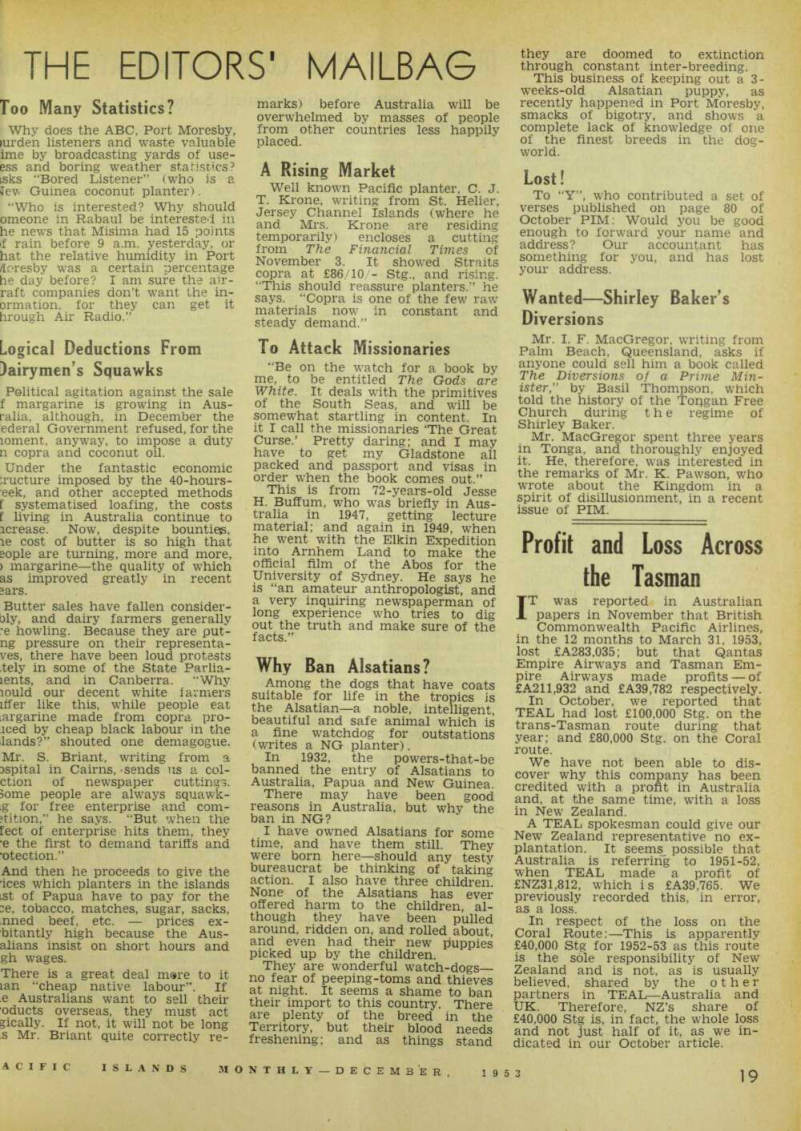
Too Many Statistics?
Why does the ABC, Port Moresby, turden listeners and waste valuable ime by broadcasting yards of use ess and boring weather statistics? isks “Bored Listener” (who is a Jew Guinea coconut planter).
“Who is interested? Why should omeone in Rabaul be interested in he news that Misima had 15 points if rain before 9 a.m. yesterday, or hat the relative humidity in Port /loresby was a certain percentage he day before? I am sure the air raft companies don’t want the in ormation, for they can get it hrough Air Radio.”
Logical Deductions From
Dairymen's Squawks
Political agitation against the sale f margarine is growing in Aus ralia, although, in December the ederal Government refused, for the loment, anyway, to impose a duty n copra and coconut oil.
Under the fantastic economic :ructure imposed by the 40-hours eek, and other accepted methods f systematised loafing, the costs f living in Australia continue to icrease. Now, despite bounties, le cost of butter is so high that eople are turning, more and more, ) margarine—the quality of which as improved greatly in recent Bars.
Butter sales have fallen consider bly, and dairy farmers generally *e howling. Because they are put ng pressure on their representa ves, there have been loud protests ,tely in some of the State Parlia ients, and in Canberra. “Why lould our decent white farmers iffer like this, while people eat Largarine made from copra pro ceed by cheap black labour in the lands?” shouted one demagogue.
Mr. S. Briant, writing from a Dspital in Cairns, -sends us a col ction of newspaper cuttings.
Some people are always squawk g for free enterprise and com ?tition,” he says. “But when the feet of enterprise hits them, they ■e the first to demand tariffs and •otection.”
And then he proceeds to give the •ices which planters in the islands ist of Papua have to pay for the ze, tobacco, matches, sugar, sacks, nned beef, etc. prices ex bitantly high because the Aus alians insist on short hours and gh wages.
There is a great deal more to it lan “cheap native labour”. If e Australians want to sell their oducts overseas, they must act gically. If not, it will not be long ,s Mr. Briant quite correctly re
marks) before Australia will be overwhelmed by masses of people from other countries less happily placed.
A Rising Market
Well known Pacific planter, C. J.
T. Krone, writing from St. Helier, Jersey Channel Islands (where he and Mrs. Krone are residing temporarily) encloses a cutting from The Financial Times of November 3. It showed Straits copra at £B6/10/- Stg., and rising.
“This should reassure planters.” he says. “Copra is one of the few raw materials now in constant and steady demand.”
To Attack Missionaries
“Be on the watch for a book by me, to be entitled The Gods are White. It deals with the primitives of the South Seas, and will be somewhat startling in content. In it I call the missionaries ‘The Great Curse.’ Pretty daring; and I may have to get my Gladstone all packed and passport and visas in order when the book comes out.”
This is from 72-years-old Jesse H. Buffum, who was briefly in Aus tralia in 1947, getting lecture material; and again in 1949, when he went with the Elkin Expedition into Arnhem Land to make the official film of the Abos for the University of Sydney. He says he is “an amateur anthropologist, and a very inquiring newspaperman of long experience who tries to dig out the truth and make sure of the facts.”
Why Ban Alsatians?
Among the dogs that have coats suitable for life in the tropics is the Alsatian—a noble, intelligent, beautiful and safe animal which is a fine watchdog for outstations (writes a NG planter).
In 1932, the powers-that-be banned the entry of Alsatians to Australia, Papua and New Guinea.
There may have been good reasons in Australia, but why the ban in NG?
I have owned Alsatians for some time, and have them still. They were born here—should any testy bureaucrat be thinking of taking action. I also have three children.
None of the Alsatians has ever offered harm to the children, al though they have been pulled around, ridden on, and rolled about, and even had their new puppies picked up by the children.
They are wonderful watch-dogs— no fear of peeping-toms and thieves at night. It seems a shame to ban their import to this country. There are plenty of the breed in the Territory, but their blood needs freshening; and as things stand
they are doomed to extinction through constant inter-breeding.
This business of keeping out a 3 weeks-old Alsatian puppy, as recently happened in Port Moresby, smacks of bigotry, and shows a complete lack of knowledge of one of the finest breeds in the dog world.
Lost!
To “Y”, who contributed a set of verses published on page 80 of October PIM: Would you be good enough to forward your name and address? Our accountant has something for you, and has lost your address.
Wanted—Shirley Baker's
Diversions
Mr. I. F. MacGregor, writing from Palm Beach, Queensland, asks if anyone could sell him a book called The Diversions of a Prime Min ister,’' by Basil Thompson, which told the history of the Tongan Free Church during the regime of Shirley Baker.
Mr, MacGregor spent three years in Tonga, and thoroughly enjoyed it. He, therefore, was interested in the remarks of Mr. K. Pawson, who wrote about the Kingdom in a spirit of disillusionment, in a recent issue of PIM.