Equator
pp. 103-105 · Read in the full issue
Snow On The
What Three Climbers Found 14,000-ft Up In NG
AS part of a New Guinea holiday, two Victorian alpine en thusiasts, Messrs. L. Rayner and N. Semple, recently climbed the four main peaks of Mt. Wilhelm, in the Eastern Highlands of New Guinea. The peaks are about 9,000 feet above the Government station of Goroka — which, at 5,200 feet, is considered itself to be very much Highland country.
The Victorians were accompanied by Patrol-Officer A. M. Keogh, of the Papua-New Guinea District Services Department; and, when they returned to civilisation, the three men were able to give some interesting information about a hitherto little-known part of New Guinea—a New Guinea where cold mist and rain, ice, and even snow take the place of the more usual damp heat of the tropics.
The information which the men gave was covered by an interesting press release from the Port Moresby Public Relations Office on Sep tember 24: r:E party found small isolated patches of snow on the upper ridges, and streams near their advance camp iced over during the night. No native carriers were taken beyond the base camp be cause of the low temperatures and the difficult rock formations which had to be traversed. Using special ?ear brought from Australia, com plete supplies for two men for five weeks was reduced to four light weight packs. This included food, clothing, bedding, tents, medical supplies and photographic equip ment.
The altimeter carried by the party gave a height of 15,400 for ;he main peak, 14,900 for the next lighest, and around 14,500 on ad joining peaks. All four main peaks were climbed to make a check on :heir height. A cairn and notes ieft by previous climbing parties were located, including those placed >n the peak by the Vial and Noakes Jxpedition of 1938.
Describing the main peak, Mr. £eogh said it was composed mainly )f granite impregnated with mag letite deposits which caused erratic r ariation in compass readings. From -he summit of Mt. Wilhelm, they lighted the Finisterre and Adelbert Ganges, also the Amele bluff at Vladang, and the Bagasin Mountains.
Veather conditions were difficult m the higher levels, and mists, leavy rain, frosts and hail were ex jenenced during the trip.
Mr. Keogh said that the Pinde umde and Guraguraga Valleys ad acent to Mt. Wilhelm are of glacial irigin, and the three lakes in the r alleys are all brilliantly coloured,
varying from jet black in overcast weather to a bright blue or green on sunny days.
The valleys were rarely visited by natives, except for hunting expeditions for ringtail possums which are fairly common in the area. It is believed that the Guraguraga Valley had never previously been visited by Europeans Vegetation in the two valleys was varied and colourful. There were small scattered dumbs of timber, but most of the vegetation consisted of patches of coarse alpine grass
and a few stunted shrubs of the gorse variety. No timber of any kind was seen above 12,500 feet.
J’he thickly-glassed floors of the two valleys were similar in appear ?^ lce T J X) the high cattle country of the Upper Murray Valley in Aus tralia. The grass was of a short, coarse type which appears to be a variety known as Cushion Grass. It
*£“Sg“J“g heigVun to°MOoS
£??? slopes al nelgms up 10 14 ' JUU Beyond the two valleys native sweet potato gardens were seen as
high as 8,700 feet, and pandanus groves at nearly 11,000. The latter
appeared to do particularly well at an altitude of 8,000 to 10,000 feet.
Many unusual flowers were seen and photographed in colour by Mr.
Rayner, who also made a colour film of the areas covered during the trip. All three members of the party likewise made a collection of unusual geological and insect speci mens.
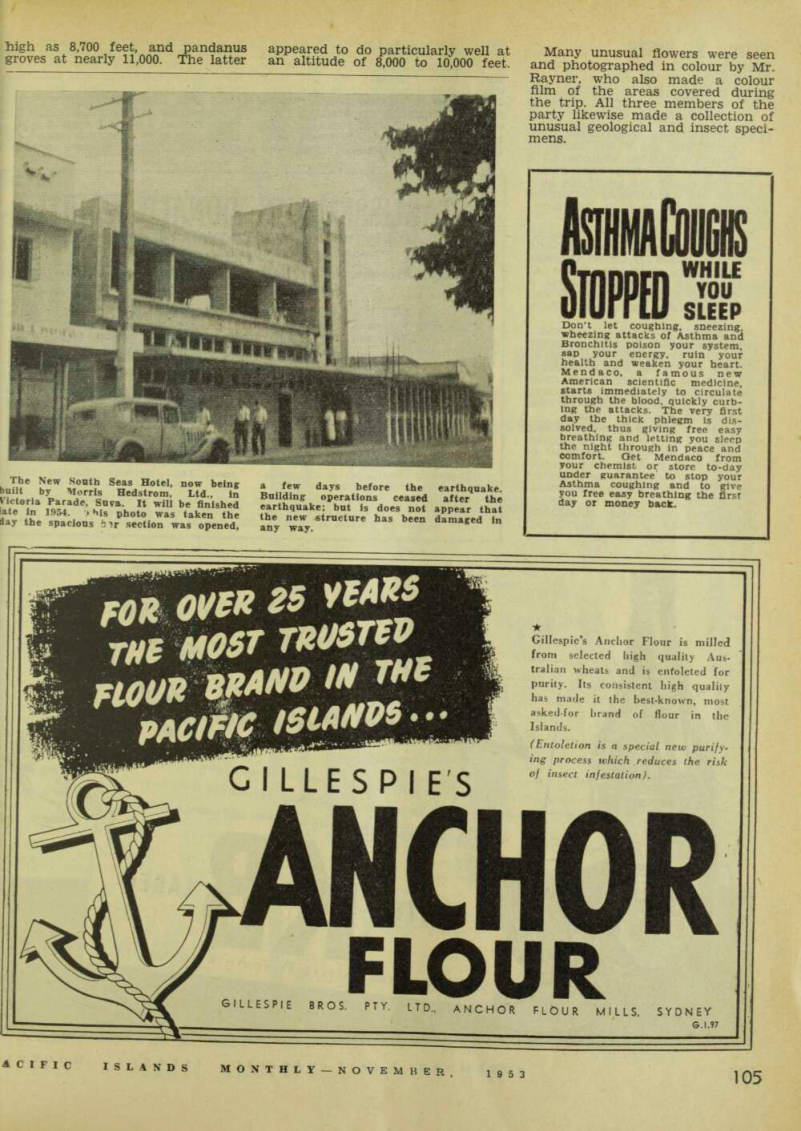
The New South Seas Hotel, now being built by Morris Hedstrom, Ltd., in victoria Parade, Suva. It will be finished [?]ate In 1954. > his photo was taken the day the spacious brr section was opened,
a few days before the earthquake.
Building operations ceased after the earthquake; but is does not appear that the new structure has been damaged in any way.