Pacific’S Most
pp. 84-86 · Read in the full issue
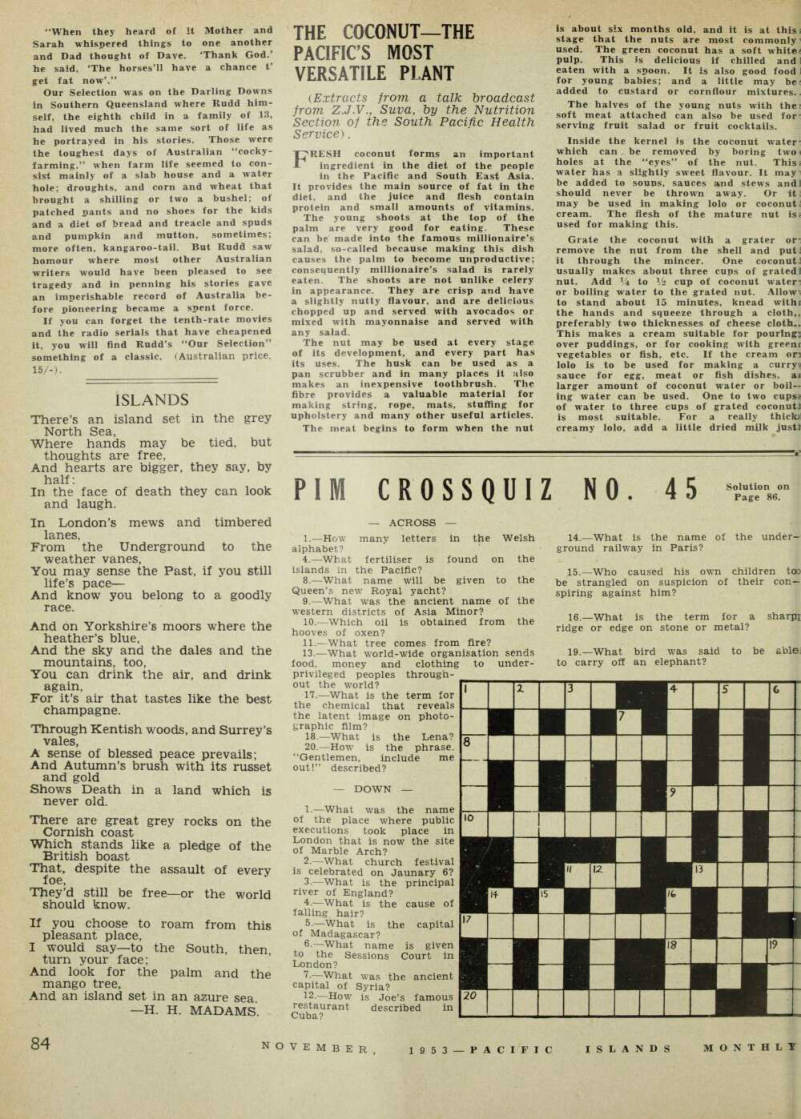
The Coconut—The
Versatile Plant
(Extracts from a talk broadcast
from Z.J.V. , Suva, by the Nutrition
Section of the South Pacific Health
Service).
FRESH coconut forms an important ingredient in the diet of the people in the Pacific and South East Asia.
It provides the main source of fat in the diet, and the juice and flesh contain protein and small amounts of vitamins.
The young shoots at the top of the palm are very good for eating. These can be made into the famous millionaire’s salad, so-called because making this dish causes the palm to become unproductive; consequently millionaire’s salad is rarely eaten. The shoots are not unlike celery in appearance. They are crisp and have a slightly nutty flavour, and are delicious chopped up and served with avocados or mixed with mayonnaise and served with any salad.
The nut may be used at every stage of its development, and every part has its uses. The husk can be used as a pan scrubber and in many places it also makes an inexpensive toothbrush. The fibre provides a valuable material for making string, rope, mats, stuffing for upholstery and many other useful articles.
The meat begins to form when the nut
is about six months old, and it is at this stage that the nuts are most commonly used. The green coconut has a soft white pulp. This is delicious if chilled and eaten with a spoon. It is also good food for young babies; and a little may be added to custard or cornflour mixtures.
The halves of the young nuts with the soft meat attached can also be used for serving fruit salad or fruit cocktails.
Inside the kernel is the coconut water which can be removed by boring two holes at the “eyes” of the nut. This water has a slightly sweet flavour. It may be added to soups, sauces and stews and should never be thrown away. Or it may be used in making 1010 or coconut cream. The flesh of the mature nut is used for making this.
Grate the coconut with a grater or remove the nut from the shell and put it through the mincer. One coconut usually makes about three cups of grated nut. Add 14 to Vz cup of coconut water or boiling water to the grated nut. Allow to stand about 15 minutes, knead with the hands and squeeze through a cloth, preferably two thicknesses of cheese cloth.
This makes a cream suitable for pouring: over puddings, or for cooking with green vegetables or fish, etc. If the cream or 1010 is to be used for making a curry sauce for egg, meat or fish dishes, a larger amount of coconut water or boil ing water can be used. One to two cupsi of water to three cups of grated coconut is most suitable. For a really thick; creamy 1010, add a little dried milk just;
before serving, one teaspoon of dried milk to the cup of 1010 is sufficient.
Lolo can have salt water or sea water added before it is used with vegetables.
It can be flavoured with lime leaves, limes, or lemon juice before adding to sweet or fruit dishes.
The grated coconut meat will still re tain sufficient flavour after the cream has been extracted and may be used for curries, puddings, macaroons and candy.
Add about one tablespoon of grated coco nut to a pint of ice cream before the last whipping, or substitute Vi cup of 1010 of coconut cream for ’•> cup of milk in an ice cream recipe.
A baked sprouted nut makes a delicious dish. The outer husk is removed and the nut is baked whole in a moderately hot oven, about IV2 to 2 hours depending on its size. It is then split open, the inside of the nut scooped out and seasoned with salt and pepper. It may be served as a vegetable or plain ?.s an accompaniment for a pudding.
Bananas With Coconut Sauce
6 small green bananas. 2 tablespoons sugar (if you use dessi cated package coconut, 1 tablespoon of sugar will be sufficient). 2/3 cup grated fresh coconut. 1 cup milk.
Place the whole, unpeeled bananas in boiling water and cook 20-30 minutes or until they are soft. Remove the skins from the bananas and cut them length wise. Make a sauce by heating the grated coconut and sugar in the milk. Pour this sauce over the bananas and serve them as a dessert with whipped cream if desired. Serve either hot or cold.
Lolo can be used instead of milk and sugar.
THE kernels of the ripe coconuts are used to make copra. The nuts are split in half and are either sun, smoke or kiln dried for about four days, then crushed and milled to give oil and coconut meal. The oil is often a basis for margarine, substitute ghee and various cooking oils. The meal, which is left after the oil is extracted, is fed to cattle, pigs and poultry. It has a high protein content but is difficult to utilise as a human food.
In the Gilbert and Ellice Islands, a coconut drink called toddy is prepared by cutting the skin of the coconut flower bud. The syrup-like juice then drips overnight into a coconut cup which is suspended below. The following morning it is collected and used throughout the day. Children are given the toddy when it is fresh but some adults prefer it slightly fermented. This drink provides an important source of vitamins.
“Sour” toddy is an alcoholic drink made from the over-fermented liquor.
Sometimes toddy is boiled before drinking.
If it is boiled for a long time all the water evaporates and leaves a sweet sugar. It is used the first and second day after making and babies are often given both fresh and boiled toddy.
Pawpaw And Coconut Pudding
3 cups grated coconut and 1 cup boiling water (make into IV2 cups lolo).
IV2 cups thick pawpaw pulp, sieved.
Pinch salt. % cup sugar. 7 tablespoons cornflour or cassava flour.
Make the 1010 using the grated nut and the boiling water. If the 1010 measures less than IVz cups make up with coconut water. Mix the cornflour, sugar, and salt together, and stir into the pawpaw. Cook over a slow heat, stir until the mixture thickens. Add the 1010 and cook five to 10 minutes. The mixture should be stiff but not stiff enough to mould when cold.
Pour into a dish and chill. Lolo may be served over the pudding if desired.