The Yanks Left
pp. 79-80 · Read in the full issue
Santo, The Town
By
Judy Tudor
This mighty bomber strip, and those outlying fighter strips that lie . hidden behind the mossgreen hills, were built by Americans, with American money. It is American fighters that stand in the revet ments; American shoulders and American cement that built those permanent wharves inside the reef...
But who owns the island on which so much money is being invested on permanent improvements? It is not legally America’s. , .
On some islands where there are coconut plantations owned by big British and French companies the US has bought coconut palms— every one being counted by a Com pany representative on the spot— at prices ranging from 50 cents to several dollars each —in order to have the right to cut them down to build defence runways.
In the Pacific . . . after selecting a coral spot necessary to defend Australia, Alaska and America, and recover the Indies, Malaya, Burma and China, we begin making this hitherto valueless spot well pro tected and secure and as valuable as possible—all without any pur chase, agreement or understanding.
SO wrote US war correspondent George Weller for the Chicago Daily News in July, 1943. A good news story then, for home consump tion, it makes strange reading in Santo, New Hebrides, just 10 years later—and Santo was no doubt one of the places Weller had in mind when he wrote the article (called U.S. As Sucker No. 1 in Pacific Isles ).
It has been kept and was given to me by Mr. Tom Harris, of Santo, who has lived in that part of the woods for the past 35 years. He was there when the first Americans came, looking for a Hebrides base from which to kick back at the Japs in the Solomons; he rounded up some horses and helped them explore the area; took them to the place which ultimately be came their first air-strip, and obtained the labour which helped to make it.
He remained on at Santo while it grew into one of the largest bases in the South Pacific, with about 350,000 troops at the peak of its usefulness, over 400 miles of wide coral roads, half-dozen bomber and fighter strips, a similar number of wharves and thousands of the Quonsets which seem as though they might be the most permanent legacy of the US invasion of the Pacific.
He remained still when, in the later stages of the war, they shipped out to bases further north; and he is there to-day—running what is probably the largest cinema in the South Pacific—certainly one of the most unique.
But Santo, in 1953, is largely (but not altogether) a variation of an old theme —from jungle to jungle in half a generation. Probably not more than 60 miles of the roads are still in use. No one uses the airfields—Santo’s weekly airservice to and from Australia is by flying boat; the thousands of Quonsets have been reduced (at a wild guess) to a hundred still in use.
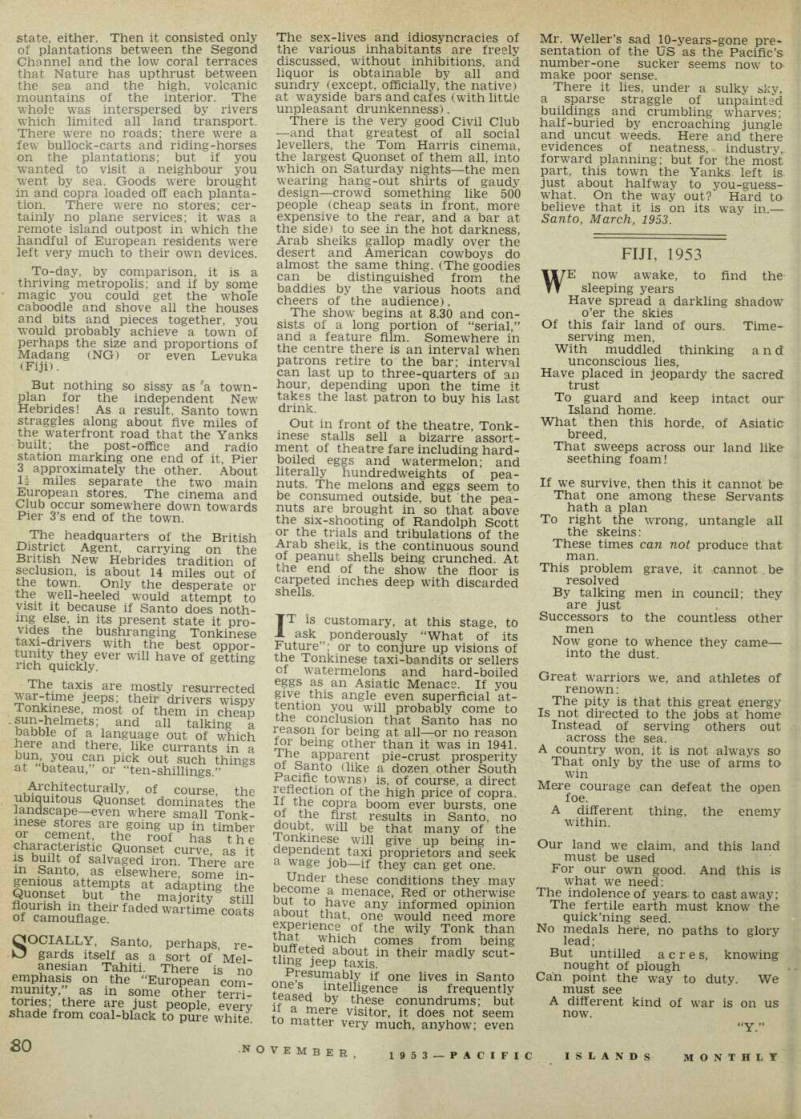
What Mr. Weller was pleased to call “permanent improvements” in the way of wharves, have been re duced to a silly joke. What are still called grandiloquently Pier 3 and Pier 5 are in existence; but they have both reached the stage now when a good hard jolt from a row boat would likely send them toppling into Segond Channel.
Master mariners approach them cautiously, and the ideal is to tie up with two or three feet to spare.
Pier 3 has suffered most from mariners who have not achieved the ideal. Swathes have been cut off each end by visiting copra ships, and a huge scollop has been put into it somewhere near the middle by the old Morinda. In the centre of the decking there is a gap, maybe 30 feet square, now ringed around by red-painted oil drums, where a lorry went through. Minor holes occur at intervals; but, by using hatch-covers and pieces of airfield matting, it is possible to get lorries onto about one-third of it.
Pier 5 is peppered with holes of varying shapes and sizes, and what decking remains carries a healthy crop of local grass. They keep the lorries off this one. Native steve dores pick their way daintily be tween and around the holes.
BUT Santo —or maybe more cor rectly, the Segond Channel area —has not reverted to its 1941
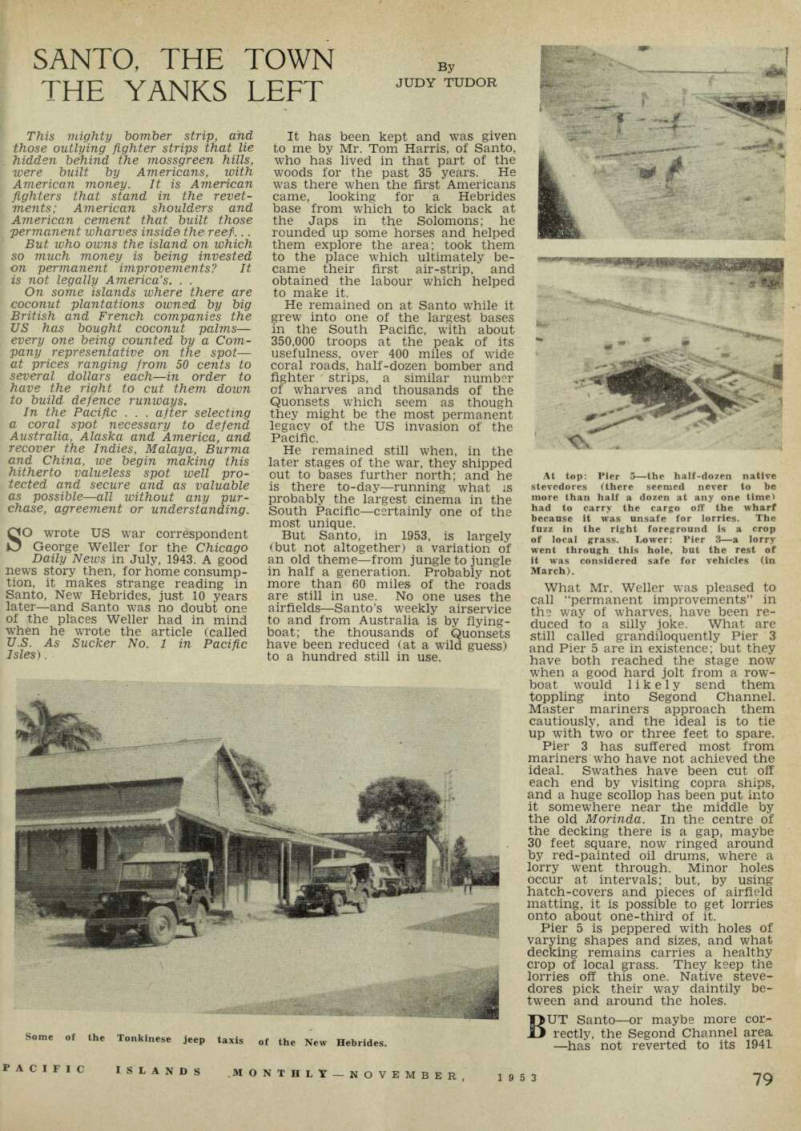
Some of the Tonkinese jeep taxis O f the New Hebrides.
At top: Pier s—the half-dozen native stevedores (there seemed never to be more than half a dozen at any one time) had to carry the cargo off the wharf because it was unsafe for lorries. The fuzz in the right foreground is a crop of local grass. Lower: Pier 3—a lorry went through this hole, but the rest of it was considered safe for vehicles (in March).
state, either. Then it consisted only of plantations between the Segond Channel and the low coral terraces that Nature has upthrust between the sea and the high, volcanic mountains of the interior. The whole was interspersed by rivers which limited all land transport.
There were no roads; there were a few bullock-carts and riding-horses on the plantations; but if you wanted to visit a neighbour you went by sea. Goods were brought in and copra loaded off each planta tion. There were no stores; cer tainly no plane services; it was a remote island outpost in which the handful of European residents were left very much to their own devices.
To-day, by comparison, it is a thriving metropolis; and if by some magic you could get the whole caboodle and shove all the houses and bits and pieces together, you would probably achieve a town of perhaps the size and proportions of Madang (NG) or even Levuka (Fiji).
But nothing so sissy as 'a town plan for the independent New Hebrides! As a result, Santo town straggles along about five miles of the waterfront road that the Yanks built; the post-office and radio station marking one end of it, Pier 3 approximately the other. About U miles separate the two main European stores. The cinema and Club occur somewhere down towards Pier 3’s end of the town.
The headquarters of the British District Agent, carrying on the British New Hebrides tradition of seclusion, is about 14 miles out of the town. Only the desperate or the well-heeled would attempt to visit it because if Santo does noth ing else, in its present state it pro vides the bushranging Tonkinese taxi-drivers with the best oppor tunity they ever will have of getting rich quickly.
The taxis are mostly resurrected war-time jeeps; their drivers wispv Tonkinese, most of them in cheap ■f. U uu? eln l ets; and all talking a babble of a language out of which here and there, like currants in a b^.ypu can pick out such things at bateau,” or “ten-shillings.”
Architecturally, of course, the übiquitous Quonset dominates the landscape—even where small Tonk inese stores are going up in timber °£ ce p ie . n t, the roof has the characteristic Quonset curve, as it is built of salvaged iron. There are in Santo, as elsewhere, some in genious attempts at adapting the Quonset but the majority still flourish in their faded wartime coats of camouflage.
SOCIALLY, Santo, perhaps, re gards itself as a sort of Mel anesian Tahiti. There is no emphasis on the “European com munity, as in some other terri tones; there are just people, everv shade from coal-black to pure white.
The sex-lives and idiosyncracies of the various inhabitants are freely discussed, without inhibitions, and liquor is obtainable by all and sundry (except, officially, the native) at wayside bars and cafes (with little unpleasant drunkenness).
There is the very good Civil Club —and that greatest of all social levellers, the Tom Harris cinema, the largest Quonset of them all, into which on Saturday nights—the men wearing hang-out shirts of gaudy design—crowd something like 500 people (cheap seats in front, more expensive to the rear, and a bar at the side) to see in the hot darkness, Arab sheiks gallop madly over the desert and American cowboys do almost the same thing. (The goodies can be distinguished from the baddies by the various hoots and cheers of the audience).
The show begins at 8.30 and con sists of a long portion of “serial,” and a feature film. Somewhere in the centre there is an interval when patrons retire to the bar; interval can last up to three-quarters of an hour, depending upon the time it takes the last patron to buy his last drink.
Out in front of the theatre, Tonk inese stalls sell a bizarre assort ment of theatre fare including hard boiled eggs and watermelon; and
literally hundredweights of pea
nuts. The melons and eggs seem to be consumed outside, but the pea nuts are brought in so that above the six-shooting of Randolph Scott or the trials and tribulations of the Arab sheik, is the continuous sound of peanut shells being crunched. At the end of the show the floor is carpeted inches deep with discarded shells.
IT is customary, at this stage, to ask ponderously “What of its Future”: or to conjure up visions of the Tonkinese taxi-bandits or sellers of watermelons and hard-boiled eggs as an Asiatic Menace. If you give this angle even superficial at tention you will probably come to the conclusion that Santo has no reason for being at all —or no reason for being other than it was in 1941.
Th c apparent pie-crust prosperity of Santo (like a dozen other South Pacific towns) is, of course, a direct reflection of the high price of copra. 11 the copra boom ever bursts, one of the first results in Santo, no doubt, will be that many of the Tonkinese will give up being in aependent taxi proprietors and seek a wage job—if they can get one.
Under these conditions they may become a menace, Red or otherwise out to have any informed opinion aoout that, one would need more experience of the wily Tonk than tnat which comes from being buffeted about in their madly scut tling jeep taxis.
Presumably if one lives in Santo r nes , intelligence is frequently teased by these conundrums; but a r P, ere visitor, it does not seem to matter very much, anyhow; even
Mr. Weller’s sad 10-years-gone pre sentation of the US as the Pacific’s number-one sucker seems now to make poor sense.
There it lies, under a sulky skv, a sparse straggle of unpainted buildings and crumbling wharves; half-buried by encroaching jungle and uncut weeds. Here and there evidences of neatness, industry, forward planning; but for the most part, this town the Yanks left is just about halfway to you-guess what. On the way out? Hard to believe that it is on its way in.— Santo, March, 1953.