Tropicalities
pp. 77-78 · Read in the full issue
Magazine Section
No Whip For Mother Mac
FANNING ISLAND has been much in the news lately. It was in 1903 that I was working on the Suva end of the cable from Fanning, and I have always remembered a Service memo from the Superin tendent. Fanning Island Cable Station to the Superintendent, Suva, asking him to send a box of worms by the cable ship Iris, shortly to leave Suva for Fanning.
It seems they were battling to get a kitchen garden started and, probably quite rightly, thought a few worms might help things along.
Some of the staff loved Fanning Island. For my part I got out of the service for fear of being sent there. Fancy doing two years on a mid-Pacific atoll where there were no worms (or girls) !
It was years later, when I was sitting on the upstairs verandah at Mother Mac’s hotel, in Suva, at early morning tea-time, when a lady from a few rooms up suddenly called: “Look! Look! Here comes a horse!” —and a six-years-old boy rushed out from their room to get what was obviously his first sight of a real, live horse.
He was a young Wardrop, born at Fanning Island, and the family had arrived the night before after a spell of about seven years there.
Speaking of Mother Mac’s: the recent very interesting reminiscences in the PIM were, I think, a bit astray over the horse-whip. Mrs.
Mac never needed one—the lash of her tongue was quite enough to clear any rowdy bar parlour I ever saw. When the old grey dressing gown appeared at the top of the stairs, everyone knew it was time to go.
She was one of the very best, at heart. Well I remember having a quiet after-dinner “wad” with her one evening.
“When I first started this busi ness,” she remarked, “I said to my self, ‘Old Girl, you’ve got to be a devil’”; and, with a cackle of laughter, she continued: “and, my god, I’ve BEEN a devil.”
As for the horsewhip, I think someone will back me up when I say it was Ma Reading, at the Mel bourne Hotel, farther up the Parade, who was supposed to crack that, and right skilfully, too. Another good old sort was Mrs. Reading, who never did anybody any harm.
Wagga.
Living High In Noumea
THE cost of living (and that in cludes beer!) shocked the Aus tralians who went to New Cale donia for the Centenary celebra tions in September.
Sydney newspapermen who were there to cover the Sydney-Noumea yacht race said that the island offered the tourist a wonderful time —if he could afford it.
With the Australian £ worth 140 francs, a roll of film which cost 3/3 in Australia cost 6/9 in Noumea: a two-mile taxi ride was 16/-, beer 2/3 per glass, butter 7/- a pound, tea 11/- a pound, cauliflowers 12/6 each, and eggs 9d each.
They said carpenters and other tradesmen got £32 per week—-and needed every penny of it.
No More Nenes
IT is reported from Hawaii that the nene, one of the rarest birds in the world, is rapidly dying out despite all efforts to preserve the species.
The nene is a large goose, native to two islands in the Hawaiian chain, Maui and Hawaii. Their numbers were estimated at 25,000 at the beginning of last century; but there are not more than 70 of the birds, over half of them in captivity, living to-day. Their life span is known to exceed 40 years.
The Hawaiian Board of Agricul ture and Forestry spent $6,000 last year in an effort to increase their numbers by artificial insemination and other means. The birds usually keep to the one mate, and the younger ones rarely produce fertile eggs.
Bring On Your Pigs And
Your Buns!
IN Rarotonga the Titikaveka village elders revealed what that popular Cook Islands excursion known as the tere party costs the hosts.
When guests from Aitutaki de scended upon them in three recent visits the following items were de livered to the village chefs on each occasion; Pigs, 112; fowls, 112; meat, 244 16-oz tins; taro and kumaras, 448 lbs; banana puddings, 224; cakes, 65 dozen; bread, 336 loaves; scones and buns, 2,400 pieces.
This explains why the live-stock are reported to get fidgety when ever a local small-craft is seen approaching an island.
Association Of Ideas
BETWEEN service in Malaya and his return to Fiji in November, Lieut.-Colonel Ratu Edward Cakobau, MC, enjoyed an Australian holiday—taking in the Melbourne Cup and seeing some of the sights of Sydney Town. He is still the best looking man south of the Line and this 6-ft Fijian in green beret, khaki sulu and shirt, got, in return, his fair share of attention in the Southern cities.
The Colonel tells with much relish of the struggles of the reception clerks at his Sydney hotel with a name that is spelled Cakobau and, incomprehensibly, is pronounced Thakombau. And of the evident confusion of the lady who got into
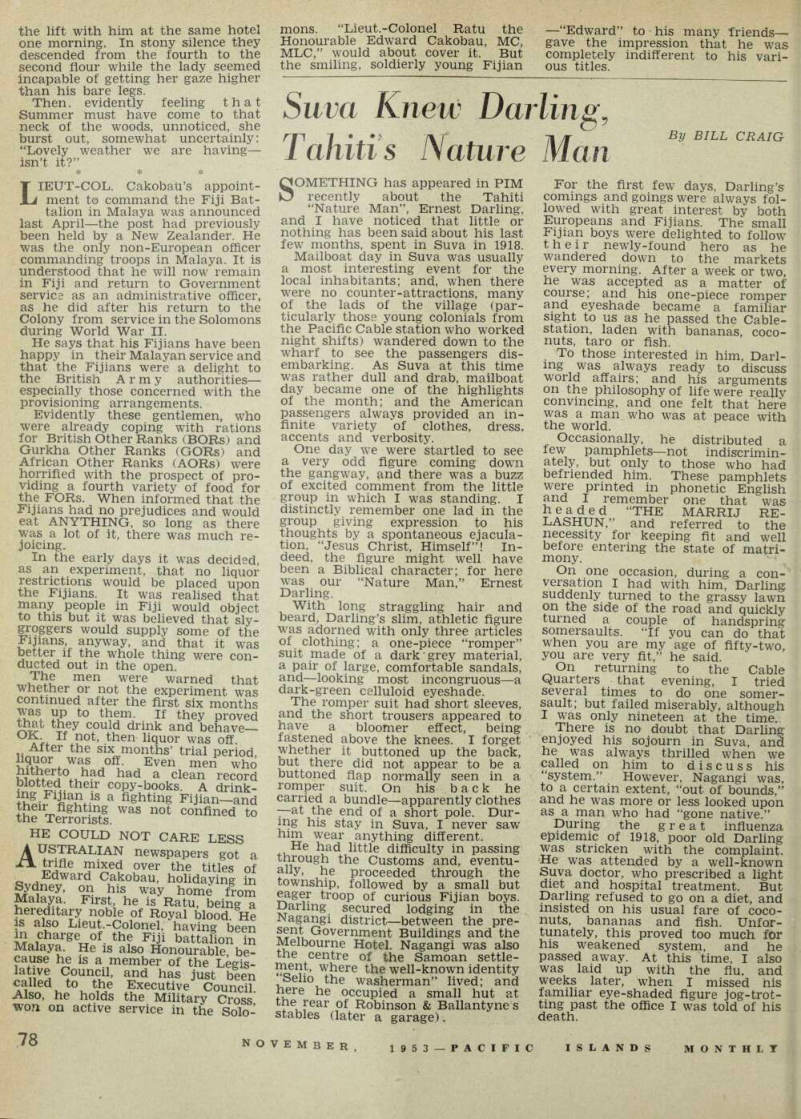
Portrait
of an
Artist
Captain Brett Hilder of MV Malaita at work on a rough sketch which no doubt by now has formed the basis of one of his famous water colours of Pacific Islands natives. The sub ject in this case was the native helmsman of the Administra tion workboat at Sohano, Buka Passage, TNG.
The interested on looker in the back ground is Mr. Jimmy Joyes of Iwi Planta tion, Bougainville.
the lift with him at the same hotel one morning. In stony silence they descended from the fourth to the second flour while the lady seemed incapable of getting her gaze higher than his bare legs.
Then, evidently feeling that Summer must have come to that neck of the woods, unnoticed, she burst out, somewhat uncertainly; “Lovely weather we are having— isn’t it?” * * * LIEUT-COL. Cakobau’s appoint ment to command the Fiji Bat talion in Malaya was announced last April—the post had previously been held by a New Zealander. He was the only non-European officer commanding troops in Malaya. It is understood that he will now remain in Fiji and return to Government service as an administrative officer, as he did after his return to the Colony from service in the Solomons during World War 11.
He says that his Fijians have been happy in their Malayan service and that the Fijians were a delight to the British Army authorities— especially those concerned with the provisioning arrangements.
Evidently these gentlemen, who were already coping with rations for British Other Ranks (BORs) and Gurkha Other Ranks (GORs) and African Other Ranks (AORs) were horrified with the prospect of pro viding a fourth variety of food for the FORs. When informed that the Fijians had no prejudices and would eat ANYTHING, so long as there was a lot of it, there was much re joicing.
In the early days it was decided, as an experiment, that no liquor restrictions would be placed upon the Fijians. It was realised that many people in Fiji would object to this but it was believed that sly groggers would supply some of the Fijians, anyway, and that it was better if the whole thing were con ducted out in the open.
The men were warned that whether or not the experiment was continued after the first six months JY as , HP to If the y Proved that they could drink and behave— If not, then liquor was off After the six months’ trial period, hquor was off. Even men who hitherto had had a clean record blotted their copy-books. A drink a fighting Fijian—and rp fight ß g was not confined to the Terrorists.
He Could Not Care Less
Australian newspapers got a trifle mixed over the titles of
Edward Cakobau, holidaying in
Sydney, on his way home from Malaya. First, he is Ratu, being a hereditary noble of Royal blood. He is also Lieut.-Colonel, having been in charge of the Fiji battalion in Malaya. He is also Honourable be cause he is a member of the Legis- C f^ Un S 1 ’ a £ d has just been balled to the Executive Council Also, he holds the Military Cross' won on active service in the Solo
mons. “Lieut.-Colonel Ratu the Honourable Edward Cakobau, MC, MLC,” would about cover it. But the smiling, soldierly young Fijian
—“Edward” to his many friends— gave the impression that he was completely indifferent to his vari ous titles.