Australia’s Dead in New Guinea
pp. 20-21 · Read in the full issue
Some Aspects of G-G’s Visit to War Cemeteries
THE ceremonies of unveiling the Crosses of Sacrifice in the three great war cemeteries of Papua-New Guinea (Port Moresby, Lae and Rabaul), which were car ried out in late October by the Gov ernor-General of Australia (Sir William Slim), were notable for three things; • It was a triumph of organisa tion by Brigadier D. M. Cleland and the high officials of his Administra tion. Nearly 50 officials and their women folk, and 23 next-of-kin of servicemen buried in PNG, had to be accommodated and moved rap idly from place to place Port Moresby ceremony on October 19: Lae on October 21; and Rabaul on 23rd but everything appears to have run smoothly and according to schedule. • Although an appalling pro gramme of engagements was thrown upon Australia’s new Governor- General, he carried the heavy strain without a tremor. On the days between the cemetery ceremonies he met hundreds of Europeans and Chinese, and thousands of natives and attended countless functions; but everywhere he gave an im pression of great sincerity and ur banity, and every one of his three main speeches was distinguished by a high level of thought, a pointed application of the lessons of sac rifice presented by the war cemetery, and high literary quality. • Despite the hurry and official anxiety involved in bringing all these widely-scattered events with in the compass of one week, the proceedings were notable for smoothness of official performance, and great goodwill on the part of the three communities concerned.
SUCH good work by the Admini stration tended to remove the first bad impression given by Canberra’s bungling, when it pro posed to send a large party of Top Brass, and its attendant women
folk, at the public’s expense, to wit ness the Governor-General perform these ceremonies, while the party was to include less than a baker’s dozen of soldiers’ next-of-kin.
The caustic comments of public and Press sent Canberra into a wild scramble for more next-of-kin; but the eventual total of 23, carried as
the country’s guests to the wa; cemeteries, looked poor and thin h comparison with the 45 or mor Ministers, High Commissioners, Par liamentarians and other decorativ folk who went along to enjoy th ride and observe the scenery.
It is not a happy chapter in th story of Australia’s Administrate] of these Territories. The unveilin ceremonies and the general invita tion to next-of-kin to visit Papua New Guinea, should have take: place years ago. After all it is eigh
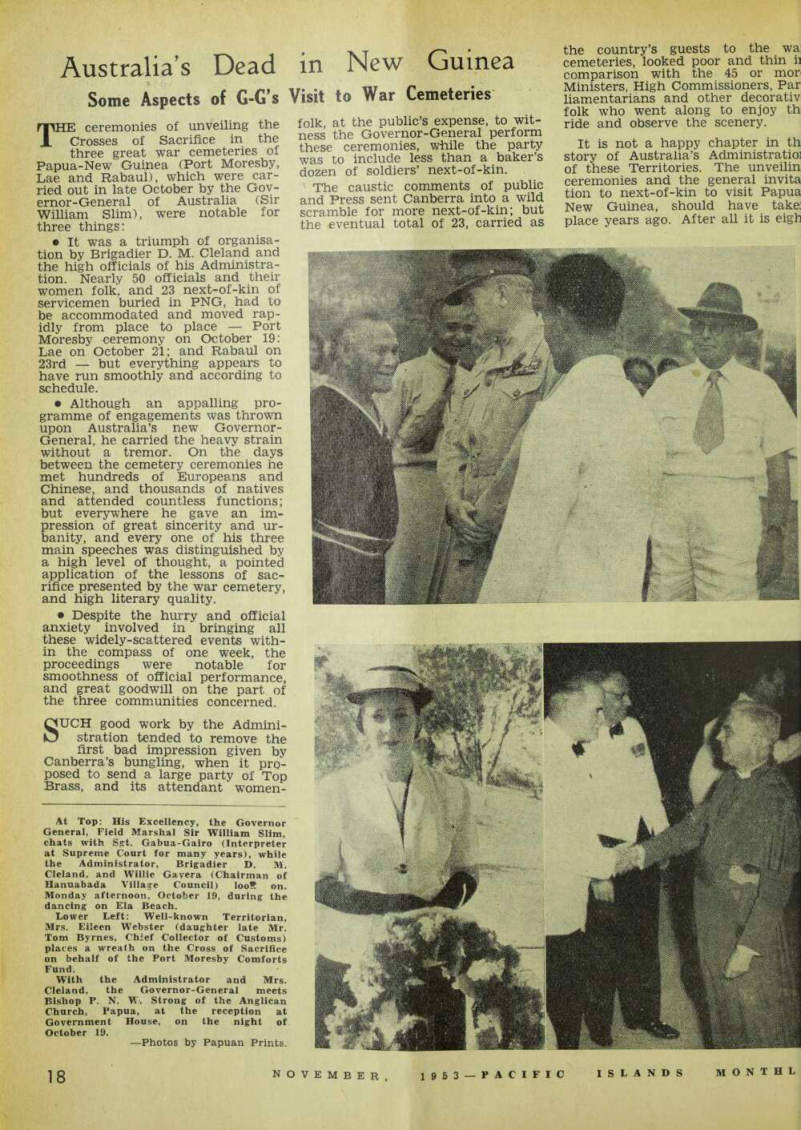
At Top: His Excellency, the Governor General, Field Marshal Sir William Slim, chats with Sgt. Gabua-Gairo (Interpreter at Supreme Court for many years), while the Administrator, Brigadier D. M.
Cleland, and Willie Gavera (Chairman of Hanuabada Village Council) loo? on.
Monday afternoon, October 19, during the dancing on Ela Beach.
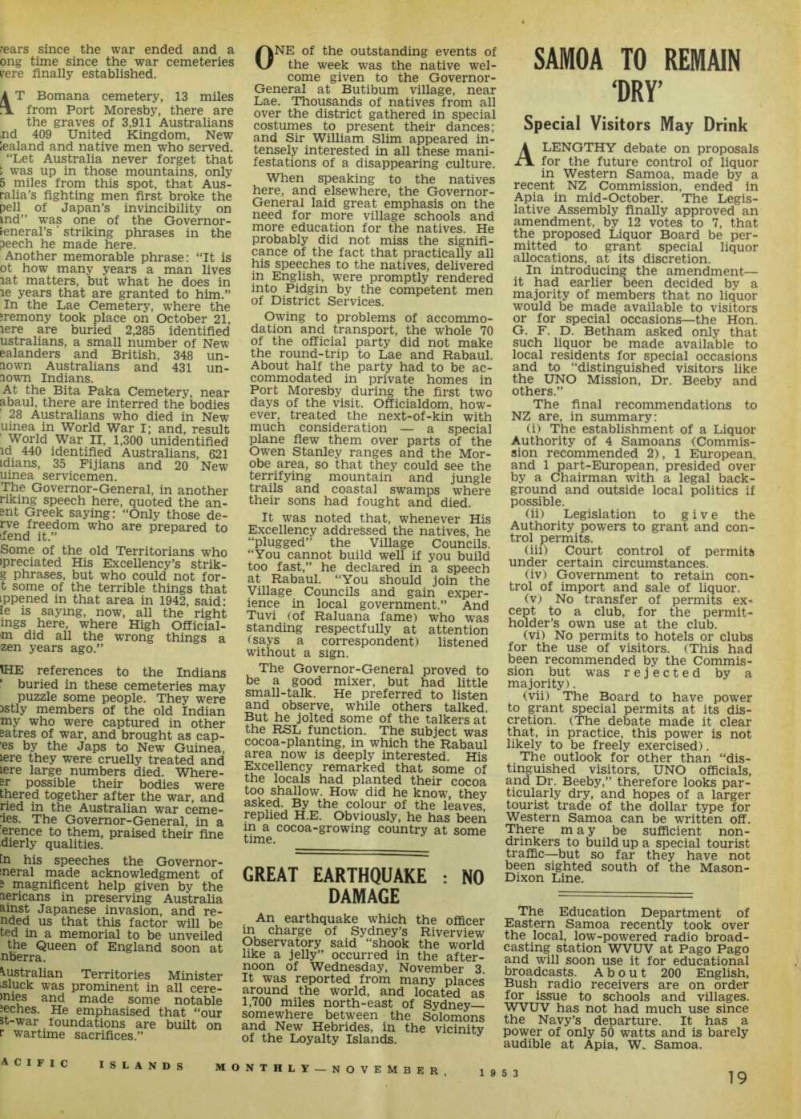
Lower Left; Well-known Territorian, Mrs. Eileen Webster (daughter late Mr.
Tom Byrnes, Chief Collector of Customs) places a wreath on the Cross of Sacrifice on behalf of the Port Moresby Comforts Fund.
With the Administrator and Mrs.
Cleland, the Governor-General meets Bishop P. N. W. Strong of the Anglican Church, Papua, at the reception at Government House, on the night of October 19.
Photos by Papuan Prints.
rears since the war ended and a ong time since the war cemeteries srere finally established.
A T Bomana cemetery, 13 miles :jL from Port Moresby, there are the graves of 3,911 Australians ,nd 409 United Kingdom, New lealand and native men who served.
“Let Australia never forget that t was up in those mountains, only 5 miles from this spot, that Aus ralia’s fighting men first broke the pell of Japan’s invincibility on ind” was one of the Governor leneral’s ‘ striking phrases in the peech he made here.
Another memorable phrase: “It is ot how many years a man lives lat matters, but what he does in le years that are granted to him.”
In the Lae Cemetery, where the jremony took place on October 21, lere are buried 2,285 identified ustralians, a small number of New ealanders and British, 348 un tiown Australians and 431 un lown Indians.
At the Bita Paka Cemetery, near abaul, there are interred the bodies 28 Australians who died in New uinea in World War I; and, result ' World War 11, 1,300 unidentified id 440 identified Australians, 621 idians, 35 Fijians and 20 New uinea servicemen.
The Governor-General, in another nking speech here, quoted the an ent Greek saying: “Only those de rye freedom who are prepared to ifend it.”
Some of the old Territorians who (predated His Excellency’s strik g phrases, but who could not for t some of the terrible things that ippened in that area in 1942, said: le is saying, now, all the right mgs here, where High Official m did all the wrong things a zen years ago.” \HE references to the Indians buried in these cemeteries may puzzle some people. They were istly members of the old Indian my who were captured in other satres of war, and brought as cap es by the Japs to New Guinea, lere they were cruelly treated and (ere large numbers died. Where er possible their bodies were thered together after the war, and ried in the Australian war ceme ;ies. The Governor-General, in a erence to them, praised their fine dierly qualities. [n his speeches the Governor meral made acknowledgment of 5 magnificent help given by the tiericans in preserving Australia ainst Japanese invasion, and Te nded us that this factor will be ted in a memorial to be unveiled the Queen of England soon at nberra.
Australian Territories Minister isluck was prominent in all cere >nies and made some notable ieches. He emphasised that “our st-war foundations are built on r wartime sacrifices.”
ONE of the outstanding events of the week was the native wel come given to the Governor- General at Butibum village, near Lae. Thousands of natives from all over the district gathered in special costumes to present their dances; and Sir William Slim appeared in tensely interested in all these mani festations of a disappearing culture.
When speaking to the natives here, and elsewhere, the Governor- General laid great emphasis on the need for more village schools and more education for the natives. He probably did not miss the signifi cance of the fact that practically all his speeches to the natives, delivered in English, were promptly rendered into Pidgin by the competent men of District Services.
Owing to problems of accommo dation and transport, the whole 70 of the official party did not make the round-trip to Lae and Rabaul.
About half the party had to be ac commodated in private homes in Port Moresby during the first two days of the visit. Officialdom, how ever, treated the next-of-kin with much consideration a special plane flew them over parts of the Owen Stanley ranges and the Mor obe area, so that they could see the terrifying mountain and jungle trails and coastal swamps where their sons had fought and died.
It was noted that, whenever His Excellency addressed the natives, he “plugged” the Village Councils.
“You cannot build well if you build too fast,” he declared in a speech at Rabaul. “You should join the Village Councils and gain exper ience in local government.” And Tuvi (of Raluana fame) who was standing respectfully at attention (says a correspondent) listened without a sign.
The Governor-General proved to be a good mixer, but had little small-talk. He preferred to listen and observe, while others talked.
But he jolted some of the talkers at the RSL function. The subject was cocoa-planting, in which the Rabaul area now is deeply interested. His Excellency remarked that some of the locals had planted their cocoa too shallow. How did he know, they asked. By the colour of the leaves, replied H.E. Obviously, he has been m a cocoa-growing country at some time.