Pacific
pp. 17-149 · Read in the full issue
British Monarch In South
Formal Visits to Fiji and Tonga
'II7TTHIN a few weeks there will ▼ T occur an event of outstanding importance, and unique in the I history of the South Pacific islands.
F The world’s greatest monarch.
Queen Elizabeth II of England and the British Commonwealth, accom panied by her Consort, the Duke of Edinburgh, will make a formal visit to the British Colony of Fiji and the Kingdom of Tonga (under British protection), while en route from the West Indies to New Zealand and Australia.
This is not only the first time in history that a King or Queen of England has visited the South Paci fic countries it is also the first time in history that any great mon arch has been here.
The honour that has been done Fiji and Tonga by including them in the Royal Tour is something that never will be forgotten. Fiji and Tonga are deeply conscious of the fact; and the preparations which are being made for the reception and entertainment of the Royal party on December 17-18 (Fiji) and 19-20 (Tonga) are marked by a wave of mounting excitement which, nevertheless, is orderly, de signed, and calculated to provide on the days mentioned a series of spectacular events worthy of the oc casion.
The liner Gothic, on which the Royal party is travelling, left Eng land for the West Indies in mid- November. Many members of the Royal party were then on board; but the Queen and her Consort, and their personal staff, have flown to the West Indies to join the liner there. A number of British colonies and territories in the West Indies will be visited before* the Gothic proceeds, via the Panama Canal, to the eastern Pacific, en route to Fiji.
PFiji, under the personal direc tion of the Governor (Sir Ron ald Garvey) and Lady Garvey, i number of committees have been lard at work for many weeks, com peting the details of the formal wents which have been included in he two-days’ programme.
Given fine weather always a [amble at this time of the year in ’’iji the Fijian ceremonies of welcome in Albert Park, Suva, soon Jter the Queen arrives in the morn ng of Thursday, December 17, pro lably will be an outstanding event n the Royal tour.
From a platform, decorated with Baves and tapa, specially built for hem, the Queen and the Duke will witness a series of Fijian ceremonies 'f welcome the Qalowaqa (a welcome to a lady of high rank),
he Qaloqalovi; the Luvanitawake;
the Sevusevu; and the Yaqona, or kava drinking. Some of these are ceremonies which the oldest in habitants of Fiji have rarely, if ever, seen.
After Her Majesty has made an address to the Fijian people, there will be formal presentation on be half of the Fijian people of great quantities of food which, of course, will be dealt with a little later in mighty feasting.
On this occasion, the Colony of Fiji will make a presentation to the Queen, the Duke and their two children. Fiji’s gift to the Queen will be a ring containing a Fiji grey pearl set in diamonds and emeralds.
For the Duke there is a walking stick, beautifully made of Fiji woods.
There is a model canoe for Prince Charles and a doll, in Fiji cere monial dress, for Princess Anne.
This is only one of the events which the busy committees have or ganised in and around Suva and in Lautoka, and which will fully occupy all of Thursday and Friday, Dec ember 17-18.
There will be many presentations °f Tabua the whales’ tooth which is so very highly prized in the most important Fijian cere monial occasions. . The committees and high offic ials have had to prepare not only for the ceremonies themselves but alsp for the handling of the crowds which are expected to arrive in Suva from all parts of the Fijian Islands creating special problems of trans port, food and accommodation.
A great deal of the ceremonies will be connected with native life and customs; but opportunity is being given to the other communities Europeans, Indians and Chinese to join completely in the Colony’s demonstrations of welcome and lov alty. J
In Tonga
UNDER an unexpected re arrangement of the Royal tour (the cause of which is dis cussed in another article) the Royal
The huge, white-painted Shaw- Sayill liner Gothic sailed from the United Kingdom on November 10 for Jamaica, direct. The Queen and the Duke of Edinburgh, with their personal staff, are due in Bermuda by air on November 24. After 24 hours in Bermuda, they fly on to Jamaica, to undertake a strenuous programme extending over 21 days during which they receive delega tions from other British West Indian territories. Then they join the Gothic and proceed immediately through the Panama Canal. Thus they will have 18 days of complete rest before arrival in Fiji.
couple will not terminate their visit to Suva late in the evening of Friday, December 18. They had in tended to depart from Suva harbour m the Gothic very early on the morning of the 19th. Instead, they will remain in Suva overnight as the guests of the Governor and Lady Garvey while the Gothic steams to Nukualofa; and, the following morning (Saturday, 19th) they will fly 400 miles to Nukualofa,
(Continued on Page 148)
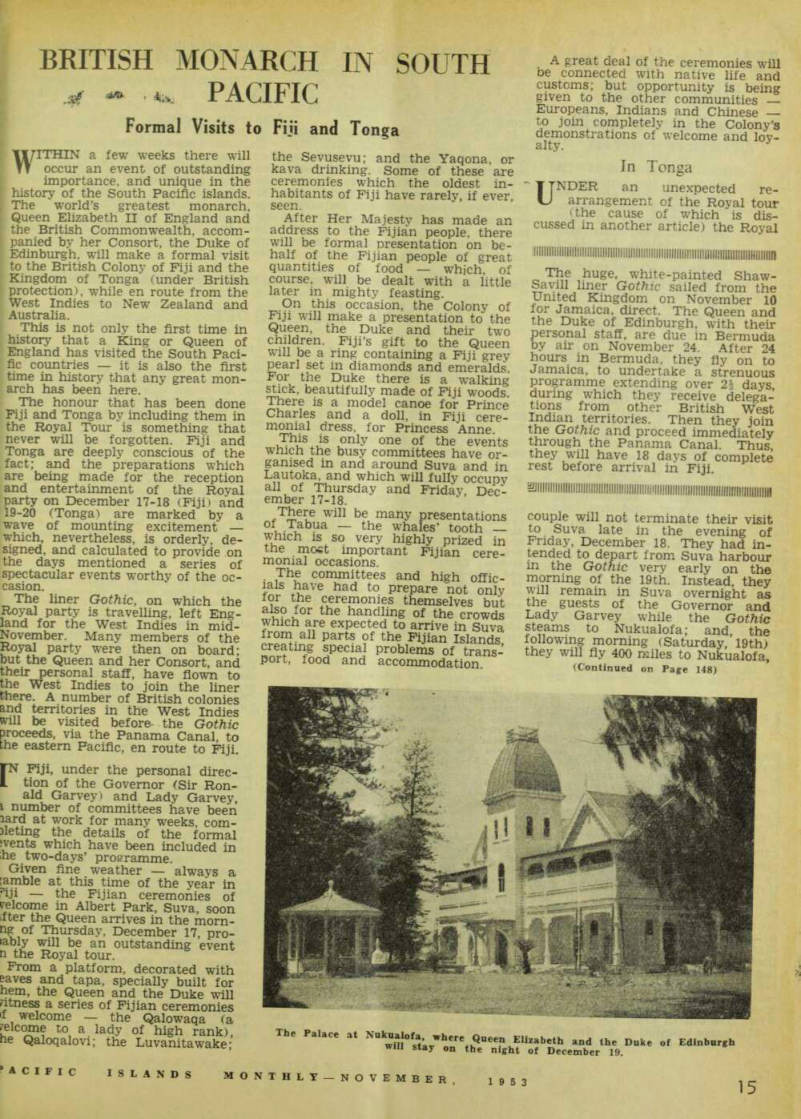
The Palace at Nukualofa,.where Queen Elizabeth. and the Duke of Edinburgh Will stay on the night of December 19.
where they will rejoin the Goff As a result of this, Queen EIJ beth and the Duke of Edinburgh spend most of Saturday and a g* part of Sunday in Nukualofa, When Queen Salote returned!
Tonga, in early October, she cai a large meeting of High Chiefs j leading officials and made to th the surprise announcement ti Queen Elizabeth would arrive Saturday, 19th, instead of Suno 20th, as originally planned, and tf Tonga’s preparations of welco would have to be expanded s speeded up accordingly.
The little Kingdom immediatj was thrown into tremendous ack ity, and elaborate preparations dancing and feasting have be under way ever since.
The plane carrying the Rcd party (presumably the plane mix available by TEAL for the Quee; visit to Lautoka on 18th) will am* in Nukualofa about noon on 19tt Queen Elizabeth’s first duty t be to place a wreath on the Tongi War Memorial. This will be follow by a presentation of Tongan git; followed by feasting and danco until four when the Queen will tire to the Palace and rest uu the Roval dinner with Queen SalL at the British Consulate. The Qu«i will spend the night at the Pali! which hundreds of Tongans v surround all night with torch!
Dawn will be heralded by t Tongan Guard playing nose fluff On the morning of Sunday 2(D: the Royal party will attend a serw in the Wesleyan Church, aft which Queen Elizabeth will go wv Queen Salote to visit the latte) country estate. The rest of t Royal party will partake of a feis on the Malae at Nukualofa.
The Queen and Royal party w depart from Nukualofa for NZ Zealand in the Gothic at 3 p.mn It is probable that the events g Tonga, like the events in Fiji, w provide a memorable chapter in t history of Queen Elizabeth’s rounj the-world tour.
Polynesia And N. Guineas
During the ensuing four month the Royal party will be on tour i New Zealand and Australia, ae very elaborate preparations g being made in each country.
In order that the people of Wee ern Samoa and the Cook Islam may join in the welcome to ti Queen, the New Zealand Govern ment has arranged to transptq selected delegations of Samoans as Cook Islanders to NZ in DecemHr and January. Some very picture*! que ceremonies of welcome by tt Maoris of NZ have been arrang§x but it is expected that the Polo nesian parties representing Samm
id Cook Islands will be allowed organise their own welcome, while e Royal party is in Auckland.
It had been hoped that the Queen ight be able to make a brief visit Melanesia especially the east n part of New Guinea but that ,s not been found possible. Bow er, a selected number of people )m Papua and New Guinea will lit Australia, so that they may ke part in the welcome to the leen.
Pour Europeans from New Guinea d four from Papua will accom ny the Administrator, Brigadier eland and Mrs. Cleland to Can •ra between February 13 and Feb iry 20 to represent New Guinea ring the Royal Visit to the Aus lian capital. In addition, there 1 be a full representation of tive servicemen, Army and Navy, 1 the Royal Papua-New Guinea nstabulary; and as well, one offi and 12 other-ranks of the ?ua and New Guinea Volunteer les (a European unit).
FIE Europeans who have been chosen to represent the Terri tory are: Bishop P. N. W. ong, Mrs. Myra Humphries, Mr.
A. James, and Mr. E. J. Frame n Papua. And from New Guinea,
Mr. D. Barrett, Mrs. Doris Booth, Mr. James Leahy and Mr. Paul Mason.
II Mrs. C. H. Maclean, of New Guinea, has been down in Sydney since early October and intends re maining until early in the New Year when she will return to the Territory. Mrs. Maclean was ill for some weeks before she left NG and spent some time in hospital after she arrived in Sydney, but she is now well. In the Territory she makes her home with her son, Dis trict Commissioner Colin Maclean, of Sohana.
Mr. John Koontz, an American of Columbus, Ohio, arrived at the Lutheran Mission at Madang, New Guinea, in early October, where he will direct the printing plant. He has been foreman of the Lutheran Press in Columbus for the past few years, although he was in Madang in 1946-47. At that time most sup plies were impossible to get, ink and paper having to be imported from America. He built his own accom modation from army surplus mat erials then, but this time he has been supplied with a three-bedroom house.