Sport Booms In P-Ng
p. 107 · Read in the full issue
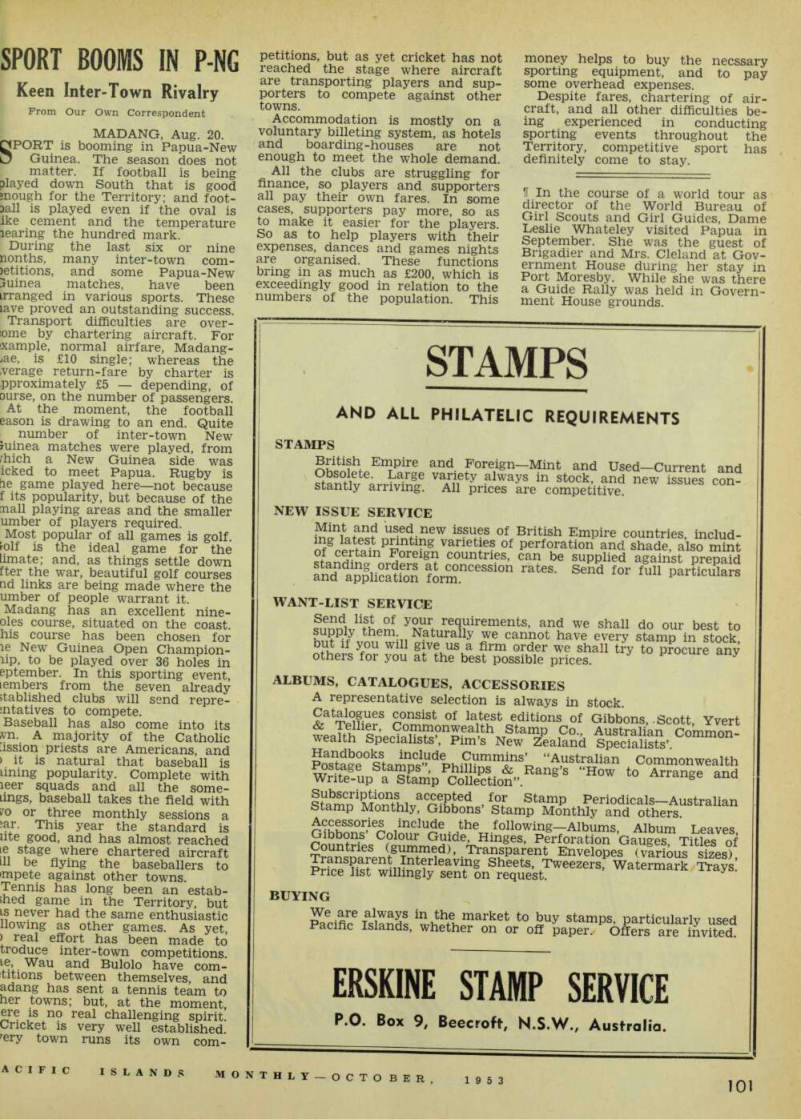
Keen Inter-Town Rivalry
From Our Own Correspondent
Madang, Aug. 20.
SPORT is booming in Papua-New Guinea. The season does not matter. If football is being played down South that is good mough for the Territory; and foot ball is played even if the oval is ike cement and the temperature learing the hundred mark.
During the last six or nine nonths, many inter-town com letitions, and some Papua-New Guinea matches, have been irranged in various sports. These lave proved an outstanding success.
Transport difficulties are over due by chartering aircraft. For xample, normal airfare, Madang jae, is £lO single; whereas the verage return-fare by charter is pproximately £5 depending, of Durse, on the number of passengers.
At the moment, the football eason is drawing to an end. Quite number of inter-town New kiinea matches were played, from rtiich a New Guinea side was icked to meet Papua. Rugby is tie game played here—not because f its popularity, but because of the uall playing areas and the smaller umber of players required.
Most popular of all games is golf, rolf is the ideal game for the limate; and, as things settle down fter the war, beautiful golf courses nd links are being made where the umber of people warrant it.
Madang has an excellent nine ties course, situated on the coast, his course has been chosen for le New Guinea Open Champion iip, to be played over 36 holes in eptember. In this sporting event, lembers from the seven already >tablished clubs will send repre mtatives to compete.
Baseball has also come into its vn. A majority of the Catholic :ission priests are Americans, and > it is natural that baseball is lining popularity. Complete with leer squads and all the some lings, baseball takes the field with 70 or three monthly sessions a Jar. This year the standard is ute good, and has almost reached Le stage where chartered aircraft ill be flying the baseballers to mpete against other towns.
Tennis has long been an estab ihed game in the Territory, but is never had the same enthusiastic flowing as other games. As yet, ) real effort has been made to troduce inter-town competitions ie, Wau and Bulolo have com titions between themselves, and adang has sent a tennis team to her towns; but, at the moment, ere is no real challenging spirit.
Cricket is very well established. r ery town runs its own com
petitions, but as yet cricket has not reached the stage where aircraft are transporting players and sup porters to compete against other towns.
Accommodation is mostly on a voluntary billeting system, as hotels and boarding-houses are not enough to meet the whole demand.
All the clubs are struggling for finance, so players and supporters all pay their own fares. In some cases, supporters pay more, so as to make it easier for the players.
So as to help players with their expenses, dances and games nights are organised. These functions bring in as much as £2OO, which is exceedingly good in relation to the numbers of the population. This
money helps to buy the necssary sporting equipment, and to pay some overhead expenses.
Despite fares, chartering of air craft, and all other difficulties be ing experienced in conducting sporting events throughout the Territory, competitive sport has definitely come to stay.
If In the course of a world tour as director of the World Bureau of Girl Scouts and Girl Guides, Dame Leslie Whateley visited Papua in September. She was the guest of Brigadier and Mrs. Cleland at Gov ernment House during her stay in Port Moresby. While she was there a Guide Rally was held in Govern ment House grounds.