Ex-Territorians
p. 85 · Read in the full issue
Pacific Nature Notes
By Raimanu
About Rice Birds
Attc't'td at t a v, v,, USTRALIA had trouble with a bird invasion of the rice fields, * when wild ducks made havoc ot the Rivenna crops a year or two ago. A duck can get away with a fair bit of rice. Now Fiji is having Somewhat the same trouble.
But it is rather a different story from NSW. The birds being accused in Fiji are mere midgets, compared with wild ducks. They are just tiny little finches. According to a newspaper letter, it is the little Parrot Finch ( Erythrura pealei) , brilliant green in colour, with bright red head and rump.
I don t doubt that some of these birds visit the rice fields: but I strongly suspect that their brilliant colouring has drawn attention to them when the real culprit Is a different bird altogether. The Parrot Finch is a native of Fiji, and has near relations in most of the Islands groups, as well as in Australia. But to 6 an a iSfnrinptS 11S more dUe t0 c?n n fa^ lt ic C lvf ed - spe « I ?s’ oi the nce sel5 eld s near my fwb-o 6 v, C °!} CB ?i ne( k, tbere ,are SSvl^Lf 0 !-- hundrec J, s *; her e around haivest time—hundreds of finches, mbP few • 0 > them are green - The great majority are more sober in colour, brown and grey, with touches of red, and a bit of white spotting on black; though the male in , plumage is a splendid bird, deep red all over, W nnvr o Sp s tS 9 n flanks and ru. m P- This red colour, spotted with led Qf to h ii s bei ~? called by some the Strawberry Finch.”
Now, this finer plumage of the male is worn for but a short time; then he reverts to the sombre plumage of the female for the rest of the year. From all I can gather he is the Common Amaduvade of Southern Asia ( Estrilda amandava) That means he was introduced into this part of the world at some time in the past. By whom’
Casey Wood, writing in 1926 mentioned a bird known as the"
Strawberry Finch, which had been released in the suburbs of Suva early in the century by the Hon Mr. Remenschneider. It was then hoped that it would prove a worth while addition to the Fijian avifauna, and perhaps be useful as an eater of weed-seeds This seems to be the Rice Bird of the current complaint. From the numbers around the fields here in the middle of June last, I can well believe that they can do a lot of damaee However to return to rhp rmp<; ’
Hon ofthe introduction this bM I may be wrong in laying the blame at the door of Mr. Remenschneider and if anyone can enlighten me I shall be grateful. Bu* there is one blt ° f much older inf o™iation which suggests an earlier origin. E. L.
Layard, who was British Consul in Fiji at the time of Cession (1874) and administered the Colony until the arrival of the first Governor contributed many orntholog?cal items to the British of the time, and he refers to a Finch that I cannot place Writing in 1875, he says: “I sav» on the plantations of the Navna River, Viti Levu a small Amadlna (?) in flocks. .’ .” The reference doesn’t help much except to lue gest that our Rice’ Bird P may have been in Fiji for a very long time
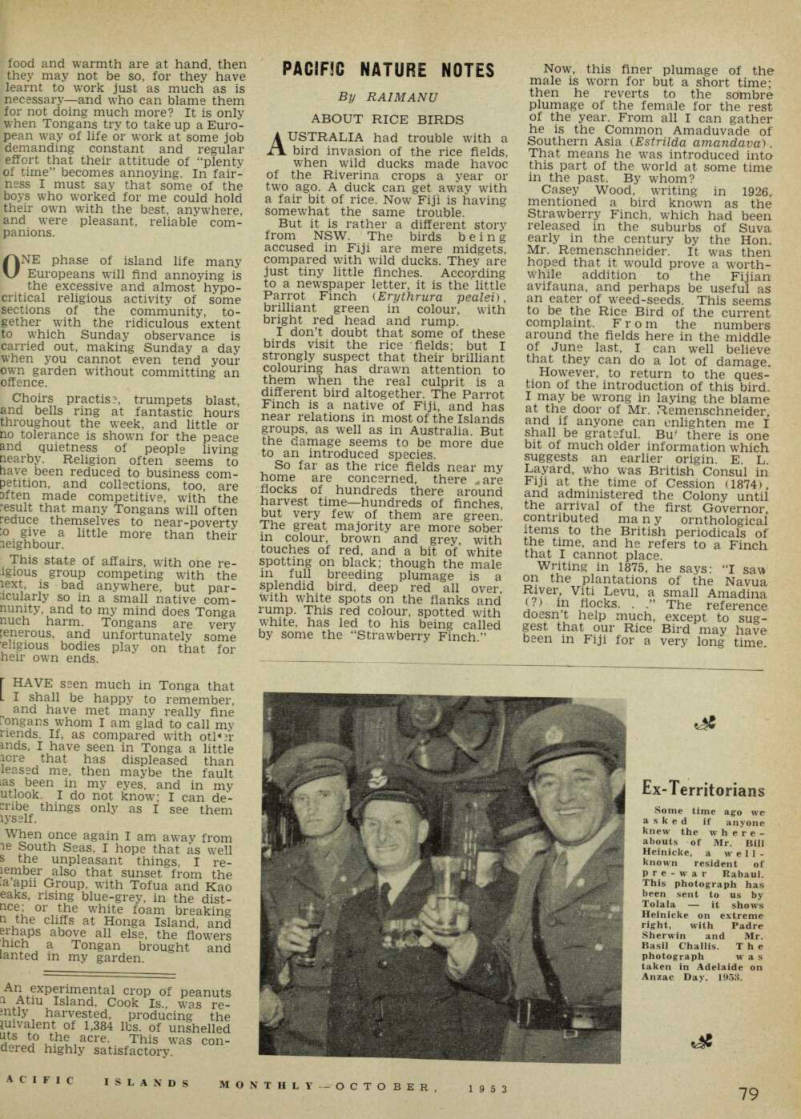
Ex-Territorians
Some time ago we asked if anyone knew the where abouts of Mr. Bill Heinicke, a well known resident of pre-war Rabaul.
This photograph has been sent to us by Tolala - it shows Heinicke on extreme right, with Padre Sherwin and Mr.
Basil Challis. The photograph was taken in Adelaide on Anzac Day, 1953.