To Empty North
pp. 48-49 · Read in the full issue
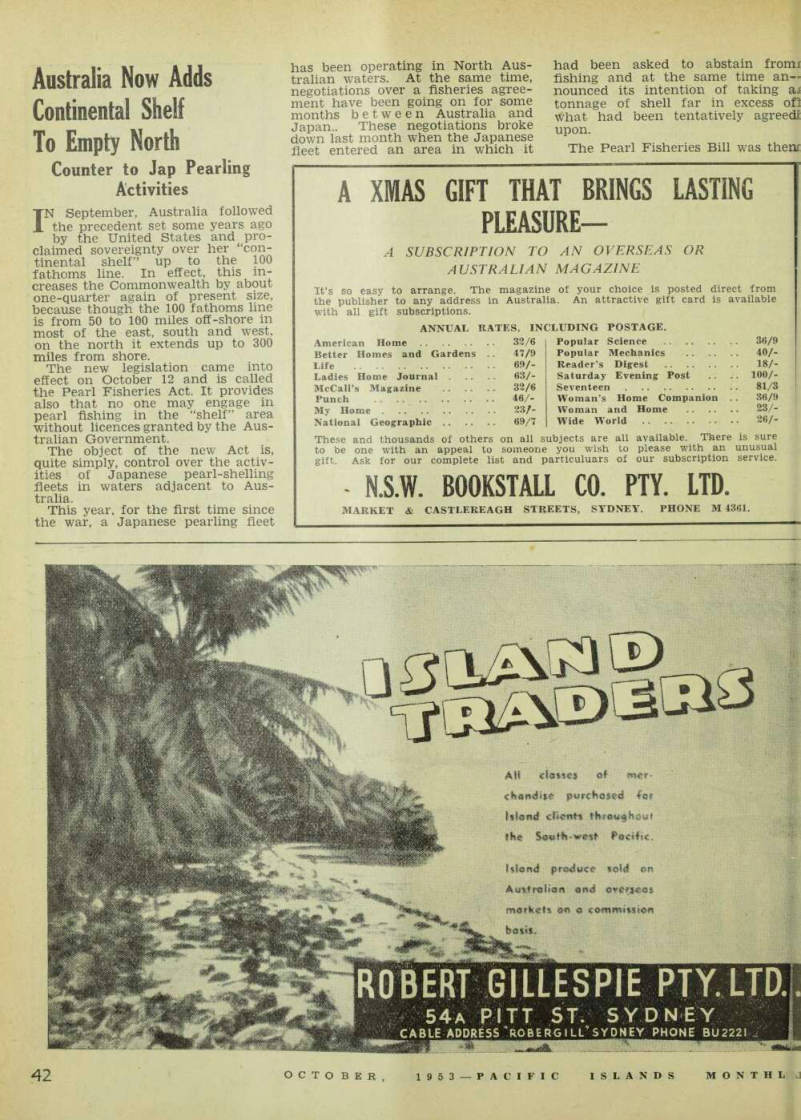

Australia Now Adds Continental Shelf To Empty North Counter to Jap Pearling Activities
IN September, Australia followed the precedent set some years ago by the United States and pro claimed sovereignty over her “con tinental shelf” up to the 100 fathoms line. In effect, this in creases the Commonwealth by ab9ut one-quarter again of present size, because though the 100 fathoms line is from 50 to 100 miles off-shore in most of the east, south and west, on the north it extends up to 300 miles from shore.
The new legislation came into effect on October 12 and is called the Pearl Fisheries Act. It provides also that no one may engage in pearl fishing in the “shelf” area without licences granted by the Aus tralian Government.
The object of the new Act is, quite simply, control over the activ ities of Japanese pearl-shelling fleets in waters adjacent to Aus tralia.
This year, for the first time since the war, a Japanese pearling fleet
has been operating in North Aus tralian waters. At the same time, negotiations over a fisheries agree ment have been going on for some months between Australia and Japan.. These negotiations broke down last month when the Japanese fleet entered an area in which it
had been asked to abstain fromi fishing and at the same time an nounced its intention of taking ai tonnage of shell far in excess off what had been tentatively agreed* upon.
The Pearl Fisheries Bill was thenr
introduced and rushed through Parliament.
Concession To Japan
fTTHE Act does not totally prohibit A the Japs from pearl shelling in the area: the license system is designed to regulate their activities to the “economic interests of the Australian pearl shell industry.”
A few days after the Bill was passed, it was announced from Canberra that for the remainder of this season (till approximately the end of November) the Japanese pearlers will be permitted to operate without a licence in a specified area. It was said that this was be cause Australia wanted to introduce the licensing system “in a reason able manner.”
It was perhaps hoped that this concession would satisfy the Japs for the current season, during which they have literally scooped the pool and left Australian pearlers lamenting, but it probably was an indication of Australian uncertainty, rather than of reasonableness.
Legal Position
JUST where the continental-shelf theory stands in International Law has not yet been put to the test; but the Australian Govern ment was fully aware that the Jap anese could appeal to the Inter national Court for a ruling. And this, it was officially announced on October 11, in Tokio. they intend to do. It is believed that it will be from six to 12 months before the International Court will give judgment.
The United Nations Law Com mission recently went into the matter of the continental-shelf as opposed to the old doctrine of the three-mile limit and reached an opinion that a country has sovereign rights over the conti nental-shelf waters fringing its borders “but only for the purpose of exploring and exploiting its natural resources.” It has no con trol of the air above these waters (beyond the 3-miles limit) nor may it interfere with shipping going about its normal business in such waters.
However, it is one thing for the [JN to have an opinion about these things; much more difficult for it to get its member governments— specially those whose sea-shores slope so steeply that they have no :eal shelf at all —to agree to it.
Australia’S Unhappy
Position
IAIORALLY, Australia is in an LTI unhappy position. It has a vast area of undeveloped land, l population of over 8 million people vho prefer to live in the cities or uong the south-eastern seaboard, md an immigration policy that pro hibits the entry of people from :rowded Asia. Not content with this, t now seeks to keep those same Asiatics from the fruits of the seas
up to 300 miles from shore, although doing remarkably little to develop the marine industries in those areas, Australians may see this as economically or nationally sound.
Hungry Asiatics naturally see it in a different light, and in spite of 100 Colombo Plans, it is unlikely that Australia will indefinitely be able to protect her undeveloped resources
by the simple expedient .of passing legislation.
II Mr. W. C. Cockell, who recently retired from the Fiji Health De partment after 26 years of service, left for New Zealand with Mrs.
Cockell at the end of August. Mrs.
Cockell was formerly on the staff of the Suva Girls’ Grammar School.