How Much Longer Will Britain Ignore Her Fiji Problem?
pp. 15-16 · Read in the full issue
BY his article on the acute and growing population problem in Fiji (published in this issue) Mr. Amie Ragg does good service to his country. We may not agree with his final recommendation— namely, the ordered deportation of all Indians under 45—but we can read his dispassionate and well reasoned statement of the position with profit, and agree with his logical conclusion that this problem may no longer be ignored. It must be dealt with on the highest administrative level.
But Mr. Ragg, in his summary, ignores some vital factors. One is that the Indian cane-growers may not be removed from Fiji without
crippling Fiji’s biggest industry; and this in turn would completely dislocate the economy of this big and prosperous British colony. The argument that Europeans or Fijians could replace the Indians in this field need not be seriously pursued.
Another factor is that the com pulsory removal of the Indians from Fiji would have very serious political repercussions. It might have been done 30 or 40 years ago; for obvious reasons, it may not be attempted to-day.
A third, and very important factor, is that a large and growing proportion of the 150,000 Indians in Fiji is Fiji-born and English speaking, and increasingly inde
pendent of the customs and traditions of the country of their and grandparents.
Mr. Ragg—and, probably, the majority of the older Fiji-Europeans —did not like the Indian-Indians and, for good and sufficient reasons, kept aloof from them in most matters connected with the public life of the Colony. Naturally enough, they carry this prejudice over into their contacts with the Fiji-Indians, and they are un willing to accept the thesis that at least a partial solution of the Fiji population problem may lie in the training, disposition and outlook of the Fiji-born Indians—in the swarms of well-fed, well-dressed Indian children which we may see any morning on the Fiji roads, going to school.
UT before the European ad ministrators of Fiji can go very far in considering the surrender of governmental powers in Fiji to the Fiji-Indians, they must be satisfied that the Fiji- Indians may be trusted with such powers.
The dominant consideration of all government in Fiji is the security and welfare of the Fijian race. Indian interests will always remain secondary to that, so long as Britain remains responsible for Fiji’s government. Years may pass before the British can feel com petent to surrender more political power to the Indians. It is a matter for the Indians themselves. For example, the British may not for get the sinister lesson of 1940-45, when they faced their greatest war crisis, and the Fiji-Indians did practically nothing to help.
The Fiji-Indians can—and, no doubt, ultimately will—prove them
selves trustworthy in relation to Fiji government; but they have only themselves to blame if the bitter taste of 1940-45 remains long in British mouths. The Fiji- Indians ignored their great oppor tunity in 1940-45, and they should not howl if their political advance ment in Fiji is correspondingly delayed.
Some good men, destined to play an important part in the future of Fiji, are showing up among the Fiji-Indians. So, also, are men of outstanding character and ad ministrative ability appearing in the Fiji native community—the Fiji-born Indians have no monopoly in that regard. The key to the future seems to lie with these men of the two races—it depends on how wisely it is handled by the British governing authority.
BEYOND any argument or doubt, there IS a grave population crisis looming in Fiji, just as Mr. Ragg points out, and the problem of providing food and living-space for these communities will remain, irrespective of what hand is guiding the destinies of the Colony. We part company with Mr. Ragg only when he arrives at his final solution—wholesale de portation.
There are other solutions worthy of consideration. It is largely a question of (a) preserving the fundamental rights of the in digenous Fijians while (b) provid ing room enough for a rapidly growing population of Fijians and Indians. As there will not be enough room for very many more Indians in Fiji, a place for surplus Fiji-born Indians should be found elsewhere, under conditions which will attract the Indians from Fiji,
and make it unnecessary to remove them compulsorily.
We believe that that can be done by making the British Protectorate of the Solomon Islands, the Anglo- French Condiminium of the New Hebrides and the French Colony of New Caledonia available for Fiji- Indian settlement and development.
Those three large Territories have great undeveloped resources, room for a much larger number of people, and no urgent problem of
indigenous population, as in Fiji.
Furthermore, if those empty South Pacific Territories are not filled up, they certainly will attract the attention of the terribly over crowded Asiatic countries —and that soon.
It is a matter for British top level attention. Top-level British administrators have ignored it for 30 years, and thus created the present troubles. How much longer will they bury their heads in Whitehall’s deserts of paper?
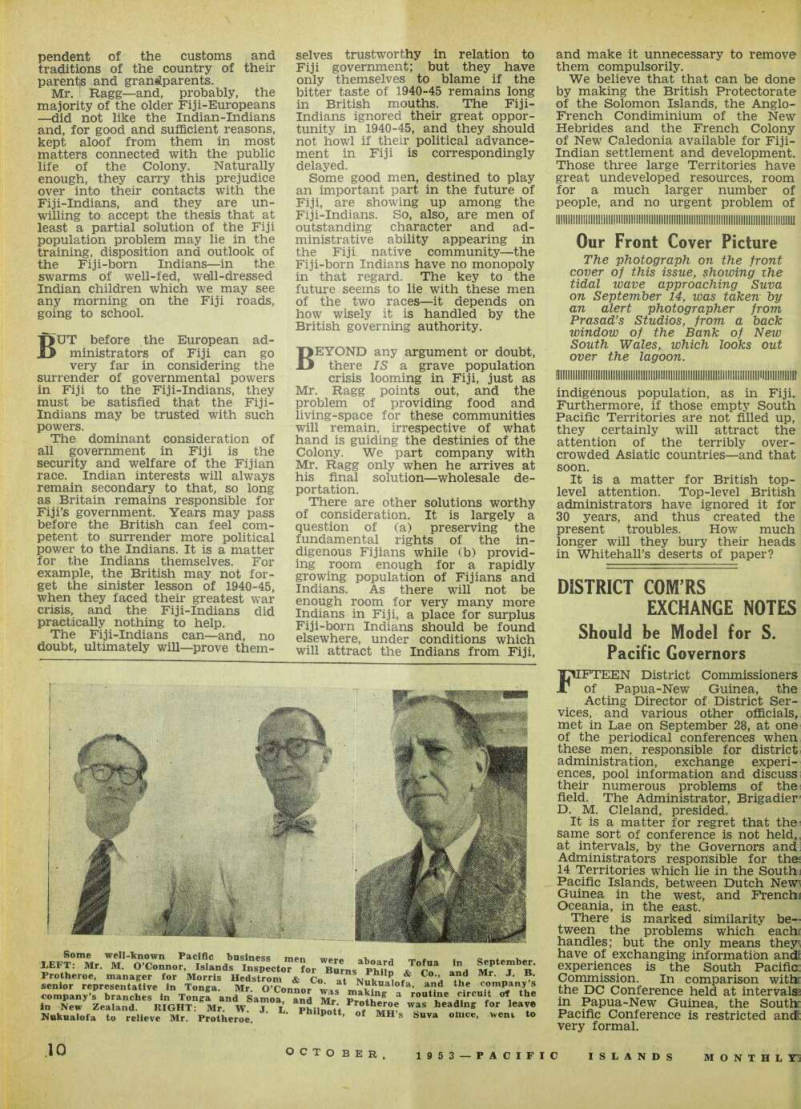
Some well-known Pacific business men were aboars Tofua in September.
LEFT: Mr. M. O'Connor, Insland Inspeetor for Burns Philp & Co., ans Mr. J.B.
Protheroe, manager for Morris Hedstrom & Co. at Nukualofa, and the company's senior representative in Tonga. Mr. O'Connor was making a routine cireuit of the company’s branches in Tonga and Samoa and Mr. protheroe was heading for leave in New Zealand. RIGHT: Mr. W. J. L Philpott, of MH's Suva otnce, went to Nukualofa to relieve Mr. Protheroe.